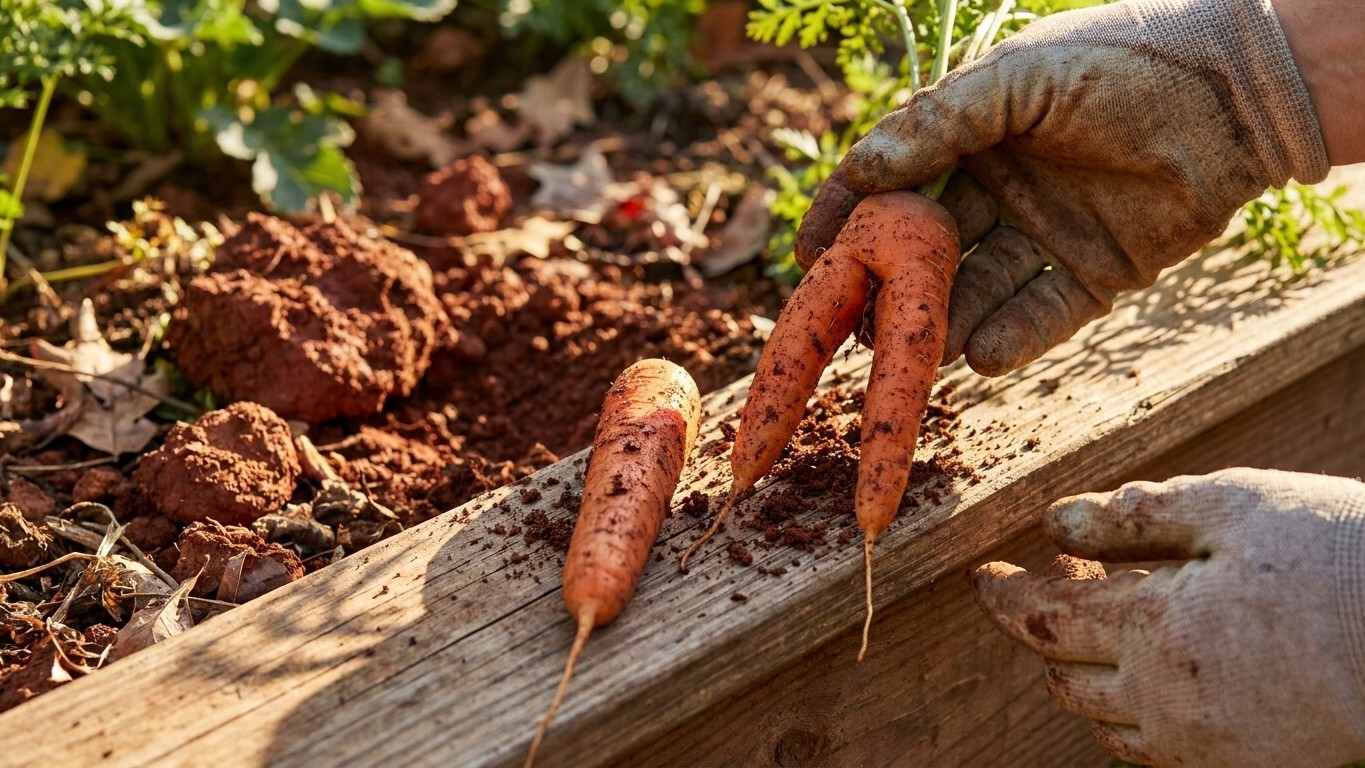

Not likely, based on the soil that represents Colorado. That soil drains well and holds a moderate share of clay, the kind of ground that lets a carrot root push straight down instead of splitting around a rock or a clay lens. That said, no single soil series speaks for every backyard in the state. Whether your carrots fork depends on what’s actually under your boots, and a raised bed or a season of compost fixes most of what heavy ground causes.
The short answer
The soil USDA lists as representative of Colorado is the Seitz series, an Alfisol, a forest soil of moderate fertility that holds nutrients reasonably well. Its surface layer runs 42 percent sand, 21 percent clay, and 37 percent silt, a loam-to-silt-loam texture, with a surface pH around 5.6, slightly acid. The drainage class is well drained, and USDA’s data also lists an organic matter figure near 70 percent for that surface horizon.
| Property | Seitz series value |
|---|---|
| Sand | 42 percent |
| Clay | 21 percent |
| Silt | 37 percent |
| Surface pH | about 5.6 |
| Drainage class | Well drained |
| Organic matter | about 70 percent (mapped surface, not a cultivated bed) |
That organic matter number needs a caveat before anyone gets excited about it. A figure that high on a mapped surface horizon almost always signals a natural organic layer, peat, muck, or forest litter, not the kind of dark, crumbly compost you’d work into a raised bed. A cultivated garden plot will never carry organic matter anywhere near that level, so treat it as a description of undisturbed ground, not a promise about your soil.
What the numbers mean for your carrots
Utah State University Extension puts it plainly: carrots want deep, sandy, well-drained soil rich in organic matter, and heavy or rocky soil makes the root fork. Measured against that standard, the Seitz profile leans in the carrot’s favor. Forty-two percent sand and well-drained status both work against forking. Twenty-one percent clay is moderate, not the dense, compacted clay that stops a taproot cold and forces it to split around an obstruction.
So the short answer for ground that resembles this series: forking risk is on the lower end, provided the bed is loose and free of buried rock. If your soil runs heavier than that, or if a hardpan sits a few inches down, the Extension guidance is specific about the fix, plenty of compost worked in, and double digging to break up the compacted layer before you sow. On genuinely rocky or clay-heavy ground, a raised bed sidesteps the problem entirely by giving the root a full column of loose, amended soil with nothing underneath to fight.
None of this is a diagnosis of your yard. Colorado spans hundreds of mapped soil series, from sandy river-bottom ground to heavy High Plains clay to thin, rocky mountain soils, and a state-representative series describes an average, not your address. It’s a starting point for guessing what your region’s ground tends to do, nothing more.
The test that settles it in your own garden
State averages are a guess. Your own dirt is the answer, and getting it takes a shovel, a few minutes, and no lab work.
- Dig a hole where you plan to sow. Go down at least the length of a full-size carrot root, and keep going until you hit rock, clay, or a color change that signals a different layer.
- Check the depth and look for stones. Note how far down loose soil runs before it turns into something a root can’t push through. Pull out any stones you find and see how common they are.
- Feel the texture with wet hands. Squeeze a moist handful. Soil that ribbons and holds a shape leans clay. Soil that falls apart and feels grainy leans sand. Something in between, that holds a loose shape but crumbles easily, is closer to a workable loam.
- Watch how water drains. Fill the hole with water and time how long it takes to disappear. Standing water after several hours points to a drainage problem that no amount of carrot variety selection will solve.
Reading the results
A hole that stays loose past the depth a carrot needs, with few stones and water that soaks away steadily, is close to what the Seitz numbers describe: low forking risk, straightforward sowing. A hole that turns to dense clay a few inches down, holds water for hours, or is full of gravel is a different garden entirely, and the fix follows the Extension guidance regardless of what the state’s representative soil says: work in compost, double dig to loosen the compacted layer, or build up and go with a raised bed.
Run this test in more than one spot if your yard has any variation, near a downspout, along a slope, close to a driveway where fill dirt may have been dumped. Two beds ten feet apart can behave like two different soil series.
What goes wrong here
Why the same garden can go two ways
A soil that tests well drained and moderately textured on paper can still misbehave in practice, usually because of compaction, weather swings, or watering habits rather than the base texture itself. These are the failures worth watching for, and each has a fix that doesn’t require replacing the soil.
- Forking in heavy or compacted ground. Even soil that starts out loam-textured compacts under foot traffic or heavy rain, and a compacted layer forces the taproot to split around it just like clay or rock would. The remedy is the same one Extension recommends for heavy soil generally: work in compost and double dig the bed before sowing, breaking up any hardpan so the root has a clear path down.
- Poor germination during a hot spell. Carrot seed is slow to sprout under the best conditions, and a dry, crusted surface during a stretch of hot weather can stop germination before it starts. Keeping the seedbed consistently moist until seedlings emerge, and mulching lightly to slow surface drying, gives the seed the steady moisture it needs.
- Splitting from uneven watering. Roots that go through a dry spell and then get soaked tend to crack or split as they resume growth too fast. A steady watering schedule, rather than occasional heavy soakings, keeps growth even and the root intact.
- Rocky pockets hiding under decent-looking topsoil. A bed can feel loose in the top few inches and still hit gravel or buried rock deeper down, right where a maturing root needs room. Digging the full test depth before sowing, not just scratching the surface, is the only way to catch this before the seed goes in.
Common questions
Does a moderate clay percentage always mean forked carrots?
No. Twenty-one percent clay, the figure recorded for Colorado’s representative Seitz series, is moderate rather than heavy, and combined with well-drained status it leans in the carrot’s favor. Forking becomes likely when clay content is high, when a compacted layer sits underneath, or when the bed is full of rock, not simply because some clay is present.
Do I need a lab soil test before planting carrots?
Not to answer the forking question. A hand-dug test hole tells you what you need to know about depth, stones, texture, and drainage. A lab test is useful for nutrient and pH questions, but it won’t tell you whether your carrots will fork the way digging a hole will.
How deep should a raised bed be for carrots on heavy ground?
The published guidance doesn’t specify an exact depth figure, but the underlying principle is straightforward: the bed needs to run loose and rock-free for the full length of the mature root, since anything harder underneath is what causes the split or fork in the first place.
Is compost alone enough, or does the soil also need double digging?
Utah State University Extension recommends both for heavy soil, compost to improve texture and add organic matter, and double digging to physically break up compaction at depth. Compost alone improves fertility but doesn’t necessarily loosen a hardpan sitting a few inches down, which is often the real obstacle a taproot runs into.