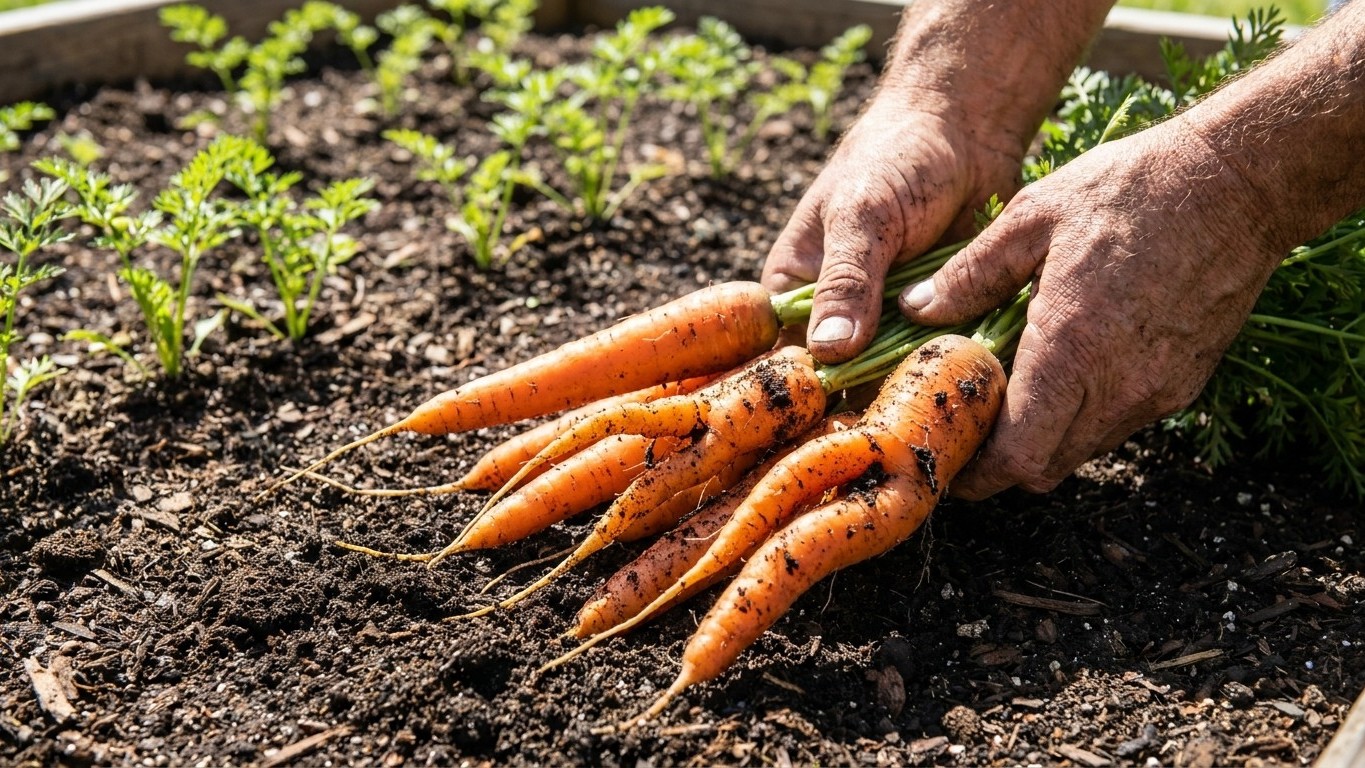

Colorado carrots go into the ground directly, seeded in place a few weeks ahead of the last frost since young plants shrug off a light chill. Count 70 to 100 days to harvest from that sowing date, never from a transplant date, because carrots don’t transplant well and gardeners here don’t try. But timing only gets a seed into the dirt. What that seed turns into, a straight orange taproot or a forked, stubby mess, depends on what’s sitting under it.
The short answer
The soil USDA records as representative of Colorado is the Seitz series, an Alfisol: a forest soil of moderate fertility that holds onto nutrients reasonably well. Its surface horizon runs 42 percent sand, 21 percent clay, and 37 percent silt, a loam-to-silt-loam blend, with a surface pH around 5.6, slightly on the acid side. It’s well drained. That drainage rating is good news for carrots, which rot fast in soil that stays soggy. The clay share is the part worth pausing on.
Utah State University Extension is blunt about what carrots want: deep, sandy, well-drained soil rich in organic matter. Heavy or rocky soil makes the root fork, splitting into two or three legs instead of growing down as one clean spike. At 21 percent clay, the Seitz series sits closer to heavy than sandy. It’s not brick-like clay soil, but it’s dense enough that a carrot pushing straight down may meet resistance and split around it, especially if a rock or a hard clod sits in its path.
The extension’s answer to heavy ground isn’t a different variety. It’s compost, worked in generously, and double digging, turning the bed over to a full spade’s depth or more so the root has loose ground to travel through. Where the native soil is too dense or too shallow to fix that way, a raised bed filled with a sandy, compost-rich mix sidesteps the problem entirely, which is why so many carrot growers on heavier Colorado ground build up instead of digging down.
One caution worth sitting with before reaching for a shovel: the Seitz series organic matter figure, around 70.0 percent, is not a number to expect in a garden bed. It reflects the surface horizon as mapped in its natural, undisturbed state, and organic matter that high points to a natural layer like peat, muck, or forest litter, not the kind of soil a cultivated vegetable bed ever holds after tilling and cropping. Don’t read it as a target or a promise about your dirt.
| Criterion | What carrots want (Utah State University Extension) | Seitz series, surface horizon (representative of Colorado) |
|---|---|---|
| Texture | Deep, sandy, loose | 42% sand, 21% clay, 37% silt (loam to silt loam) |
| Drainage | Well drained | Well drained |
| Organic matter | Rich in organic matter | About 70 percent in the mapped surface layer, not a cultivated-bed figure |
| pH | Not specified by this source | About 5.6, slightly acid |
And here’s the caveat that matters more than any of those numbers: Colorado spans hundreds of distinct soil series, from sandy river-bottom ground to compacted foothill clay to fill dirt behind a subdivision built ten years ago. The Seitz series is what USDA lists to represent the state overall. It is a starting point for thinking about the region’s soil, not a diagnosis of the dirt behind your own house.
The test that settles it in your own garden
Reading a state soil profile tells you what the region tends toward. It doesn’t tell you what’s under your raised bed, your side yard, or the plot a previous owner may have graded, filled, or paved over decades ago. Settling that takes a few minutes with a shovel, not a lab.
- Dig a test hole. Go down at least a foot in the spot you plan to sow carrots. A carrot needs open ground to travel through; if your shovel hits hardpan, buried construction rubble, or solid rock well before a foot down, that’s the answer right there, and a raised bed becomes the simpler fix.
- Check the depth and look for stones. Loosen the soil you just dug and sift through it by hand. Rocks and gravel are exactly what makes a carrot root fork or veer sideways, since the tip pushes down until it meets something solid and splits around it instead of continuing straight.
- Feel the texture. Grab a handful of moist soil and squeeze it. Sandy soil falls apart the moment you open your hand. Clay-heavy soil holds a ribbon shape and feels sticky or slick. Loam sits somewhere between, crumbling into loose clumps rather than a solid rope. The closer your handful feels to sandy and crumbly, the closer it is to what carrots actually want.
- Watch how water drains. Pour a bucket of water into your test hole and see how it behaves. Water that vanishes quickly points to sandy, fast-draining ground. Water that sits and pools for a long stretch signals dense clay or a compacted layer underneath, either of which raises the risk of rot before it raises the risk of forking.
What goes wrong here
- Forking in heavy ground. Clay content near what the Seitz series carries, combined with buried rocks or a compacted subsoil layer, splits the root into two or three legs instead of one straight spike. The remedy is the same one Utah State University Extension gives for any heavy soil: work in compost generously and double dig the bed, or skip the fight altogether and build a raised bed filled with a looser, sandier mix.
- Poor germination in a hot spell. Carrot seed is small and sits shallow, which means it dries out fast once surface temperatures climb. A crust forming on the soil surface during a dry, hot stretch can seal seedlings in before they ever break through. Keeping the top inch of soil consistently damp until seedlings are up, with light, frequent watering rather than one heavy soak, keeps that crust from forming.
- Splitting from uneven water. Roots that go through a dry stretch and then get soaked tend to swell fast and split lengthwise, a different failure than forking but just as common. A steady watering schedule, rather than long gaps followed by a heavy dose, keeps the root growing at an even pace instead of lurching.
- Stunted roots in compacted or shallow soil. Even without visible rocks, soil that hasn’t been loosened deeply enough gives the taproot nowhere to go, so it stops growing long before it should. Double digging to open up depth, or moving to a raised bed with loose fill, gives the root the runway it needs.
Common questions
Can I sow carrots straight into clay soil in Colorado?
You can, but expect forking unless you amend first. Utah State University Extension recommends working compost into heavy soil and double digging before sowing, since a dense, rocky bed is exactly what splits a carrot root as it grows down.
How do I find out my own garden’s soil type instead of guessing from the state average?
Dig a test hole at least a foot deep in the spot you plan to sow, check for stones and hardpan, feel a handful of moist soil for texture, and pour in water to see how fast it drains. That tells you more about your bed than any state-level soil record can.
Does a high organic-matter number always mean good soil for carrots?
Not necessarily. A figure like the roughly 70 percent recorded for the Seitz series surface horizon reflects a natural, undisturbed layer such as peat, muck, or forest litter, not a cultivated garden bed. A worked vegetable bed with plenty of compost mixed in will read nowhere near that high, and that’s normal.
Is a raised bed worth it if my native soil is heavy or shallow?
If a test hole shows compacted clay, buried rock, or hardpan within the first foot, a raised bed filled with a sandy, compost-rich mix sidesteps the problem outright, rather than requiring you to fight the native ground every season with double digging.