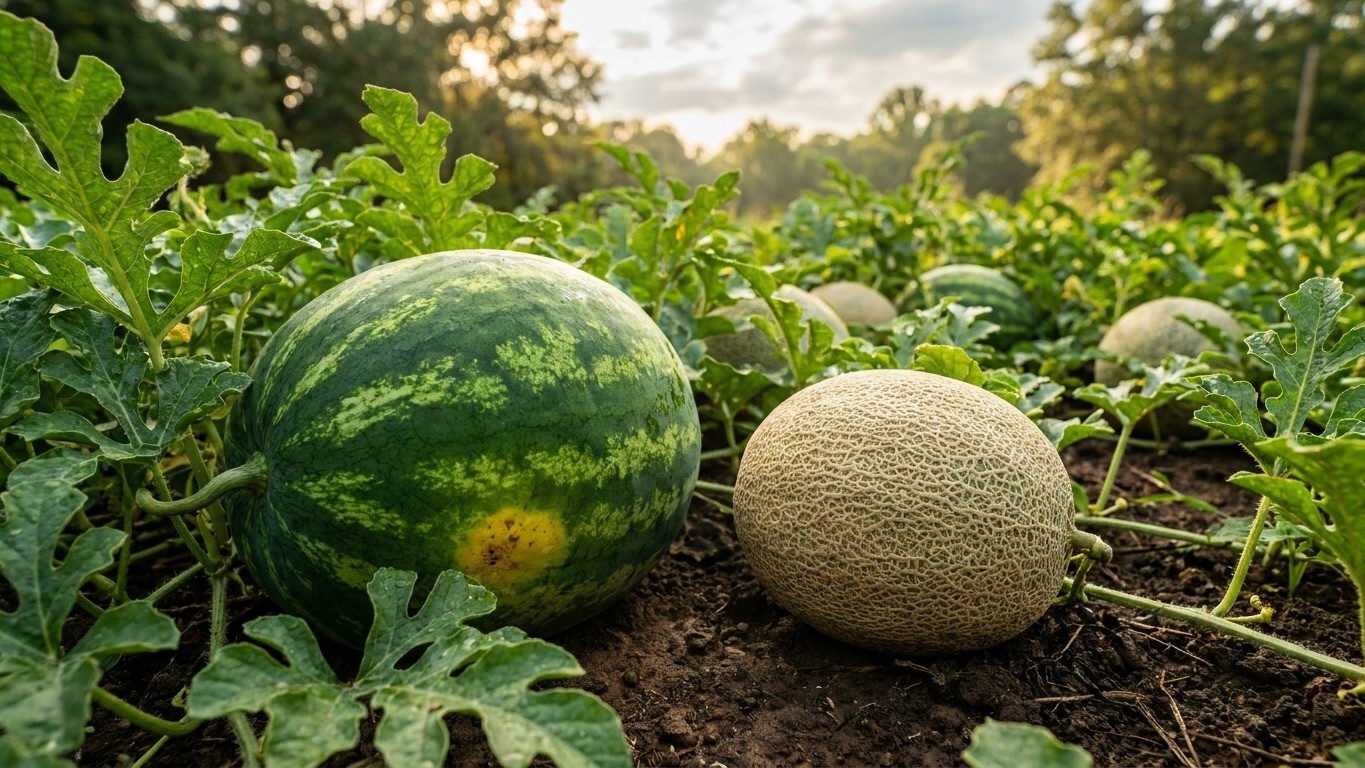

Colorado’s growing season runs short and its summers stay dry, so the melons that succeed here are the quick-maturing types: icebox watermelons and small cantaloupes, not the 100-day giants sold in seed catalogs. Anything slower needs a head start indoors and a warm microclimate to finish before the first fall frost arrives.
The short answer for Colorado
Pick by speed first, size second. The frost-free window at the reference station near Denver runs from a last spring frost between May 1 and May 11 to a first fall frost between September 30 and October 12. That is a probability band, not a guarantee, and it brackets a season of roughly 142 to 164 days at best. Melon fruit does not start sizing up the day the frost risk ends, though. Soil needs to warm past the low 60s before seed or transplant goes in, which typically pushes actual melon growing time down closer to 90 to 110 usable days on the plains. That is the number that matters, and it rules out anything advertised as a 95-to-100-day melon unless the reader is starting transplants indoors three to four weeks before the last frost date and setting them out under cover.
Inside that window, the two categories that consistently work are icebox-type watermelons and short-season cantaloupes and muskmelons. Both were bred, or selected over generations, for gardens with a compressed summer: they set fruit early, size up fast, and don’t need the long stretch of hot nights that a 25-pound watermelon demands. Honeydews, casabas, and the largest slicing watermelons belong on the “maybe, with help” list rather than the default list, because they need both a longer calendar and warmer overnight temperatures than the Denver-area normals reliably deliver.
Heat load backs this up. The reference station averages 39.6 days a year at or above 90F. That’s real summer heat, enough to ripen a fast melon, but it’s a moderate number compared to melon country in the Southeast or the low desert Southwest, where 90-degree days stack up for months. Colorado’s heat comes in a shorter burst, sandwiched between a cool spring and a fall that turns cold fast. A melon that needs sustained 90-degree days for six or seven weeks straight to finish ripening simply runs out of runway here.
| Melon type | Fit for Colorado’s season | Notes |
|---|---|---|
| Icebox watermelons | Good | Fast to mature, smaller fruit size matches a shorter heat window |
| Short-season cantaloupes/muskmelons | Good | Set fruit early, tolerate cooler nights better than large watermelons |
| Full-size watermelons | Marginal | Needs transplants and a warm microclimate to finish before fall frost |
| Honeydew, casaba, other late melons | Difficult without season extension | Long maturity window and high heat need outrun the normals |
What will not work here

Direct-seeding a long-season watermelon in late May and expecting a full harvest by frost is the most common failure. Do the math: if the last spring frost lands at the late end of the band, May 11, and the first fall frost arrives early, September 30, that leaves 142 days on paper. Subtract the two to three weeks the soil needs to warm enough for melon roots to grow, and a gardener is often working with closer to 110 to 120 real growing days. A watermelon variety bred for the long, humid summers of the mid-South or the Southeast can ask for more days than that, and it will still be a hard green fruit when the first cold night hits.
Weekly watering is the second failure mode, and it’s a dry-climate problem specific to places like this one, not a universal melon rule. Summer rainfall across June, July, and August averages about 5.7 inches at the reference station, with August, the month melons are actively sizing fruit, delivering just 1.58 inches on average. That’s not enough to carry a shallow-rooted vine crop through a week between waterings, especially once daytime highs are pushing toward that 90-degree mark 39.6 days a year. Melons planted in sandy soil and watered on a once-a-week schedule modeled after a wetter region will show it in stunted vines and bitter, undersized fruit long before frost becomes the limiting factor.
Crowding plants tight the way a gardener might in a humid eastern state is also a mismatch here, just in the opposite direction. Colorado’s low summer humidity and modest rainfall actually reduce the fungal pressure that drives close-spacing warnings elsewhere, so the bigger practical risk isn’t disease from crowding, it’s vines competing for the limited soil moisture that is available. Give melon vines the spacing the seed packet recommends for a dry-summer garden, and treat every square foot of unmulched soil around them as moisture the plant is not going to get for free from the sky.
What changes across Colorado
The USDA Plant Hardiness Zone Map places the state anywhere from zone 3b to zone 7b, and that spread is a measure of one thing only: average annual extreme minimum winter temperature. It’s not a melon-growing forecast on its own, but the width of that range, four and a half zones, is the clearest signal on this page that there is no single melon calendar for Colorado. A garden in a 3b or 4b pocket, common at higher elevation, is working with a season that can be a full month or more shorter than the Denver-area normals cited above. A garden in a 7b pocket, typically lower elevation or a sheltered valley, is working with a longer, gentler shoulder season on both ends.
What that means in practice: a gardener at higher elevation or in a mountain valley should treat every number in this article as an outer limit, not a target, and shift toward the fastest-maturing icebox and small-cantaloupe varieties available, started as transplants indoors rather than direct-seeded. Black plastic mulch to warm the soil, row cover during cool nights, and a south-facing slope or wall for reflected heat aren’t optional extras there, they’re what closes the gap between the state normals and a shorter local reality. A gardener on the milder end of the range has more room to experiment with a mid-season variety, but should still watch the local fall frost date rather than assume the Denver-area window applies unchanged.
The western slope adds another layer the zone number alone doesn’t capture: different elevation profiles and different precipitation patterns than the Front Range plains where the reference station sits. None of this is something a state-level page can resolve for an individual garden, which is exactly why the hardiness zone range is given here as a range and not narrowed down further.
Where to check this for your own county
Colorado State University Extension is the source that closes the gap this page can’t. Its site, extension.colostate.edu, is organized by county office, and each county publishes guidance tuned to its own elevation, frost dates, and soil rather than a statewide average. That distinction matters more in Colorado than in almost any other state, given how much elevation swings the growing season from one county to the next.
Two things are worth looking for specifically once there. First, the county’s own planting calendar, which will translate the state-level frost probability bands used on this page into dates that reflect local elevation, not the Denver-area reference station. Second, any list of melon varieties the county’s master gardener program or horticulture agents have actually trialed in demonstration gardens nearby. Extension trial results carry more weight than a seed catalog’s description, because they’re grown in that county’s actual soil and actual summer, not a generalized zone.
A county recommendation beats a state one every time, and this page is the state one. Treat everything above as the starting framework, the numbers that explain why fast melons matter here and why full-size watermelons are a stretch, and treat the county extension office as the source that tells a reader exactly which varieties and which dates apply to the ground they’re actually planting.
Checking this against your own garden
None of the dates or averages above outrank what a gardener can observe directly in their own soil and their own plants. Three signals are worth tracking every spring, and each one answers a different question about a specific microclimate.
Soil warmth by feel comes first. Push a finger a few inches into the bed in the morning before the sun has warmed the surface. If it still feels cool and slightly damp rather than a mild room temperature, melon roots aren’t ready to grow yet, regardless of what the frost-date calendar says. This single check catches the gap between “frost risk has passed” and “the soil has actually caught up,” which in a high-elevation or shaded garden can run two or three weeks longer than the plains normals suggest.
The first flush of male flowers is the second signal. Melon vines produce male blossoms well before the female flowers that actually set fruit appear, and a healthy plant putting out its first males on schedule is a sign the plant is tracking normal seasonal growth for its variety. A vine that’s slow to flower at all, weeks after nearby gardens are seeing blossoms, is flagging either a cool pocket in that particular yard or a nutrient or watering problem worth checking before blaming the calendar.
The first true leaves, the second set that emerges after the rounder seed leaves, tell a gardener whether a transplant or direct-seeded start is actually established rather than just surviving. Slow, pale true leaves in a spot that should be warm and sunny usually point to a local drainage or exposure issue, the kind of detail no state page, and no county page either, can see from a distance.