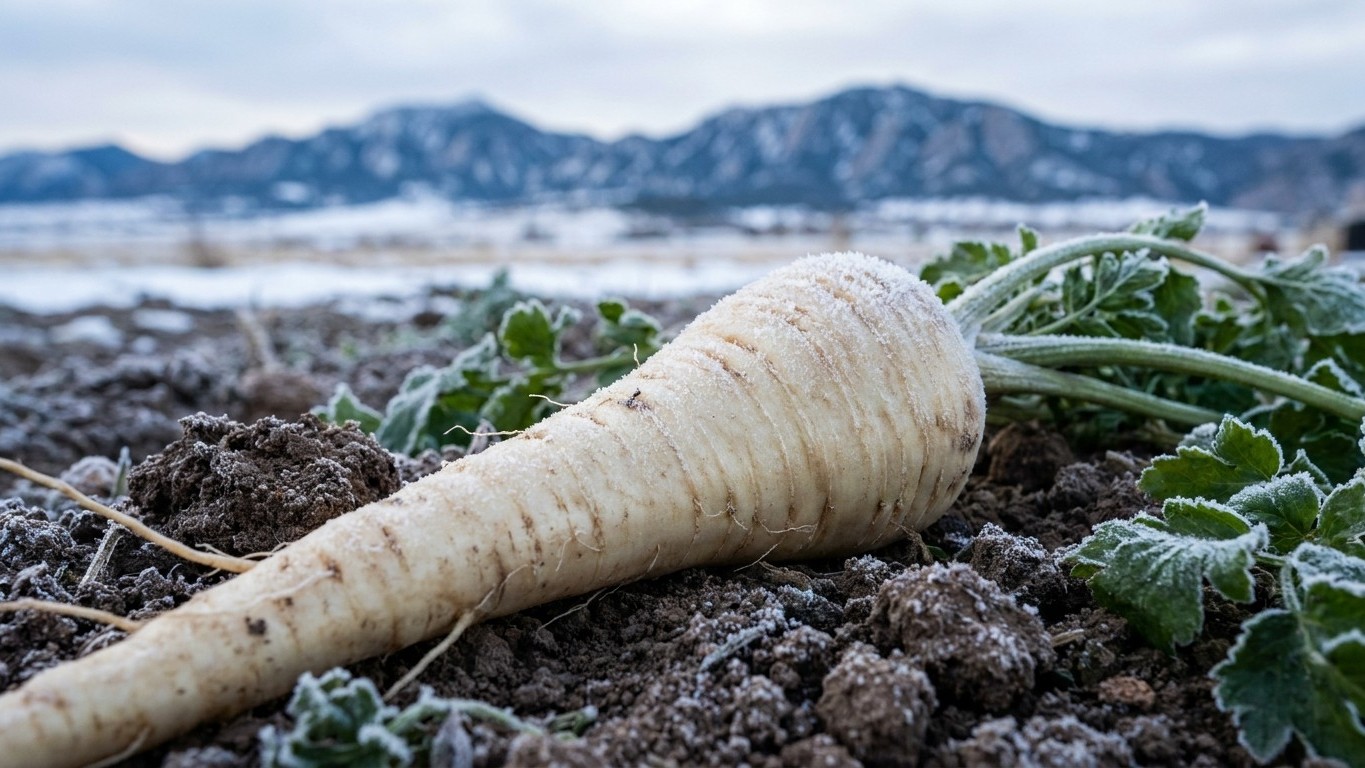

Colorado’s high plains and Front Range winters run cold enough, long enough, to do the one thing a parsnip needs before it’s worth eating: turn stored starch into sugar. Denver’s coldest month averages a nightly low of 18.4°F, and that’s not a single hard freeze but a whole season of exposure. Grown in the ground and left there through fall’s chill, a Colorado parsnip won’t just survive. It will sweeten.
The short answer

The question that actually decides this isn’t “what zone am I in.” It’s “does this place deliver several frosty weeks in a row.” Along Colorado’s Front Range and eastern plains, the answer is yes, and by a wide margin. The mean minimum temperature for the coldest month, using Denver as the reference station, sits at 18.4°F. That’s not an average that hides a few mild nights against a couple of brutal ones. It means that across the coldest weeks of the year, the typical overnight low runs well into the twenties and teens, night after night. For a root vegetable that needs cold to convert starch to sugar, that’s exactly the kind of repeated, sustained exposure the process depends on.
This is worth separating from the hardiness zone conversation, because gardeners often reach for the wrong number. A hardiness zone tells you whether a perennial plant’s roots or crown will survive winter where you live. It says nothing about whether a biennial root crop harvested in fall gets enough frost to trigger the starch-to-sugar conversion. A place can sit in a zone that sounds mild and still deliver plenty of sweetening frost, and a place can sit in a colder zone and still have winters too erratic or too short on sustained cold to do the job. In Colorado, the two numbers happen to point the same direction: cold zone, cold nights, real sweetening. But that alignment is a coincidence of geography, not a rule you can apply elsewhere.
Where this gets more complicated is elevation. Denver’s 18.4°F figure describes the plains at roughly a mile above sea level. Mountain towns run colder and see frost arrive earlier and linger longer into spring, which generally helps sweetening but shortens the growing window on the other end. The western slope runs its own climate pattern entirely, shaped by the Rockies blocking and redirecting weather systems. A gardener in Grand Junction is not gardening in the same climate as one in Fort Collins, even though both are technically “Colorado.” The plains-based numbers here are a reasonable starting point for most of the state’s population centers, but they’re not a substitute for checking your specific county.
Does the season fit?
Parsnips are sown directly in the ground, not started indoors and transplanted, and the clock for the 100 to 120 days to maturity starts at seeding, not at germination or transplant. Germination itself is slow, typically 14 to 21 days before anything visible pushes through the soil, which matters because impatient gardeners often assume a failed planting and re-sow over ground that was simply still working. Here’s how the arithmetic runs against Colorado’s frost calendar.
- Pick a sowing date. Utah State University Extension recommends sowing 2 to 3 weeks before the last expected spring frost. Along the Front Range, that last frost falls between May 1 and May 11, which puts a reasonable sowing window somewhere in the second half of April.
- Add the germination lag. Nothing emerges for 14 to 21 days, so seedlings won’t be visible until roughly early to mid-May, even though the clock for maturity is already running from the seeding date.
- Count 100 to 120 days from seeding. A sowing in mid-April reaches maturity somewhere between mid-July and early August. A sowing closer to late April pushes maturity into early-to-late August.
- Check that against the first fall frost. The Front Range’s first fall frost lands between September 30 and October 12.
- Read the gap. Even the latest maturity estimate, late August, leaves five to seven weeks before the first fall frost arrives. That gap isn’t just breathing room for a slow season. It’s the window where the root can sit in the ground, fully grown, waiting for the cold snaps that actually sweeten it.
For most of Colorado’s populated corridor, the season fits comfortably, with weeks of margin on both ends. That margin matters more than it sounds, because the real payoff crop doesn’t come at day 100. It comes after the root has already matured and then sat through several hard frosts on top of that.
What goes wrong here
- Forked roots from heavy or stony native soil: Colorado’s clay-heavy and rocky ground is common outside sandy river-bottom pockets, and a parsnip root pushing down through compacted or rock-strewn soil will split and fork rather than grow straight. Utah State University Extension recommends deep sandy soil for this crop, and where the native ground doesn’t offer that, double digging the bed before sowing, breaking it up a full two feet down, is the remedy.
- Forked roots from overwatering: this is a separate cause from soil texture, and gardeners often blame the dirt when the real problem is a hose. Inconsistent, heavy watering encourages the taproot to branch in search of moisture rather than driving straight down. Even, moderate watering through the growing season keeps the root growing on one line.
- A short-season location running out of time: the plains-based frost dates used here don’t hold in mountain towns or at high elevation, where the growing season can run considerably shorter and frost can arrive in July. A gardener in one of those pockets who assumes Denver’s timeline applies risks sowing too late for the 100 to 120 day cycle to finish before hard freeze.
- Harvesting before the frost has done its work: pulling roots the moment they’ve reached size skips the entire point of growing parsnips in a cold climate. The remedy is patience: leave mature roots in the ground through several hard frosts, mulching if needed to keep the ground workable, before digging them.
Before any of that harvest happens, there’s a warning worth taking seriously, because almost no garden guide mentions it. NC State Extension states it plainly: “All parts of this plant contain furocoumarins which can make skin sensitive to light causing burns so be sure to wear gloves, long sleeves and long pants when dealing with it.” That’s the whole plant, not just the foliage, and not just the sap that oozes from a cut stem.
What makes this surprising is the mechanism. The burn doesn’t come from the sap alone. It comes from sap on the skin combined with sunlight. That combination is exactly what happens on a bright afternoon spent pulling tops or hauling roots out of the ground, hands and forearms exposed, sap transferring from cut foliage onto skin that then sits in direct sun for the rest of the job. The reaction isn’t instant either. It can take hours to show up, which is part of why people don’t connect the dots and blame something else entirely, a plant they brushed past, a soap they used. Because the damage requires sunlight to activate, washing the skin afterward doesn’t undo it the way it would with a simple irritant. The protection has to come before exposure: gloves, long sleeves, long pants, on any day you’re handling this plant in the sun.
Checking this against your own county
Everything above uses Denver as the reference point, because that’s where the published climate normals sit, but Colorado’s terrain makes a single reference point risky to lean on too hard. A garden in a mountain valley, on the western slope, or at a markedly different elevation than the Front Range plains can see frost dates weeks apart from what’s used here. Before committing a full season to parsnips, it’s worth confirming the local frost window and typical winter lows with Colorado State University Extension, which maintains county-level offices across the state with data specific to local conditions. A quick call or visit to the county extension office can confirm whether the plains-based numbers apply where you’re actually digging, or whether your particular valley, canyon, or high-elevation lot runs on its own calendar entirely.
Common questions
Do parsnips need to freeze in the ground to taste good?
They need repeated exposure to cold, frosty weather after reaching maturity, which is what converts the stored starch into sugar. A parsnip pulled before that exposure will be edible but flat-tasting compared to one left through several hard frosts.
Can I start parsnip seed indoors and transplant it in Colorado?
Parsnips are sown directly in the garden bed where they’ll grow to maturity. The long taproot doesn’t tolerate transplanting well, so the sowing date used for the season’s arithmetic is the direct-sow date, not a transplant date.
Why hasn’t my parsnip seed come up yet?
Germination is slow for this crop, running 14 to 21 days under normal conditions. Bare-looking soil at the two-week mark isn’t necessarily a failed planting; it may still be within the normal window.
Is the sap dangerous to touch even without sunlight?
The reaction described by NC State Extension depends on the combination of sap contact and light exposure. Handling the plant covered up, with gloves and long sleeves, avoids the exposure regardless of how sunny the day is.