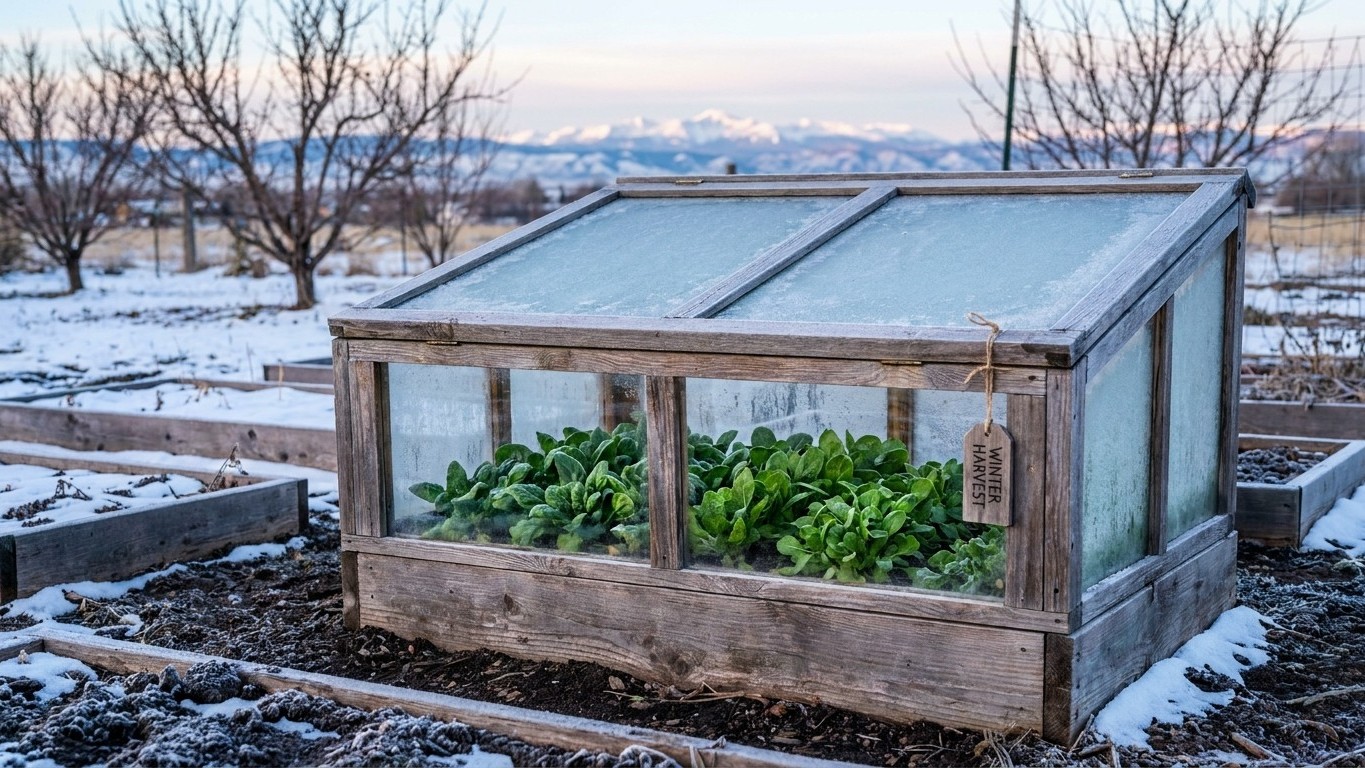

Across most of Colorado, January is not a planting month in the open garden. The last spring frost on the Front Range runs May 1 to May 11, so bare soil sits three months or more from safety. What actually happens this month is dormant work, indoor starts, cold-frame greens, and the occasional garlic clove tucked into workable ground where the state’s mild pockets allow it.
What goes in the ground in January

Here is the plain version: in most of Colorado, nothing goes into open, unprotected ground this month. The last spring frost window at the Denver reference station (USW00003017) runs from May 1 to May 11, and that number comes from 30 years of NOAA climate data, not a guess. Soil at that point is often frozen solid or blanketed in snow along the Front Range and mountain valleys, and even where it thaws briefly, a single cold night undoes any head start.
That said, the state’s hardiness range spans USDA zones 3b through 7b, and the lower end of that spread (the milder pockets on the southeastern plains and parts of the western slope) sometimes offers a workable window on a warm, dry stretch. In those spots, dormant bare-root planting of fruit trees, cane fruit like raspberries, and roses can happen if the ground isn’t frozen and drains well. Elsewhere, hold that project for late winter.
Cold frames and low tunnels are where January planting actually lives. Hardy greens sown earlier in the season, things like spinach, mache, and claytonia, can be kept cropping under a frame if it’s vented on sunny days and closed tight at night. Forcing is another option worth the counter space: dig a rhubarb crown, pot it, and force it in a dark, cool spot for pale, tender stalks weeks ahead of anything the garden could produce outdoors. Witloof chicory roots respond the same way, forced in darkness for tight, blanched heads. None of this replaces outdoor sowing, but it keeps a gardener’s hands busy and a household fed while the ground itself stays off-limits.
What to start under cover
Seed-starting math runs backward from that May 1 to May 11 last-frost window, not forward from any fixed date on the calendar. Onions and leeks are the slowest movers in most seed-starting plans, generally wanting 10 to 12 weeks of growth under lights before they go out as transplants. Counted back from the earliest edge of the frost window, that puts the sowing date for those crops squarely in this stretch of winter, with the slower varieties pushed into early February instead.
Peppers, another slow starter, follow a similar backward count and often get their first tray time now as well, giving them the long runway they need before Colorado’s short, intense growing season kicks in. Anything that needs a cold-stratification period, certain perennial flowers and some native seed, can also go into the refrigerator or an unheated space now so it’s ready to sow once the weather turns.
The two ways this goes wrong both come from ignoring the arithmetic. Start too early and the seedlings outgrow their trays weeks before it’s safe to plant, turning leggy and rootbound under grow lights with nowhere to go. Start too late and the plant never builds the root mass or fruiting size the short window between May’s last frost and the first fall frost (September 30 to October 12) actually demands. Counting weeks backward from the frost range, rather than trusting a habit of “starting seeds in winter,” is the difference between a healthy transplant and a stressed one.
What is ready to pick
Little to nothing comes out of an open Colorado garden this month, and that’s worth saying plainly rather than dressing it up. The outdoor harvest season closed with the first fall frost back in the September 30 to October 12 range, and nothing planted since has had the growing degree days to produce.
What still feeds a household is what was tucked in or stored before winter set in. Kale and leeks left in the ground, especially under a layer of snow acting as insulation, often survive and can be dug or cut on a milder day. Cold frames holding spinach, mache, or arugula keep producing in small, steady amounts through the coldest weeks. Indoors, sprouts and microgreens fill the gap fastest, ready in days rather than weeks and needing nothing more than a sunny sill or a countertop tray.
Stored crops need a check-in now too. Squash, potatoes, and onions from earlier harvests should get pulled out, looked over, and sorted. Any squash with a soft spot or a sweet smell near the stem end is on its way out and should be used first. Potatoes that have sprouted or gone soft, and onions that have started to sprout green or feel mushy at the neck, are signs the whole batch needs sorting before one bad piece spreads rot to the rest.
The jobs that matter this month
Dormant pruning is the biggest item on the list, and the timing genuinely matters. Apple and pear trees, along with raspberry and other cane fruit, are pruned while they’re fully dormant and before buds swell, which reduces stress on the plant and makes it far easier to see the branch structure without leaves in the way. Wait too long and pruning cuts into the plant’s spring energy push instead of shaping it ahead of time.
Seed ordering belongs here too, and it’s more time-sensitive than it looks. Popular varieties, especially anything bred for a short season or drought tolerance, sell out of seed catalogs well before spring planting begins. Ordering now means having the actual seed in hand when the backward-counted start dates from the section above arrive.
Planning next season’s crop rotation is easiest done now, with last year’s garden map still fresh and no planting pressure forcing a rushed decision. Pair that with a soil test, sent through the Colorado State University Extension service, to know exactly what the ground needs before a single amendment goes down. Turning compost, even in cold weather, keeps the pile from going anaerobic and speeds up finished compost for spring beds. Rounding out the list: cleaning and sharpening pruners and shovels, repairing raised bed frames and fencing before spring winds hit, and giving stored crops another pass for anything starting to turn. None of this is filler. Skip it now and the cost shows up in March.
What not to do in January
The classic mistake this month is trusting a warm afternoon over the calendar. A 55-degree day in the middle of winter feels like spring, but the soil underneath hasn’t caught up, and seeds or transplants set out on the strength of one nice day usually rot or freeze within days. Warm-season crops especially have no business outside until well past the May 1 to May 11 frost window, no matter how the air feels.
Uncovering cold frames or pulling mulch back too far during a mild stretch is a close second. Plants that have hardened off under protection lose that toughness fast once exposed, and the next cold snap, which Colorado delivers reliably, hits them harder than it would have before the frame came off. Better to vent a frame partway on a warm day and close it back up at night than to strip protection entirely on a hunch that winter is done.
Feeding nitrogen now is the third trap. Dormant plants aren’t using nutrients the way they will once growth resumes, so fertilizer applied this month either leaches away before it’s needed or, worse, pushes a flush of soft new growth right into the next freeze. Hold nitrogen applications until closer to active spring growth, and let the soil test guide what’s actually needed instead of a routine feeding schedule.
Checking this against your own county
A statewide month is a starting point, not an instruction, and Colorado makes that gap wider than most states. The hardiness range alone runs from USDA zone 3b to 7b, and elevation does more work here than almost anywhere else in the country: mountain towns can see frost in July, while lower-elevation pockets on the plains and the western slope run weeks ahead or behind the Front Range dates used here. Before acting on any date in this article, check it against local conditions through the Colorado State University Extension service, which publishes county-level guidance built for exactly this kind of variation.
Common questions
Can I plant anything outdoors in Colorado in January?
In most of the state, no. The last spring frost doesn’t arrive until May 1 to May 11 at the Denver reference station, and soil is typically frozen or snow-covered through this stretch. Cold frames, low tunnels, and indoor forcing of crops like rhubarb are the realistic options.
What’s the earliest I should start seeds indoors?
Count backward from the last-frost window rather than a fixed date. Slow growers like onions, leeks, and peppers, needing 10 to 12 weeks before transplant, often get their start now; faster crops should wait to avoid leggy, rootbound seedlings by spring.
Is it too late to prune fruit trees if I missed early winter?
No, as long as the tree is still dormant and buds haven’t swollen. Pruning apples, pears, and cane fruit while dormant is the goal; the deadline is bud break, not a specific week on the calendar.
Why does my county’s frost date seem different from what’s listed here?
Elevation and location shift Colorado’s frost windows significantly. Mountain towns can frost in July, and the western slope runs on its own schedule separate from the Front Range. Check county-specific data through Colorado State University Extension before planning around a statewide date.