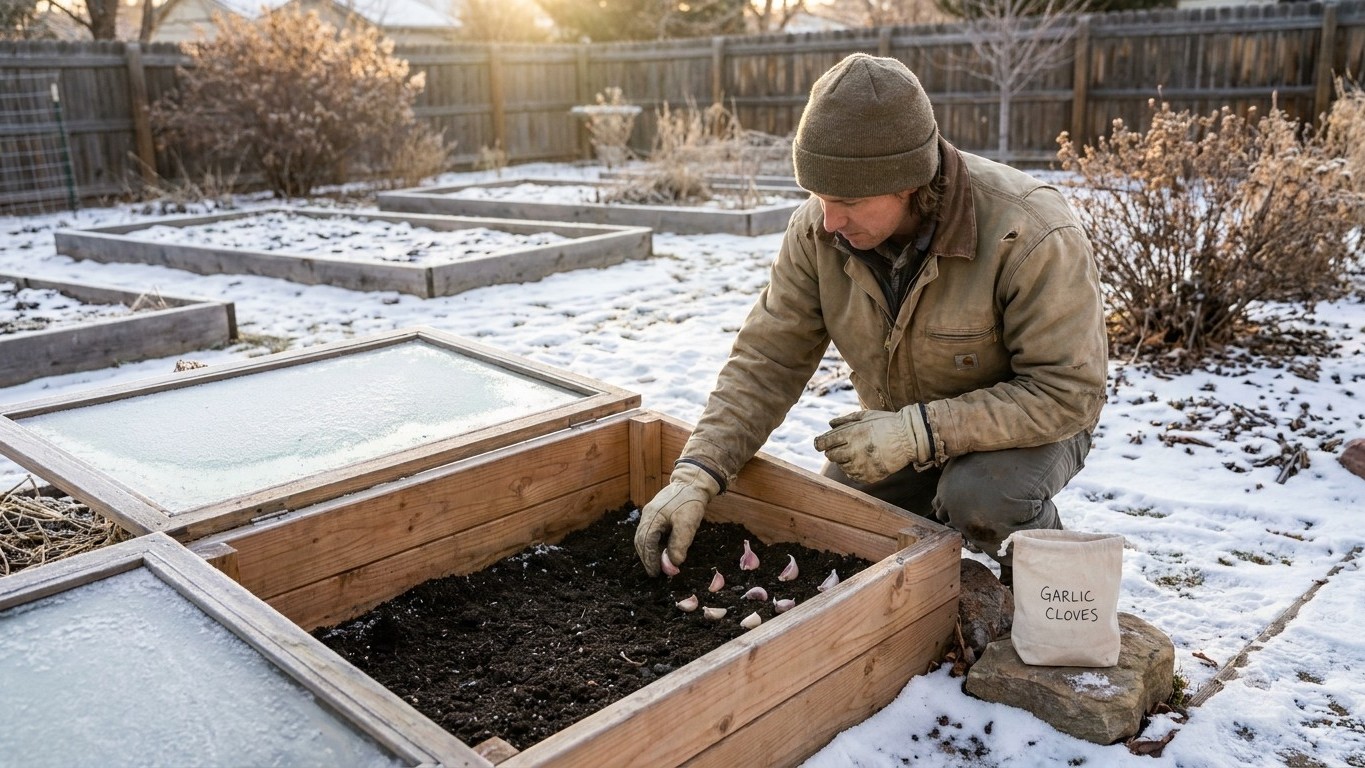

Across most of Colorado, December sits deep in the frozen middle of the gardening year, months past the first fall frost and months short of the last spring one. The honest answer for outdoor planting is: almost nothing. What’s realistic this month is dormant work, bare-root and garlic planting where soil is still workable, cold frames, and the planning that makes spring go smoothly.
What goes in the ground in December

For most of Colorado, nothing goes into open ground this month. That’s not a hedge, it’s the mechanism at work: soil temperature, not the calendar, decides what a seed or root will do, and by December the ground across the Front Range plains is frozen solid or close to it. The reference station for Denver (USW00003017, 5,280 feet) shows a first fall frost window of September 30 to October 12 and a last spring frost window of May 1 to May 11. December falls roughly in the middle of that dormant stretch, nowhere near either edge.
Colorado’s USDA hardiness zones run from 3b to 7b, which tells you the average extreme minimum winter temperature swings enormously depending on where you garden, but it doesn’t change the fact that soil this month is either frozen or close to it almost everywhere in the state, from the coldest mountain valleys to the milder Western Slope river bottoms.
What’s still possible
If you missed fall garlic planting and happen to garden in a milder pocket where the soil hasn’t locked up, cloves can still go in, buried deep and buried under a heavy mulch of straw or leaves to buy them insulation before real cold sets in. That’s a narrow window, not a reliable one, so don’t count on it as a plan.
- Cold frames and low tunnels protecting greens that were established before frost
- Bare-root and dormant shrub, tree, or rose planting, only if the ground is truly workable and the plant is fully dormant
- Forcing rhubarb or chicory indoors in a dark, cool space for an out-of-season harvest
Beyond that short list, resist the urge to put anything else in open ground. A seed or transplant that goes into frozen or near-frozen soil doesn’t wait patiently for spring, it rots or dies outright.
What to start under cover
The arithmetic that matters here works backward from the last spring frost window of May 1 to May 11, not forward from today’s date. Onions and leeks need roughly 10 to 12 weeks indoors before they’re ready to go outside, and they typically go out a few weeks before the last frost since they tolerate cold soil, which puts their seeding date in mid-January to early February for most of the state, not December. Peppers need 8 to 10 weeks and go out after the frost window closes, landing their seeding in late February to early March.
Run that same math and December lands just before the true seed-starting clock opens for the season. Start too early, counting from a fixed date instead of the frost window, and you end up with leggy, rootbound plants sitting under lights for weeks longer than they should, stretched and stressed before they ever see the garden. Start too late and short-season transplants never catch up before summer heat arrives.
What actually works this month
Microgreens and sprouts don’t run on a frost calendar at all, they’re ready in 7 to 14 days regardless of the season outside, which makes them the one genuinely reliable thing to sow under cover in December. Many gardeners also use the month to force spring bulbs like amaryllis or paperwhites indoors for bloom, which isn’t food production but is real, useful under-cover activity for the same shelf space and light setup that will hold seed trays come January.
The more useful December task under cover isn’t sowing, it’s building the setup: cleaning grow lights, checking that heat mats still work, and confirming seed-starting mix is on hand so that when the January and February windows for onions, leeks, and celery actually open, nothing delays the start.
What is ready to pick
Outdoors, the honest answer is little to nothing across most of Colorado this month. What’s still edible is what was tucked away or grown to tolerate real cold before winter locked in.
Kale and leeks left in the ground under a blanket of snow often keep going, snow acting as insulation rather than a threat, and both can be dug or cut as needed on days the ground isn’t frozen solid. Cold frames holding spinach, mache, or other hardy greens planted in fall can still be harvested a few leaves at a time, especially on the sunnier side of a south-facing frame.
Indoors and in storage
Sprouts and microgreens started under cover fill the gap for fresh, fast-growing food when nothing outdoors is producing. The other job this month is checking what’s already in storage: winter squash, potatoes, and onions all need a walk-through for the ones starting to soften, sprout, or show a soft spot, since one turning squash in a bin can spread rot to its neighbors faster than most people expect. Pull anything questionable now rather than finding a ruined bin in January.
The jobs that matter this month
A quiet month in the ground doesn’t mean a quiet month in the garden. December carries a full list of dormant-season work, and skipping it costs real ground come spring.
Pruning and structure
Dormant pruning of fruit trees and cane fruit is best done now, while the plant’s sap isn’t flowing and there’s no foliage hiding the branch structure. Cuts made during dormancy also close and heal faster once growth resumes, and there’s far less disease pressure moving through open wounds in cold weather than there is in the growing season.
Ordering, planning, and soil
Seed catalogs move fast, and the varieties gardeners actually want, particularly short-season and cold-hardy types suited to Colorado’s swing between zones 3b and 7b, sell out well before spring planting windows open. Ordering now, rather than waiting, is the difference between growing the variety you wanted and settling for whatever’s left.
- Testing and amending soil while beds are empty and workable
- Planning next season’s crop rotation on paper before the rush
- Turning the compost pile to keep it active through winter
- Cleaning and sharpening pruners, shears, and shovels before storage
- Repairing raised beds, trellises, and fencing damaged over the season
None of this is filler. A dull pruning saw tears wood instead of cutting it cleanly, an unamended bed comes into spring depleted, and seed that isn’t ordered by January often isn’t available by February.
What not to do in December
The classic Colorado mistake this month is trusting a warm afternoon. A chinook wind can push temperatures into the 50s or 60s for a day or two in the dead of winter, and that warmth tempts gardeners to set out transplants or uncover protected beds. The soil underneath hasn’t warmed with the air, and the cold returns within days, undoing whatever was exposed or planted. Treat a mild spell as a break in the weather, not a sign the season has changed.
Uncovering cold frames or pulling mulch too early after one of these warm stretches is the same error from the other direction, exposing hardy greens or dormant garlic to the next hard freeze right after they’ve lost their insulation. Leave protection in place until the pattern actually shifts, not after one comfortable afternoon.
Feeding nitrogen this month is also a mistake gardeners make with good intentions and bad timing. Dormant plants aren’t building new growth, they’re resting, and a nitrogen application now either washes away unused or pushes a flush of tender growth right before a hard freeze kills it. Save the feeding for when active growth actually resumes.
Working frozen or waterlogged soil is the last trap: walking beds or turning ground that’s frozen or saturated compacts the structure you spent the season building, and that compaction doesn’t undo itself, it has to be worked back out.
Checking this against your own county
A state-wide month is a starting point, not an instruction, and nowhere is that truer than Colorado. Elevation moves these windows by weeks on its own, and the difference between the Front Range plains, the high mountain valleys, and the Western Slope can be the difference between a workable garden bed and one buried under snow.
| Region | Elevation pattern | What differs |
|---|---|---|
| Front Range plains (Denver area) | Reference elevation, 5,280 feet | Frost windows above are based on this station |
| Mountain valleys and high country | Considerably higher | Season can be far shorter, frost risk lingers longer into the year |
| Western Slope valleys | Lower valley floors | Often milder winters than the plains, but local variation is wide |
For a county-level check, the Colorado State University Extension is the resource to use before adjusting anything on this page for a specific address.
Common questions
Can you still plant garlic in Colorado in December?
Only in a narrow set of conditions: the soil has to still be workable rather than frozen, and even then it’s a late, riskier planting compared to the standard fall window. A heavy mulch layer helps buy the cloves insulation before hard cold sets in.
Is it too late to start seeds indoors in December?
For most vegetable transplants, yes, it’s simply too early rather than too late. Counting back from the May 1 to May 11 last frost window, onions, leeks, and peppers land their seeding dates in January through March, not December. Microgreens and sprouts are the exception, since they run on their own short clock.
What USDA hardiness zone is Colorado in?
The state spans zones 3b through 7b under the USDA Plant Hardiness Zone Map, a range built on one measurement, the average annual extreme minimum temperature. That spread means a planting decision that works in a milder Western Slope valley can fail outright in a high mountain town.
What’s the single most important December garden task in Colorado?
Dormant pruning of fruit trees and cane fruit, timed to the plant’s dormancy rather than a date, does the most long-term good of anything on this month’s list, alongside getting seed orders in before the varieties gardeners want sell out.