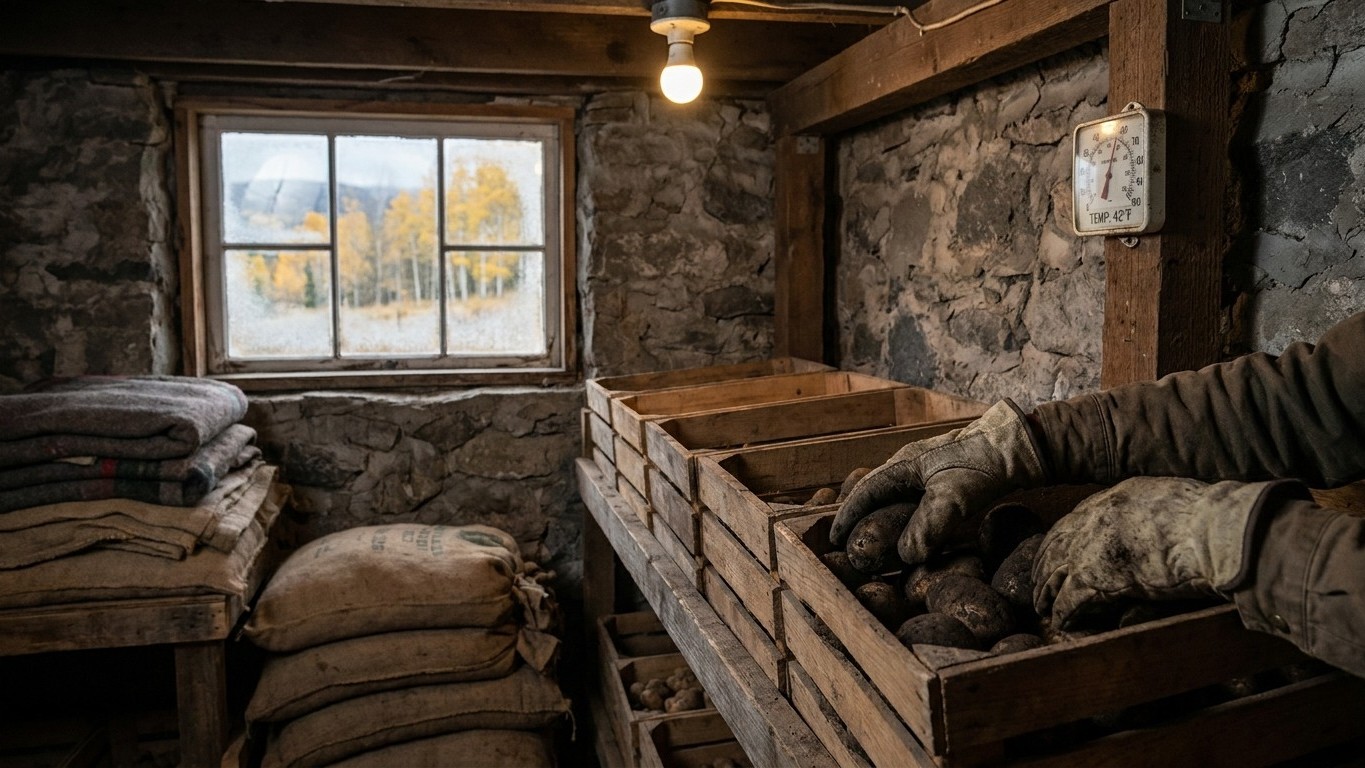

In most of Colorado, potatoes come out of the ground before the calendar hits October and go straight into curing, not storage. The state’s coldest month runs a mean daily low of 18.4 F, cold enough to freeze a crop left in an unheated garage or shed for the whole winter. A root cellar, insulated basement corner, or a space you can heat slightly is what gets a Colorado potato harvest to spring intact.
The short answer
Denver’s first fall frost typically arrives somewhere between September 30 and October 12, based on NOAA NCEI’s 1991-2020 Climate Normals for that station. That window is the trigger for harvest along the Front Range and much of the eastern plains: potatoes should be dug before a hard freeze hits the foliage and, more importantly, before the ground itself chills enough to damage tubers sitting a few inches under the surface. Mountain towns run on a different clock entirely. Some can see frost in July, and growers at elevation need to watch their own local dates rather than lean on a plains-based average. The western slope has its own pattern too, distinct from both the mountains and the Front Range.
The second number matters more once the crop is out of the ground. Denver’s coldest month averages a mean minimum of 18.4 F. That’s not a record low or a single cold snap, it’s the average nightly low across the whole month, which means a typical winter night in that stretch sits well below freezing as a matter of routine, not exception. An unheated space, a detached garage, an uninsulated shed, a porch, will track outdoor air closely enough that it drops into the teens right along with it. Potatoes stored there don’t survive a Colorado winter. They freeze, and a frozen potato doesn’t recover once it thaws; the flesh turns soft, discolors, and breaks down.
What holds 40 to 45 F through a winter with an 18.4 F mean minimum is a space with some thermal mass or insulation between the tubers and outside air: a basement, a root cellar dug into the ground, or an insulated closet against an interior wall. The colder the outside air gets, the more that buffer matters, and in Colorado’s dry, sharp winters the swing between a mild afternoon and an 18-degree night can be extreme. That gap is the whole reason storage location gets decided before harvest, not after.
Curing, and where
Utah State University Extension specifies that potatoes cure best at 55 to 60 F with high humidity, held for two to three weeks before the crop moves into longer-term storage. That window firms up the skin, seals small wounds from digging, and cuts down on rot once the tubers are packed away for months. Skipping it, or curing in the wrong spot, is one of the more common reasons a Colorado harvest doesn’t make it to spring.
The timing problem is specific to this climate. Harvest lands in the days and weeks around that September 30 to October 12 frost window, which means curing has to happen right as Front Range nights are already dropping fast. A shaded porch that felt mild in September can sit well under 55 F by the second week of October, and once nights start brushing toward freezing, an open-air spot stops working for curing entirely.
- Dig the crop on a dry day, before a hard freeze reaches the foliage, and brush off loose soil without washing the tubers.
- Move them out of direct sun immediately. Even short exposure while curing can turn the skin green, and light exposure is a separate problem from cold.
- Set them in a spot holding 55 to 60 F with high humidity. In most of Colorado at harvest time, that means an interior basement room or an attached garage that doesn’t dip into the 40s overnight, not an open porch or an unheated outbuilding once frost season starts.
- Leave two to three weeks, checking that the space isn’t sliding below the range as fall deepens. A thermometer left in the curing spot is worth more than a guess based on how the room feels.
- Sort before moving to storage, setting aside any tuber with cuts, soft spots, or greening rather than storing it alongside sound ones.
Storing through this winter
Once cured, potatoes want a dark space in the 40 to 45 F range, per Utah State University Extension, or as cold as 38 F held at 95 percent humidity, according to the University of Maine Cooperative Extension. Both figures assume the space stays inside that band consistently. Neither one survives contact with Colorado’s coldest month, where a mean nightly minimum of 18.4 F sits far below even the lower end of Maine’s 38-degree target.
That gap is the whole storage problem in one sentence. An unheated Colorado outbuilding won’t stall at a gentle 40 F and hold there through January, it will follow outside air down toward the teens on an ordinary cold night, and a potato held at that temperature freezes. A basement, by contrast, generally stays warmer than outdoor air because it’s insulated by surrounding soil and the heat of the house above it, which is exactly why basements do the job in this climate when unheated sheds and garages don’t. A root cellar built into a slope or below frost depth works on the same principle: the ground itself becomes the buffer against the 18.4 F swings happening at the surface.
Darkness matters as much as temperature. Light exposure during storage, not just during curing, turns the skin green and bitter, so wherever the space is, it needs to block light as reliably as it holds temperature. A cardboard box inside a dark basement corner, or a bin with a lid in a root cellar, covers both requirements at once. Humidity is the third piece: too dry and the tubers shrivel over months, too wet without airflow and rot sets in, which is why the Maine extension figure pairs a specific temperature with a specific humidity level rather than giving one number alone.
What goes wrong here
- Digging after the ground has already chilled. Waiting past the September 30 to October 12 window risks tubers exposed to cold soil temperatures right before harvest, which can show up later as internal discoloration. Dig on the early side of that window when the forecast looks uncertain.
- Curing on a porch or in a garage that’s already dropped below 55 F. Colorado nights cool fast once frost season starts, and a curing spot that felt fine in early September can be too cold two weeks later. Move curing indoors, to a heated interior room, if outdoor-adjacent spaces have already slipped out of range.
- Storing in an unheated shed or detached garage through the winter. With a coldest-month mean minimum of 18.4 F, these spaces will freeze stored potatoes on a normal winter night, not just during an extreme cold snap. Move stored crop to a basement or root cellar before the first hard freeze of the season.
- Letting stored tubers sit in any light source. A single window, or a bare bulb left on near open storage, is enough to green the skin over weeks. Use a lidded container or an interior space with no light at all.
- Ignoring damaged tubers before storage. A bruise or cut from digging becomes a rot entry point over months of storage, and one rotting potato can spread the problem to others nearby. Sort them out during curing, not after they’ve already gone into the storage bin. If disease pressure was an issue during the growing season, an appropriate fungicide applied earlier in the season, per label directions, reduces the tubers likely to break down in storage.
Common questions
How early should I plan to dig potatoes in Colorado?
Base the date on the first fall frost window for the local area. Along the Front Range, that generally falls between September 30 and October 12, per NOAA NCEI’s Climate Normals. Mountain and western slope growers should check conditions specific to their elevation, since both regions can see frost far earlier.
Can I cure potatoes outdoors in Colorado?
Only if the space reliably holds 55 to 60 F with high humidity for the full two to three weeks, per Utah State University Extension. Given how fast Front Range nights cool once frost season starts, an interior room is usually more reliable than a porch or open garage.
Will an unheated garage work for winter storage?
Not through a full Colorado winter. With a coldest-month mean minimum of 18.4 F, an unheated garage will drop well below the 40 to 45 F range Utah State University Extension recommends, and the crop will freeze on ordinary cold nights, not just during unusual weather.
What temperature and humidity should stored potatoes actually hold?
Utah State University Extension recommends 40 to 45 F in a dark space. The University of Maine Cooperative Extension specifies 38 F at 95 percent humidity as an alternative target. Either works if the storage space can hold it consistently across the winter, which in Colorado generally means a basement or root cellar rather than an outbuilding.