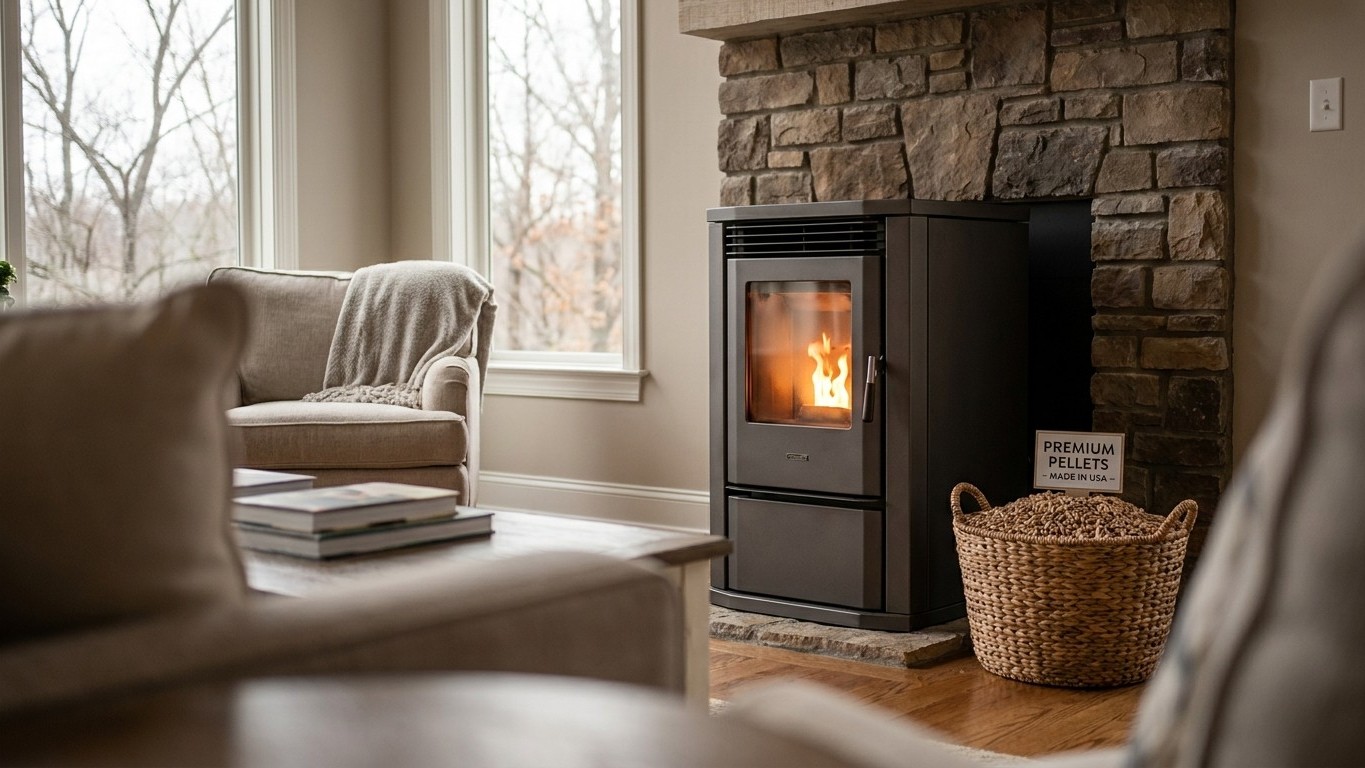

A Connecticut winter runs long before it runs brutal. The state logs about 5,140 heating degree days a year at the Bridgeport reference station, and the heating season stretches roughly eight months, October through May, with June as the last gasp of demand. For a pellet stove, that means real fuel consumption, not decorative ambiance, but the exact tonnage depends entirely on your house, not on a statewide average.
How hard the winter works here

Every degree day is a day’s worth of heating demand added up: the further the mean temperature falls below 65°F, the more degree days pile on, and the more fuel a house burns to stay comfortable. At Bridgeport Sikorsky Memorial Airport, NOAA’s 1991-2020 Climate Normals put the annual total at about 5,140 heating degree days, against roughly 955 cooling degree days. That ratio tells you something important on its own: Connecticut is a heating-dominated climate by a wide margin, and a pellet stove here is doing real work, not just adding glow to a room that’s already warm from a heat pump running in cooling mode most of the year.
The monthly breakdown matters as much as the annual number, because it separates two things people often confuse: how deep a winter runs and how long it lasts. January carries the peak load, about 1,042 degree days on its own, with February close behind at 893 and December at 868. But the season doesn’t announce itself in a single cold snap, heating demand starts building in October, when the normal mean temperature drops to 56.4°F, already below the 65°F baseline NOAA uses to count degree days. It doesn’t let go until June, when the mean finally climbs back over that line. Eight months of some heating demand is a long season, even in years where no single week feels historically brutal.
One station, not one state
Bridgeport sits on Long Island Sound, which moderates its numbers compared to inland and upland Connecticut. A household in Litchfield County or the northeastern hills should expect a colder, longer season than the Bridgeport figures suggest, the difference between a shoreline town and a hill town in the same state can be substantial. If you’re heating a house well north of the coast, treat 5,140 heating degree days as a floor, not a ceiling, and check NOAA’s normals for a station closer to your own address before you size a season’s pellet supply.
None of this makes a pellet stove a marginal choice in Connecticut. At this degree-day level, a stove sized and run as the primary heat source can genuinely carry a well-insulated home through most of the season, with a furnace or boiler picking up the coldest peaks. In a leakier house, it’s more realistically a strong supplement that cuts oil, gas, or electric heating costs without replacing the main system entirely.
How many tons a winter takes here
Nobody can hand you a tons-per-winter number that fits your house, and no source publishes one by state or county, the variation between two homes on the same street can run as high as two to one. What you can do is work the math yourself, using the same degree-day logic that drives the state’s climate numbers above.
Start with the units. A standard bag of pellets weighs 40 pounds, and a ton is 50 bags. Consumption over a season is simply the heat your house actually needs, translated into bags burned to produce it, which is exactly what those 5,140 annual heating degree days are measuring in the aggregate. A stove running through an eight-month season, from October’s first chill to June’s tail end, with January’s 1,042-degree-day peak in the middle, is going to eat through pellets at a very different pace in December than it will in April.
What actually moves the number
Three variables swing your real consumption more than any statewide average ever could:
- How well the house holds heat. Insulation, air sealing, window quality, and square footage all determine how many degree days translate into how many pounds of pellets.
- Whether the stove is your only heat or a supplement. A stove carrying the whole load in a shoulder-season home burns far more than one topping off a furnace or boiler during the coldest weeks.
- The setting it runs at. A stove left on a high or continuous setting through January and February will burn noticeably more than one dialed back and used selectively.
The honest way to answer “how many tons will I need” is to stop guessing and start counting. Track every bag you burn through one full Connecticut season, from the October start-up through the June wind-down, and you have a number specific to your house, your insulation, and your habits, a figure that beats any published estimate because it’s measured, not modeled. For the general framework behind that math, see our national guide to how many pellets a winter takes.
Buying and storing them in this climate
Connecticut’s heating season starts building in October, which means the buying window that actually matters closes before then. Pellets are cheapest and most available in the off-season, roughly spring through late summer, before the first real cold snap sends every household in the region to the same handful of suppliers at once. Wait until November to stock up and you’re competing with everyone else who waited, often at higher prices and with thinner selection.
Storage matters just as much as timing, because of what pellets actually are: compressed sawdust held together by the natural lignin in the wood, with no glue or binder. That structure is exactly what makes them vulnerable to moisture. A humid Connecticut summer, especially near the coast where the same air masses that moderate Bridgeport’s winter numbers also load the air with moisture, can swell and crumble bags stored in an uninsulated garage or a damp basement corner. A concrete garage floor that sweats in July condensation is a slow way to ruin a pallet of pellets before you ever burn one.
Buy pallets shrink-wrapped when possible, keep them off the floor on pallets or boards, and store them somewhere dry and ventilated rather than sealed in plastic without airflow, which can trap ambient humidity against the bags. Compare price per ton across suppliers rather than per bag, since that’s the only figure that lets you compare offers on equal footing. For the fuller mechanics of moisture damage and quality grading, our national pages on pellet storage and pellet quality cover the details that apply regardless of which state you’re in.
What a winter outage means here
A pellet stove is not a wood stove, and the difference shows up exactly when you need heat most. Pellet appliances rely on an auger to feed fuel into the burn pot and a blower to move heated air into the room; both run on electricity. Cut the power, and the stove goes cold no matter how full the hopper is. That’s the trade-off for the convenience and efficiency pellet stoves offer over splitting and stacking cordwood.
In a climate running 5,140 heating degree days a year, with January alone carrying over a thousand of them, a power outage in the depth of winter is not a minor inconvenience, it’s a heating emergency, especially in a house where the pellet stove is doing real work rather than sitting as backup. An outage in October or April, at the shallow edges of the season, is a different story: uncomfortable, maybe a night under extra blankets, but not dangerous.
What Connecticut households fall back on during an outage depends on what’s already installed. State data shows furnaces as the dominant primary heating equipment at 61%, with steam or hot-water boilers at 23%, and by fuel, fuel oil or kerosene leads at 39%, natural gas at 36%, electricity at 19%, and propane at just 4%. Central heat pump use wasn’t published with a reliable estimate for the state, so it’s not something to assume as a widespread outage backup here. Most Connecticut homes losing power in a pellet-stove household are also losing their furnace or boiler at the same time, since those systems need electricity to run blowers and circulators too — which is exactly why sizing backup power correctly matters more here than in milder climates. Check your stove’s appliance label for its actual power draw, and see our national guide to pellet stoves and power outages for how to think through backup capacity without guessing at a generator or battery size that doesn’t match your equipment.