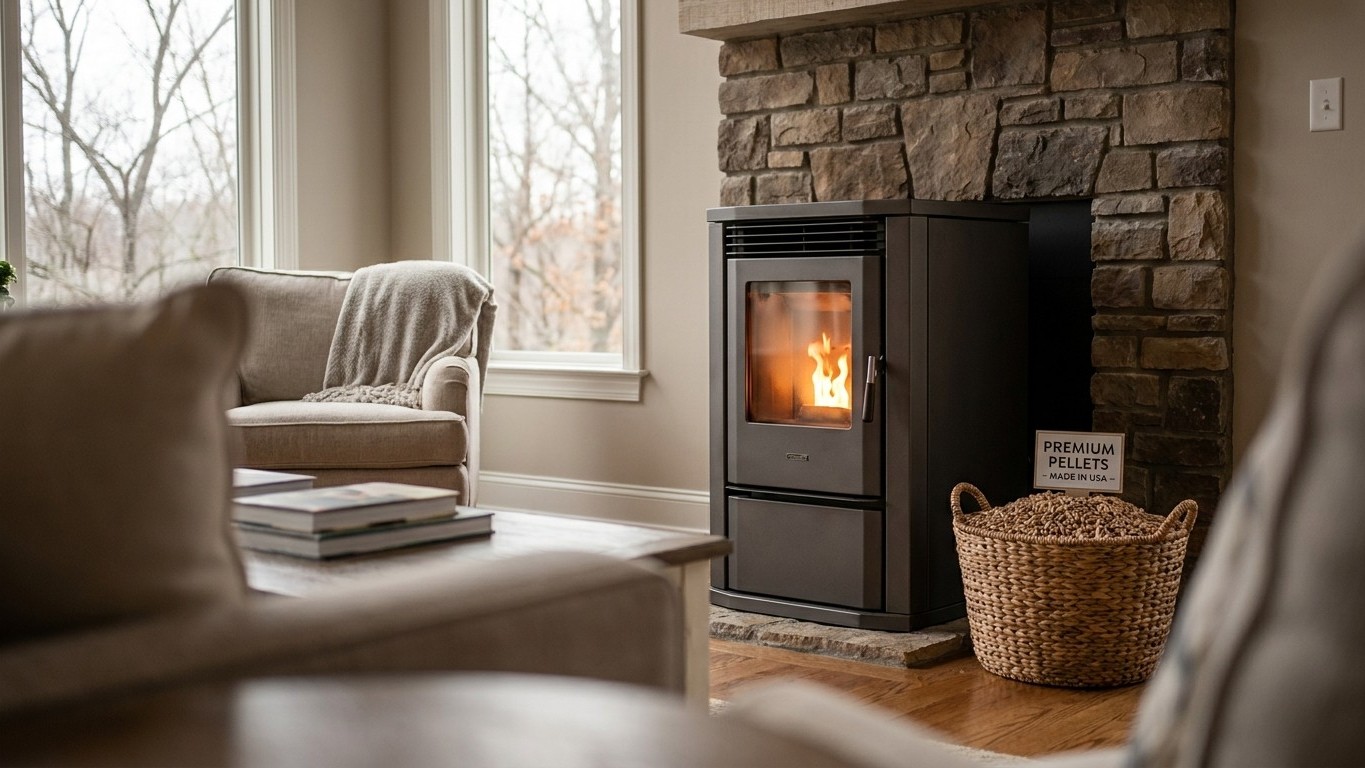

A pellet stove in Wyoming isn’t decoration. With roughly 6,959 heating degree days a year at the Cheyenne reference station, this is one of the coldest heating climates in the country, and the season runs close to ten months. That combination means real tonnage, a real electrical dependency, and a real plan for what happens when the power goes out mid-blizzard.
How hard the winter works here

Start with the number that drives everything else: about 6,959 heating degree days a year, measured at Cheyenne, Wyoming, based on NOAA’s 1991-2020 Climate Normals. Heating degree days add up, for every day of the year, how far the average temperature falls below 65°F. A house that needs twice the degree days needs roughly twice the fuel to stay warm, all else equal. Cheyenne’s total puts it well above the U.S. norm, in the range shared by places like Fargo or International Falls rather than anywhere near the coasts.
But depth isn’t the only story. Length matters just as much, and Wyoming’s heating season is long as well as hard. Based on the monthly normals, demand starts in September, the first month whose average temperature drops below that 65°F baseline. It builds through fall, peaks in December at 1,125 degree days for that month alone, stays brutal through January (1,110) and February (994), and doesn’t fully let up until the average climbs back above 65°F in July. That’s close to ten months of the year where a house is losing heat faster than it’s gaining it. A stove here isn’t lit for a few cold snaps in January. It’s a fixture from early fall through late spring.
Cheyenne isn’t the whole state
That 6,959-degree-day figure comes from one station: Cheyenne, sitting at roughly 6,100 feet on the southeastern plains. It’s a reasonable stand-in for the Front Range corridor and the lower valleys, but Wyoming is a big, vertical state. Mountain towns and higher counties, anywhere near Jackson, the Bighorns, or the Wind River Range, run colder and longer than Cheyenne’s numbers suggest. If you’re at higher elevation or further north, treat this figure as a floor, not a ceiling, and expect your own season to start earlier and stretch further into spring.
How many tons a winter takes here
Nobody can hand you a tons-per-winter number that fits your house, and any territorial page that claims one is guessing. What you can do is build the estimate yourself, using the same math the degree-day figure feeds into. A standard bag of pellets weighs 40 pounds. Fifty bags make a ton. From there, consumption tracks the heat your house actually needs to replace, which is exactly what those 6,959 annual degree days are measuring at the reference station. More degree days, more fuel, roughly in proportion, once you know your own baseline.
Three things swing that baseline more than anything else:
- How well the house holds heat. A tightly insulated, newer build with good windows can burn noticeably less than a drafty older farmhouse of the same square footage, even sitting in the same county.
- Whether the stove is the only heat source or a supplement. A stove carrying the whole load through a Cheyenne winter burns far more than one backing up a furnace on the coldest nights only.
- The setting it runs at. A stove left on a low, steady burn sips fuel compared to one cranked to keep a large, open floor plan comfortable at 70°F through a January cold snap.
Given how much those three variables move the total, the most honest approach isn’t an estimate at all. It’s a measurement. Buy pellets in manageable batches through the first winter, keep a rough count of bags burned by the time spring arrives, and use that number as your household’s real baseline going forward. One measured season, in your own house, beats every calculator and every stated average, because it already accounts for your insulation, your habits, and your specific setup. For the national math behind bag counts and seasonal totals, see our guide on how many pellets a winter takes.
Buying and storing them in this climate
Timing the purchase matters more in Wyoming than in milder states, because the window to buy calmly is short. Based on the monthly heating-degree-day data, demand starts climbing in September, so buying ahead means having pellets in hand before that month, not after. Once a regional cold snap hits, and Cheyenne winters produce plenty of those, local shelves can empty fast, and pellets bought in a panic in November or December almost always cost more than the same pellets bought in summer, when demand is flat. Compare offers by price per ton, since that’s the only number that lets you line up different bag sizes and suppliers fairly. Bag counts and totals vary enough that per-bag pricing alone can be misleading.
What the climate does to stored pellets
Pellets are just compressed sawdust, held together by the wood’s own lignin under heat and pressure, with no glue involved. That means moisture is the enemy. Any dampness that gets into a bag or a bulk pile makes the pellets swell, soften, and eventually crumble back into sawdust, which won’t feed properly through an auger. Wyoming’s climate is generally dry, which works in your favor compared to humid states, but two situations still cause damage every year: melting snow tracked into a garage or shed where pellets are stacked directly on a concrete floor, and condensation that forms when a cold storage space warms up quickly on a sunny day. Keep pellets off the floor on pallets or shelving, keep bags sealed until use, and avoid stacking them against an exterior wall that sweats. For more on judging pellet quality and avoiding the damaged batches that clog a hopper, see our national guides on pellet storage and pellet quality.
What a winter outage means here
A pellet stove needs electricity to work at all. An auger motor feeds pellets into the burn pot on a timer, and a blower moves warm air into the room; both depend on a standard household electrical circuit. Cut the power and the fire in the hopper does you no good, no matter how many tons are stacked in the garage. That’s the trade-off against a plain wood stove, and it matters most in exactly the kind of climate Wyoming has.
Cross that mechanical fact with the degree-day figure from earlier and the stakes get clear. In a state averaging close to 7,000 heating degree days a year, with a season that runs from September into July, a winter power outage isn’t an inconvenience. It’s a heating emergency, especially overnight during a January storm when outdoor temperatures can sit well below zero and a house without backup heat cools fast.
What do Wyoming households fall back on when the pellet stove goes dark? Based on state-level EIA survey data, natural gas is the dominant heating fuel, used in 71% of homes, and furnaces are the most common equipment type at 68%. A meaningful share, 9%, run steam or hot-water boilers, and 18% report electricity as their main heating fuel, which itself goes down in an outage. Propane serves 8% of households. Fuel oil and kerosene show up as none reported in the state survey, and there isn’t a reliable published estimate for central heat pumps here, meaning the data doesn’t support any claim about how common or rare they are in Wyoming. For most households, the practical fallback is a gas or propane furnace that doesn’t depend on the pellet stove’s electrical needs, though many of those furnaces still need a small amount of power to run their own blower and controls.
Don’t guess at generator size or battery capacity from a blog post. Check the wattage draw printed on your specific stove’s data label, and size any backup power to that number and to whatever else you’d need running during an outage. For the fuller picture on keeping a pellet stove running, or knowing when to lean on another heat source, see our national guide on what a power outage means for a pellet stove.