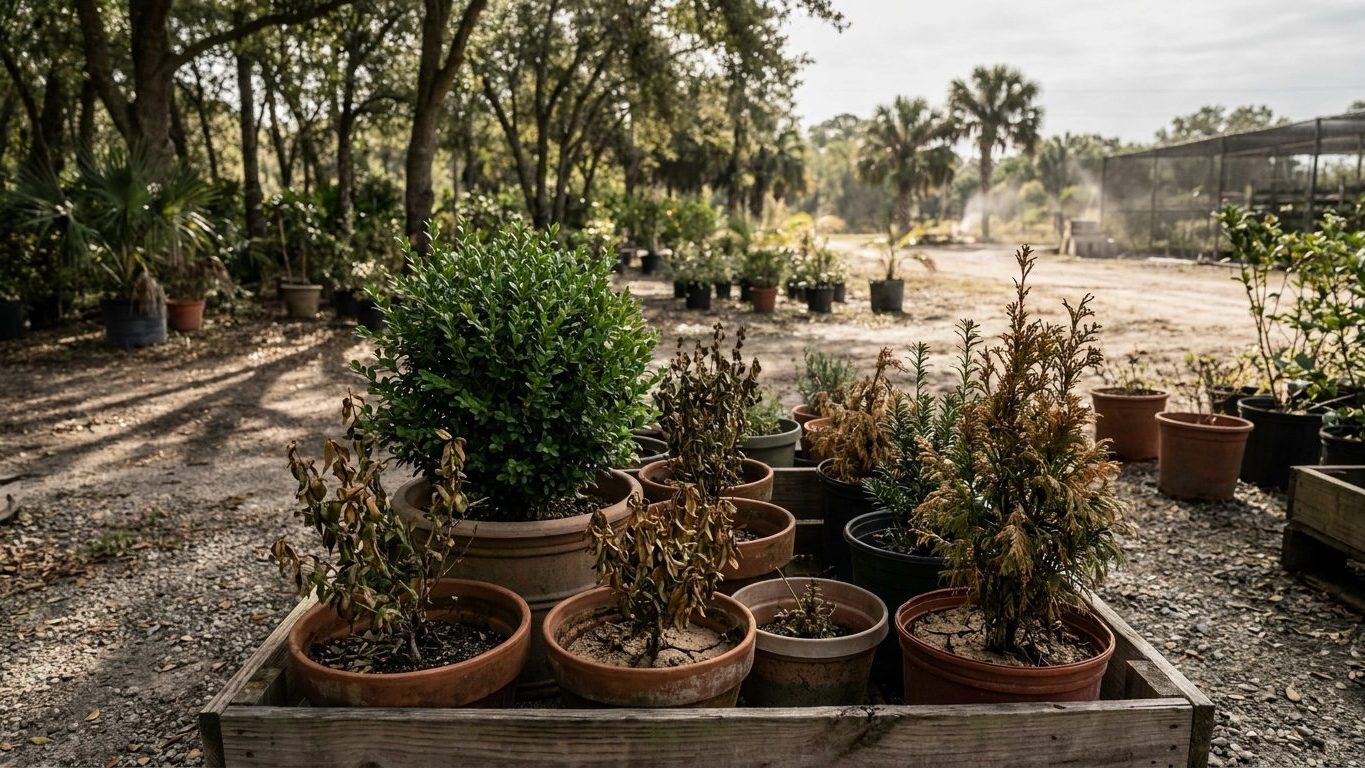

All twelve widely planted hedge species survive Connecticut winters, from the 6a hills to the 7b shoreline (USDA system). Cold will not make the choice for you. What does is how each plant responds to the shears, how fast it grows, and how it handles the fast-draining, acidic ground the state is known for. Three of the twelve can never be cut back to size once they outgrow their spot, and that matters more than any zone number.
What actually holds in Connecticut
Cold is not the filter
The USDA Plant Hardiness Zone Map (2023 edition, built on 1991-2020 normals) rates a place on a single variable: the average annual extreme minimum temperature. Connecticut spans zones 6a to 7b. The hardiness ranges for the twelve species come from the NC State Extension Gardener Plant Toolbox, and every one of them covers that entire span. None is marginal in part of the state, and none is ruled out anywhere in it. The twelve are boxwood, American hornbeam, Leyland cypress, inkberry holly, winterberry holly, eastern red cedar, privet, cherry laurel, yew, arborvitae, eastern hemlock and arrowwood viburnum.
That is an unusual result. In Hedge Plants for Wyoming: What Holds, and What Only Looks Hardy, winter cold sorts the species into those that make it and those that don’t. Connecticut’s list does not split that way.
“Holds” means survives, not thrives. A hedge that lives through January can still sulk in a windy exposure, a wet low corner or a bed of dry sand. Those are the failures that actually happen here, and the rest of this article deals with them.
Frost dates by reference city
For Bridgeport, the NOAA NCEI 1991-2020 Climate Normals put the last spring frost between April 2 and April 12, and the first fall frost between October 28 and November 10 (32°F freeze probabilities, 30 to 70 percent band). Bridgeport sits on Long Island Sound and is the mildest part of the state. Inland and northwest Connecticut freeze noticeably earlier in fall and later in spring, so a hedge in the northwest hills runs on a later calendar than one at the shore.
For a gardener reading this in October, two things follow. Evergreen hedge plants set out now need time to root before the ground freezes, and they need water through any dry autumn spell. And the shears can stay in the shed, because none of the twelve has a pruning window in October. Their windows are late winter, late spring, midsummer, or right after flowering.
The hedges you can never cut back down
Three plants with no second chance
Most hedge shrubs forgive a bad haircut. They sprout new shoots from bare, leafless wood, so an overgrown hedge can be cut hard and rebuilt. Three of the twelve cannot do that: Leyland cypress, eastern red cedar and arborvitae. Cut past the green growth into the brown interior and the gap stays a gap. The only remedy is replacement.
Leyland cypress is the one most often regretted. It grows 3 to 4 feet a year and reaches 15 to 25 feet as a screen, and it is pruned from late spring to midsummer. Eastern red cedar adds 12 to 24 inches a year and reaches 8 to 20 feet. It takes light cuts only, in late winter. Arborvitae is slower at 6 to 9 inches a year, tops out at 4 to 15 feet as a hedge, and is trimmed in late winter before growth starts, or in midsummer. Slower does not mean forgiving, though.
The practical rule is to buy for the final height. If the space is 8 feet tall, a plant that wants to be 25 will spend its life being fought.
The nine that regrow
Nine species regrow from old wood: boxwood, American hornbeam, inkberry holly, winterberry holly, privet, cherry laurel, yew, eastern hemlock and arrowwood viburnum. Yew is the natural comparison to arborvitae, since the two look alike in a clipped hedge and behave very differently when neglected. A yew grows 6 to 12 inches a year, reaches 3 to 8 feet, and is pruned in late spring after the new growth hardens. If it gets away from you, it can be rebuilt.
Regrowing does not mean any cut is safe. Eastern hemlock regrows from old wood, yet its prune guide still reads late spring, light cuts only. Boxwood grows just 3 to 6 inches a year and is shaped in late spring after the last frost, so a mistake takes years to grow out. Privet sits at the other extreme: 2 to 3 feet a year, with two cuts per season, one in spring and one in midsummer. It forgives anything, but it asks for a lot of labor in return.
Matching the plant to the job
Height and growth rate decide most hedge choices, and pruning labor follows from them. The table sorts the twelve by the job they usually do.
| Job | Plant | Height as hedge | Growth a year | Prune | Regrows from old wood |
|---|---|---|---|---|---|
| Low, formal | Boxwood | 2 to 6 ft | 3 to 6 in | Late spring, after last frost | Yes |
| Low, formal | Yew | 3 to 8 ft | 6 to 12 in | Late spring, after new growth hardens | Yes |
| Mid-height | Inkberry holly | 5 to 15 ft | 6 to 12 in | Late winter, dormant | Yes |
| Mid-height | Winterberry holly | 5 to 15 ft | 6 to 12 in | Late winter, dormant | Yes |
| Mid-height | Arrowwood viburnum | 6 to 10 ft | 12 to 24 in | Right after flowering | Yes |
| Mid-height | Privet | 4 to 12 ft | 2 to 3 ft | Spring and midsummer | Yes |
| Mid-height | Cherry laurel | 6 to 15 ft | 1 to 2 ft | Late spring, after flowering | Yes |
| Mid-height | American hornbeam | 6 to 15 ft | 12 in | Midsummer, after first flush | Yes |
| Tall screen | Eastern hemlock | 10 to 20 ft | 12 to 24 in | Late spring, light cuts only | Yes |
| Tall screen | Arborvitae | 4 to 15 ft | 6 to 9 in | Late winter, or midsummer | No |
| Tall screen | Eastern red cedar | 8 to 20 ft | 12 to 24 in | Late winter, light cuts only | No |
| Tall screen | Leyland cypress | 15 to 25 ft | 3 to 4 ft | Late spring to midsummer | No |
For a privacy screen, Leyland cypress is the fastest and the least reversible. Eastern hemlock grows 12 to 24 inches a year, reaches 10 to 20 feet and, unlike the other tall evergreens, regrows from old wood. For a screen that may need correcting later, that is a real advantage.
For a low formal edge, boxwood and yew are slow, which means the hedge stays tidy with one trim a year. The mid-height group is the widest. Winterberry holly loses its leaves in winter, so it screens only in the growing season, while inkberry holly stays evergreen at the same size and growth rate. Cherry laurel wants a single trim after flowering. Privet needs two. Count the cuts before you commit: a hedge that grows 3 feet a year is a part-time job, and one that grows 6 inches is a weekend. The broader overview in Hedges covers layout and spacing questions that apply whichever plant you pick.
The ground you are planting into
What the state’s soil tends to do
USDA lists the Windsor series as Connecticut’s representative soil. It is an Entisol, a very young soil with almost no profile development. Its mapped surface runs about 82 percent sand, 2 percent clay and 16 percent silt, with a surface pH around 5.1, which is strongly acid. It is classed as excessively drained. Those are USDA’s representative values for the surface horizon of the series’ major components (188 of them), not a reading from anyone’s garden bed. The very high organic matter figure on the record, about 95.0 percent, describes natural litter on the mapped surface, which a worked bed will not have.
What the series does tell you is what ground in this region tends to do: shed water quickly and run acid. A newly planted hedge in sand dries out faster than the same hedge in loam, and the first two or three summers are when it can die of thirst while the top of the plant looks fine. Deep, infrequent watering and a mulch ring are the usual defense, especially for evergreens that are still establishing roots.
Your yard may not be Windsor
A state spans hundreds of soil series. River bottoms, rocky hill country and any lot a builder has scraped or filled will behave differently, and compacted subsoil on a new subdivision lot can hold water where the state soil would drain it. Do not read 5.1 as your pH. The only number that counts is the one from your own soil.
A soil test through University of Connecticut Extension gives the pH and nutrient picture for the actual planting strip, along with lime or fertilizer advice if it is needed. Run it before planting a hedge that will stand for decades, not after the first plants yellow.
Common questions
Which hedge plant grows fastest in Connecticut?
Leyland cypress, at 3 to 4 feet a year. Privet follows at 2 to 3 feet a year, and cherry laurel at 1 to 2 feet. Leyland cannot be cut back down once it is oversized, while privet and cherry laurel can.
Can I cut an overgrown arborvitae back hard?
No. Arborvitae does not regrow from old wood, so cuts into bare brown interior growth leave permanent holes. Trim lightly within the green growth, in late winter before growth starts or in midsummer. Eastern red cedar and Leyland cypress behave the same way.
When should I prune a hedge?
It depends on the plant. Boxwood is done in late spring after the last frost, yew in late spring after the new growth hardens, and arrowwood viburnum right after it flowers. Both hollies are pruned in late winter while dormant. Bridgeport’s last spring frost falls between April 2 and April 12, and inland and northwest Connecticut run later, so wait until that frost has passed where you live.
Will a Connecticut winter kill any of these hedges?
Not from cold. All twelve species are hardy across zones 6a to 7b. Losses come from dry sandy soil, wind and poor drainage, or from pruning mistakes on the species that cannot regrow.