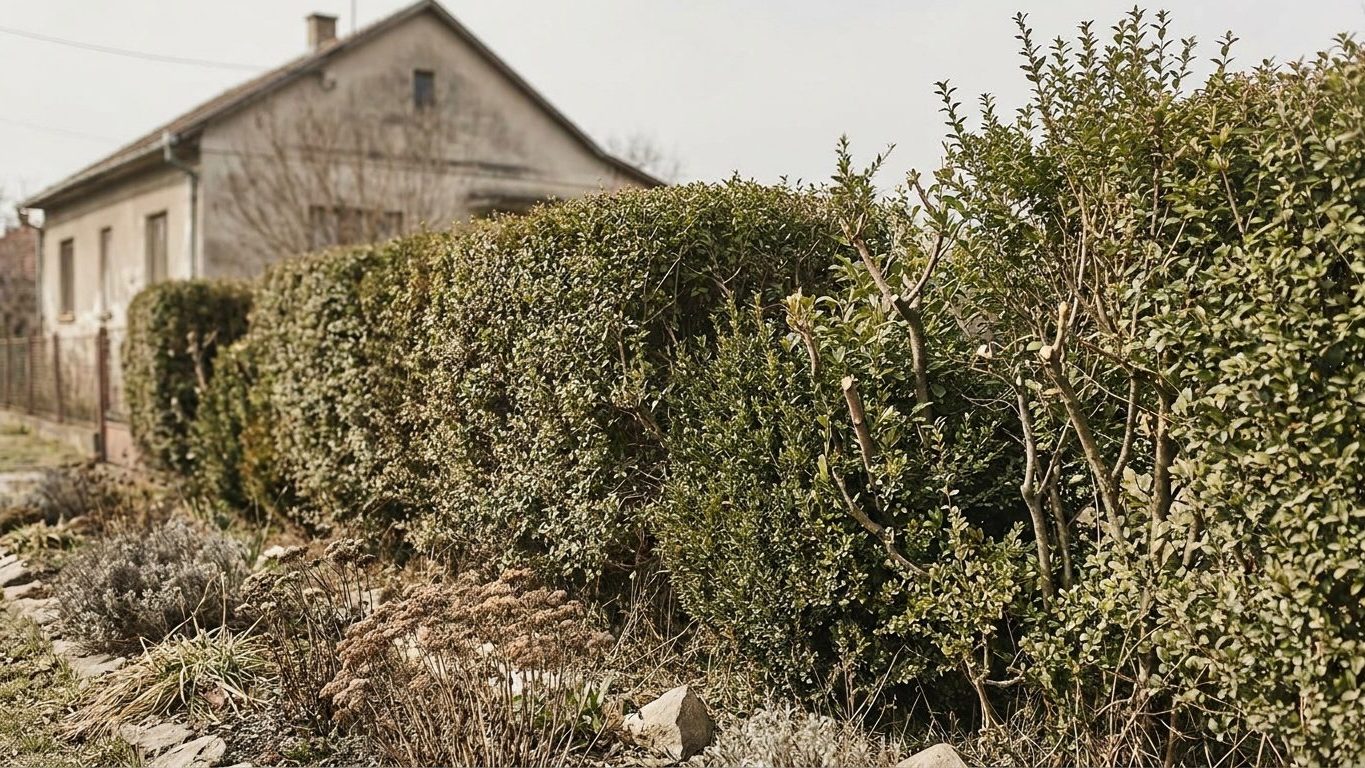

A hedge succeeds or fails long before the first cut, in three decisions: what job it needs to do, whether the species can regrow from old wood, and how far it sits from the property line. Get those right and pruning stays routine maintenance. Get one wrong and you’re tearing out the whole row in five years.
What you actually want the hedge to do
Most hedge failures start with a plant chosen for its looks at the garden center, not for the job it’s supposed to do in the yard. Before comparing species, name the function. A privacy screen that needs to be dense at eye level within three years is a different plant than a boundary marker that just needs to say “this is where my yard ends.” A windbreak protecting a garden from prevailing gusts behaves nothing like a noise buffer meant to soften traffic sound, and a formal clipped line running along a front walk asks for a completely different growth habit than either.
These five jobs pull in different directions:
- Fast, dense privacy screening at head height
- A simple, low-maintenance boundary line
- A windbreak that slows air without creating turbulence on the far side
- A sound buffer, which depends more on mass and density than on height
- A formal, tightly clipped architectural line
A windbreak, for instance, works best with some permeability. A solid wall of foliage doesn’t stop wind so much as deflect it upward and over, and it often creates a rough, swirling zone of turbulence just past the hedge, exactly where a patio or garden bed usually sits. A hedge that filters maybe half the wind through its branches actually slows it more evenly over a longer distance downwind. That’s a completely different structure than the dense, solid wall you’d want for privacy screening, where gaps are the enemy, not the goal.
Noise buffering works on a similar but distinct logic. Sound doesn’t care much about a thin line of shrubs; it takes real depth and mass, often several feet of thickness, before a hedge measurably dampens traffic noise. A single-row hedge planted for looks rarely does much for sound, no matter how tall it grows.
The job you need done determines the growth rate, density, and mature width you should be shopping for, not the other way around. Walk the space first. Decide whether you need fast coverage or patience is fine, whether you need a solid wall or a filter, whether formality matters or a looser natural line is acceptable. That answer narrows the plant list before you’ve looked at a single tag.
The one thing that decides everything later
Underneath the bark of some shrubs sit dormant buds, tiny reserves of growth tissue tucked into old wood that stay inactive for years until a hard cut triggers them into action. Other species simply don’t have them. That single biological detail is the line that separates a hedge you can renovate from one you can only replace.
Conifers like arborvitae, Leyland cypress, and eastern red cedar fall on the side with no dormant buds along their older stems. Cut one of these back into the brown, leafless interior wood and nothing happens. The cut section stays bare, permanently, because there’s no living tissue there capable of producing new shoots. That’s the mechanism behind the classic ruined arborvitae hedge: someone let it grow wide, cut it back hard to fix the shape, and ended up with a hole that never fills back in. There’s no waiting it out. That section is done.
Yew, boxwood, privet, cherry laurel, holly, eastern hemlock, American hornbeam, and arrowwood viburnum sit on the other side of the line. According to university extension horticulture guidance from institutions including Penn State, Clemson, NC State, and UMass Extension, these species carry dormant buds along their older wood and can be cut back hard, sometimes to bare stems just a foot or two off the ground, and will resprout from that old wood over a season or two. A yew hedge that’s gotten badly overgrown can be taken down almost to the trunk and rebuilt from scratch. An arborvitae hedge in the same condition cannot.
| Does not regrow from brown wood | Does take hard renovation |
|---|---|
| Arborvitae | Yew |
| Leyland cypress | Boxwood |
| Eastern red cedar | Privet |
| Cherry laurel | |
| Holly | |
| Eastern hemlock | |
| American hornbeam | |
| Arrowwood viburnum |
This is worth knowing before you plant, not after. Every later decision about a hedge, how high you’re willing to let it grow, whether a neglected or overgrown hedge can be saved, what a bad pruning cut actually costs you, traces straight back to which side of that line the species sits on. If you plant a conifer without dormant buds, you’re committing to keeping it within its mature size forever, because there’s no do-over available once it outgrows the space. Choose a species that resprouts from old wood, and you’ve bought yourself a safety net.
How hedges actually fail
Most ruined hedges didn’t die from disease or drought. They failed from three predictable, avoidable mistakes, and they happen in roughly this order of frequency.
The most common failure is shape. A hedge trimmed with straight vertical sides, or worse, sides that lean slightly inward as they rise, shades its own base more each year. The fix is a trapezoid: sides that taper outward toward the ground so the base is at least a little wider than the top, letting sunlight reach the lower branches. Skip that geometry for a few seasons and the bottom third of the hedge thins out and goes bare, a look that’s essentially permanent on species without dormant buds and takes years to correct even on ones that have them.
The second failure is spacing. A hedge planted too close to the property line, or too close to a fence, driveway, or the house itself, runs out of room for the width it’s genetically built to reach. Owners respond by shearing the street-facing or house-facing side hard every year to keep it in bounds, which stresses the plant and, on species without renewal buds, eventually creates the same bare, hollowed-out look as bad shaping. The fix is upfront: check the plant tag’s mature spread, not its size in the pot, and set the row back from any boundary by roughly half that mature width, plus a little cushion.
The third failure is genetic uniformity. Planting a single clone, one variety, propagated identically, the entire length of a property line means every plant shares the same vulnerabilities. When a fungal blight or a boring insect that targets that particular species or cultivar shows up, it can move down the whole row with nothing to stop it, turning one sick plant into a hundred feet of dead hedge in a couple of seasons. Mixing in a second, unrelated species every so often, or alternating two compatible varieties, doesn’t eliminate risk but it keeps one pathogen from wiping out the entire investment at once.
Before you plant: the part that is not horticulture
None of the plant biology matters if the hedge itself isn’t legal where you’re putting it. Height limits, how far a hedge must be set back from a property line, and who has the right to cut a hedge that straddles a boundary are all decided at the local level, by city or county ordinance, and by state law, never by one uniform national rule. A height that’s perfectly fine in one county can require a variance two towns over.
Before buying a single plant, check your municipality’s zoning or planning department and your state’s cooperative extension service, both of which typically publish guidance on hedge height, boundary setbacks, and shared-fence rules specific to where you live. Some municipalities regulate hedges the same way they regulate fences, with maximum heights near the street for sightline safety at corners and driveways. Others say nothing at all, leaving disputes to state property law and, occasionally, a judge.
Timing carries its own legal wrinkle that has nothing to do with property lines. Hedges are common nesting sites for native birds, and cutting one back hard while it’s actively being used as a nest can put a homeowner or a hired crew in violation of the federal Migratory Bird Treaty Act, which protects active nests, eggs, and young birds regardless of the species involved. A quick look through the branches before a hard spring or early-summer cut is a cheap way to avoid a problem that has nothing to do with pruning technique and everything to do with timing.
Common questions
Can I turn a row of evergreen shrubs into a hedge, or do I need to buy plants sold specifically as “hedging” varieties?
Plenty of shrub species sold individually, boxwood, privet, holly, work perfectly well planted in a row and trained as a hedge. There’s no special category of plant required, only the spacing, species choice, and pruning habits described above.
How long does it take a hedge to become a real privacy screen?
It depends entirely on the species and how densely it’s planted, and it’s not covered by the facts verified for this piece, so treat any specific timeline you see elsewhere with some skepticism until you’ve confirmed it against the mature size and growth rate for that particular plant.
Is it better to plant one long hedge of a single variety for a uniform look?
A single variety gives the cleanest, most uniform appearance, but as covered above, it also means one disease or pest outbreak can move down the entire length unchecked. Alternating two compatible species, or breaking a long run into segments, trades a bit of visual uniformity for real protection against a total loss.
What happens if my neighbor’s overgrown hedge is blocking light or view on my side?
That’s governed by local ordinance and state property law, not by a single national standard, and the rules on who may trim a boundary hedge and how far onto whose side vary by jurisdiction. Your municipality’s planning or zoning office is the right first call before assuming anything about your rights.