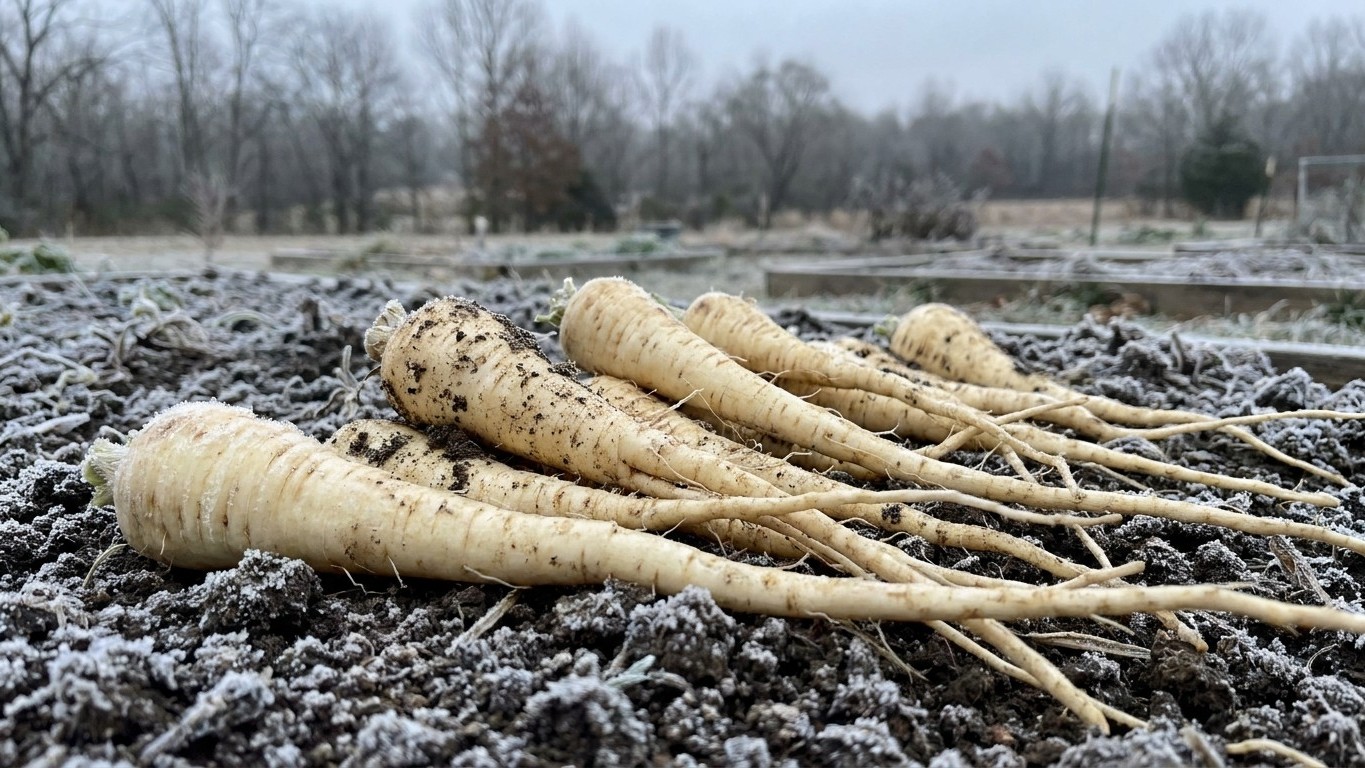

In most years, yes: parsnips planted in the Northwest Territories will sweeten, because this region hands them weeks of hard frost before the ground locks up for good. But the payoff depends on timing. Get the sowing date wrong, or leave the roots in the ground too long, and you end up with something starchy instead of the deep, sweet flavor parsnips are grown for.
The short answer
The number that actually settles this question is not a hardiness zone. It’s the mean minimum temperature of the coldest month, and for the reference station at Yellowknife, that figure is -21.1°F. That’s a brutal average low, not a rare dip, and it tells you this territory doesn’t flirt with frost the way a coastal garden might. It commits to it, hard, for an extended stretch.
That distinction matters because frost exposure and hardiness zone answer two different questions. A hardiness zone tells you the coldest temperature a perennial plant is expected to survive over winter. Frost exposure tells you how many cold, sub-freezing weeks a biennial root crop like a parsnip sits through before harvest, which is what triggers the starch-to-sugar conversion that makes the root taste sweet instead of flat. A garden could technically sit in a mild hardiness zone and still never deliver that conversion, because it never gets more than a light nip or two. Northwest Territories has the opposite problem in a good way: there’s no shortage of frost here. The question is whether the parsnip is already sized up and sitting in the ground when that frost arrives, not whether the frost itself will show up.
Given a mean coldest-month minimum over 20 degrees below zero Fahrenheit, this climate delivers far more than the “several weeks of cool, frosty weather” that Utah State University Extension identifies as the trigger for sweetening. The frost season here isn’t marginal or borderline. It’s long, it’s deep, and once it sets in, roots left in unmulched, unharvested ground face a genuine risk of freezing solid into the soil rather than simply sweetening in it. So the answer isn’t just “will parsnips sweeten here.” It’s “will they sweeten before the ground becomes too hard to dig,” and that shifts the real challenge from cold exposure, which this territory has in abundance, to timing the sowing date so the crop is mature and ready before the frost turns into a deep freeze.
That timing question is where the season length comes in, and it’s tighter than the frost numbers alone suggest.
Does the season fit?
Utah State University Extension puts parsnips at 100 to 120 days from seeding to harvest, with sowing recommended 2 to 3 weeks before the last expected spring frost. Here’s how that lines up against this territory’s frost window, worked out step by step.
- Start with the last spring frost date. Environment and Climate Change Canada’s 1981-2010 normals for station YELLOWKNIFE A put the mean last spring frost at May 25. That’s an average, not a guarantee, so in roughly half of all years frost arrives even later than that.
- Move the sowing date earlier. Sowing 2 to 3 weeks ahead of that mean date puts seed in the ground around early May, roughly May 4 to May 11.
- Account for germination before counting growth. Parsnip seed is slow, typically 14 to 21 days to germinate. That germination window is already folded into the 100-to-120-day count from seeding, but it’s worth knowing so a gardener doesn’t dig up bare soil after a week and assume the seed failed.
- Run the clock forward 100 to 120 days. From a sowing around May 4 to May 11, the 100-day mark lands in mid-August and the 120-day mark lands in the first week of September.
- Compare that to the first fall frost. The mean first fall frost at the same station is September 18. That gives the crop a buffer of roughly one to two weeks past the earliest possible harvest date, and closer to two to three weeks if the shorter 100-day maturity window is used.
That’s a season that fits, but tightly, not comfortably. Because both frost dates are means rather than guaranteed cutoffs, a late spring or an early fall frost, either one occurring in roughly half of all years by definition, can eat directly into that buffer. Gardeners here do better sowing at the earliest safe edge of that window and choosing the shorter end of the maturity range as their harvest target rather than pushing for the full 120 days.
What goes wrong here
- Forked roots from heavy or stony ground. Parsnips grow a single taproot straight down, and any obstruction, whether a rock, a clay lens, or compacted subsoil, splits that root into forks. Utah State University Extension recommends deep, sandy soil, and where the ground is heavy, it should be double dug to loosen it well below the depth the root will reach.
- Forked roots from overwatering. This is a separate cause from soil texture. Too much water, especially inconsistent heavy watering after a dry spell, encourages the root to branch rather than grow as one straight taproot. Even in loose, sandy soil, overwatering can produce the same forking that heavy ground causes.
- A season that runs out before the root matures. With only a one-to-two-week buffer between a realistic harvest date and the mean first fall frost, any delay in sowing, whether from a cold, wet spring or a late seed order, can push maturity past the point where frost damage or freezing ground cuts the season short.
- Roots trapped by a hard freeze before they’re pulled. Once the ground freezes solid, digging parsnips becomes difficult or impossible. In a climate with a mean coldest-month minimum of -21.1°F, that hard freeze arrives with force. Harvesting soon after the sweetening frosts, rather than waiting for a longer cold spell, avoids losing the crop to frozen ground.
Every part of this plant, not just the leaves, carries a chemical that can burn skin. North Carolina Extension Gardener Plant Toolbox states it plainly: “All parts of this plant contain furocoumarins which can make skin sensitive to light causing burns so be sure to wear gloves, long sleeves and long pants when dealing with it.”
What makes this surprising is the mechanism. The sap alone doesn’t burn skin. It’s sap combined with sunlight that does, a reaction called phytophotodermatitis. That’s why the injury tends to show up after a bright, sunny day of harvesting or pulling tops, and why it often doesn’t appear until hours later, once the skin has had time to react to the sun exposure that followed contact with the sap. Because the reaction depends on sunlight rather than the sap itself, washing the skin after the fact does little to prevent it once sun exposure has already occurred. The protection that actually works is covering up before handling the plant at all: gloves, long sleeves, and long pants, exactly as the source specifies, on any day bright enough for the sun to trigger the reaction.
Checking this against your own county
The Northwest Territories doesn’t divide into counties the way many places do, and frost dates from a single reference station like Yellowknife won’t match every community across a territory this large. Northern settlements and those at higher elevation typically run weeks behind Yellowknife’s averages, both in the spring thaw and the fall freeze.
For local guidance suited to specific growing conditions, the Government of the Northwest Territories’ Department of Industry, Tourism and Investment maintains an agriculture services page covering growing information relevant to the territory. Checking there before finalizing a sowing date is worth the few minutes it takes, especially in a territory where the difference between a sweet harvest and a frozen-in-the-ground loss can come down to a single week.
Common questions
Do parsnips need to be transplanted, or sown directly?
Parsnips are sown in place. The 100-to-120-day maturity window runs from the seeding date itself, not from a transplant date, because the taproot doesn’t tolerate the disturbance of transplanting well.
How long does parsnip seed take to germinate?
Germination takes 14 to 21 days, considerably slower than many garden vegetables. That slow start is already built into the overall 100-to-120-day timeline, but it’s worth knowing so bare-looking soil after a week isn’t mistaken for a failed sowing.
Can parsnips be left in the ground over winter here?
The sweetening comes from several weeks of frosty weather, not from surviving a full winter underground. Given how deep and early the freeze sets in, with a mean coldest-month minimum of -21.1°F, roots left too long risk becoming locked in frozen ground rather than gaining more sweetness.
What soil should Northwest Territories gardeners aim for?
Utah State University Extension recommends deep, sandy soil for straight roots, with heavy soil double dug to loosen it well below root depth. That’s a starting point for soil preparation, not a full diagnosis of any particular garden, so checking actual soil texture before sowing still matters.