
By November, Connecticut’s soil has already crossed the line most vegetables need to grow. First fall frost lands somewhere between October 28 and November 10, so for a lot of the state the growing season outdoors is closing rather than opening. That leaves garlic, shallots, cold frames, and a full slate of dormant-season chores as the real answers this month.
What goes in the ground in November

The short version: almost nothing new gets planted directly outdoors this month, and that is a fact worth saying plainly rather than dressing up. First fall frost across the state falls between October 28 and November 10, which means by the time November is underway, most of Connecticut has already had at least one hard freeze. Soil temperature, not the date on the wall, decides what survives, and by now that soil is cooling fast toward dormancy.
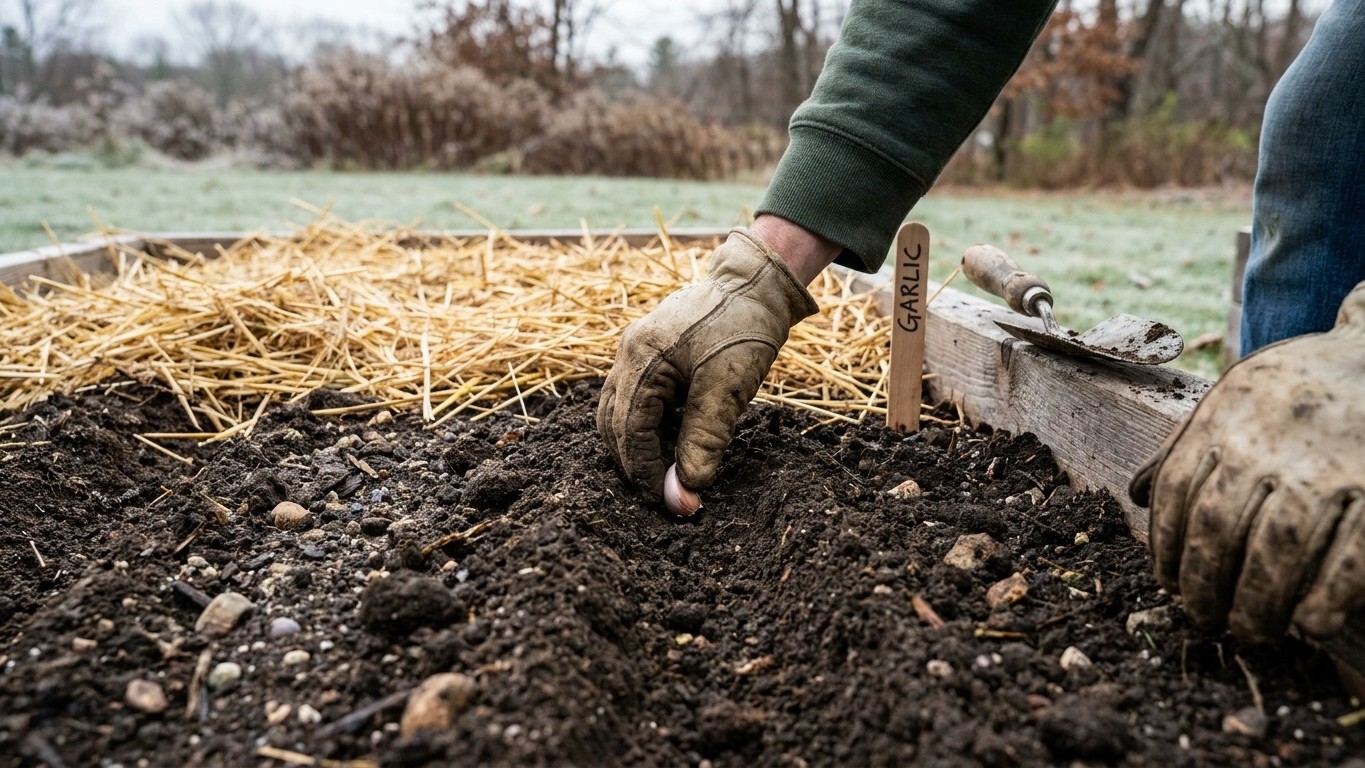
Garlic and shallots are the exception, and they are worth the effort. Both go into the ground as cloves or sets while the soil is still workable, ideally before it locks up hard. They need roughly six weeks of cool soil to root before winter sets in fully, then they sit dormant until spring pushes them back into growth. A four-inch layer of straw or shredded leaf mulch after planting protects against frost heave, which is the real threat, not the cold itself.
Bare-root fruit trees, shrubs, and cane berries can also go in during a dormant-season window, provided the ground has not frozen solid. Cold frames and low tunnels extend the season for anything already established, mainly spinach, mâche, and claytonia that were sown weeks earlier. Forcing chicory roots or rhubarb crowns indoors in a dark, cool space is a legitimate November project for anyone who wants something to harvest through winter without touching frozen ground.
| Region | Typical first frost timing | Practical note |
|---|---|---|
| Coastal Connecticut (Long Island Sound) | Later in the window, closer to November 10 | Slightly more workable ground into the month |
| Inland and northwest Connecticut | Earlier in the window, closer to October 28 | Ground often frozen or near-frozen by mid-November |
The USDA Plant Hardiness Zone Map, built on average annual extreme minimum temperature, places Connecticut between zones 6a and 7b. That range spans real differences: a Litchfield Hills garden and a shoreline garden in the same state are not working from the same calendar.
What to start under cover
Run the math backward from the last spring frost, which falls between April 2 and April 12, and November stops looking like a seed-starting month. Onions and leeks, among the earliest starts of the year, want 10 to 12 weeks indoors before transplant, which lands their sowing date in mid-to-late January at the soonest. Start them now and they sit rootbound and leggy under lights for two extra months, which weakens them more than starting late ever would.
That does not mean the windowsill sits empty. Microgreens and sprouts finish in one to two weeks regardless of the outdoor calendar, and they are the one crop where November timing is exactly right, not a compromise. Sunflower shoots, pea shoots, and radish microgreens all work well in a sunny window or under basic shop lights, and they give a harvest inside seven to fourteen days.
Potting up bulbs for indoor forcing, amaryllis and paperwhites in particular, is another cold-weather project that uses the same windowsill space without competing with spring seed starting. Anyone tempted to get ahead on tomatoes or peppers should resist; started this early, they will need repotting two or three times before the ground is even close to warm enough in April, and each repotting sets them back rather than ahead. The failure mode this month runs almost entirely in one direction: starting too early, not too late.
What is ready to pick
Outdoors, the honest answer is little to nothing across most of the state once the first fall frost has passed through. That said, a few crops shrug off freezing air and keep feeding the household well into the month. Kale, especially the curly and Tuscan types, actually sweetens after a frost as the plant converts starches to sugars, and it can be picked leaf by leaf under a light snow cover. Leeks left in the ground do the same, standing through hard freezes as long as they are mulched at the base.
Cold frames and low tunnels planted weeks earlier are now doing their real work, holding spinach, mâche, and hardy lettuce mixes a few degrees warmer than the open air outside them. Check them on sunny days, since a closed frame can overheat even when the outside temperature is well below freezing.
Indoors, this is where microgreens and sprouts earn their keep as an actual food source, not just a hobby project, giving a fresh harvest on a schedule the outdoor garden cannot match right now.
Stored crops need a hands-on check this month rather than a glance. Squash should feel firm with no soft spots near the stem end; any give means it is turning and should be used first. Potatoes showing green skin or soft eyes should be pulled from the bin before they spread rot to their neighbors. Onions with any give at the neck, rather than a papery, tight neck, are the ones to use next, not last.
The jobs that matter this month
This is the section that carries the page in a month with little happening in the open beds, and there is real work with real deadlines packed into it. Dormant pruning of fruit trees, grape vines, and cane berries is best done once leaves have dropped and the plant has gone fully dormant, since cuts made now heal cleanly without the sap flow and disease pressure of a spring pruning job done too late.
Seed catalogs move fast, and ordering now, rather than in the crush of late winter, is the difference between getting the variety wanted and settling for whatever is left. Popular garlic varieties for fall planting and heirloom tomato seed for the following spring both sell out earlier than most gardeners expect.
Soil testing has a practical advantage this month: results come back before the spring rush, giving time to source and apply lime or amendments and let them work into the soil over winter rather than scrambling in April. A basic test through a local lab or the state extension service tells you where pH and nutrients actually stand, rather than guessing.
Turning the compost pile one more time before the ground freezes keeps the pile active longer into the cold season. Cleaning and sharpening tools, oiling wooden handles, and repairing raised bed corners or fencing all take an afternoon now and save a frustrating scramble come planting season. Checking on stored crops weekly, not just once, catches rot before it spreads to the whole bin.
What not to do in November
The most common mistake this month is treating a mild afternoon as permission to act like it is still fall. A warm stretch of days does not mean the soil has warmed with it, and any warm-season transplant put into ground this late will simply sit and rot rather than grow, regardless of how pleasant the air feels.
Uncovering cold frames or removing mulch after a few warm days is the second version of the same error. Plants that have gone dormant under a mulch layer are counting on that protection staying in place through the swings of the season, and pulling it back exposes roots and crowns to the next hard freeze with no buffer left.
Nitrogen fertilizer is the third trap. Feeding trees, shrubs, or lawns with a nitrogen-heavy product this late pushes soft new growth right before the season’s harshest cold, and that new growth has no time to harden off before it gets hit. Anything fed now should be a slow-release or dormant-season formula, or nothing at all, saving the nitrogen for when growth actually resumes.
The fix for all three is the same discipline: read the soil and the calendar together, mulch and cover with the intent to leave it alone, and hold off on fertilizer until the plant is actually growing again.
Checking this against your own county
A state-wide frost window is a starting point, not an instruction for a specific backyard. Elevation in the Litchfield Hills, proximity to Long Island Sound, and the general north-south split in the state can shift these dates by two weeks or more in either direction. A shoreline garden in Fairfield County and a hillside garden in Litchfield County are not on the same clock, even though both sit inside the same statewide range.
For local frost data and season-specific guidance, the UConn Extension service is the direct source, along with the state’s own month-by-month planting calendar for a county-level check against what is written here.
Common questions
Can I still plant garlic in November in Connecticut?
Yes, as long as the ground is still workable and has not frozen solid. Garlic needs a few weeks of cool soil to root before going fully dormant, so earlier in the month is safer than later. Mulch heavily right after planting to prevent frost heave.
Will frost kill my kale and leeks?
No. Both crops tolerate hard freezes well, and kale often tastes better after frost converts some of its starches to sugar. Leeks mulched at the base can be harvested through snow cover in most of the state.
Is it too late to start seeds indoors for spring?
For most crops, yes. Onions and leeks, among the earliest indoor starts, are not sown until mid-to-late January based on the April 2 to April 12 last frost window. Starting now leads to leggy, rootbound plants long before it is safe to transplant them outside.
What should I check on stored vegetables this month?
Squash for soft spots near the stem, potatoes for green skin or sprouting eyes, and onions for any softness at the neck. Anything showing these signs should be used first, since one bad piece can spread rot through a whole storage bin.