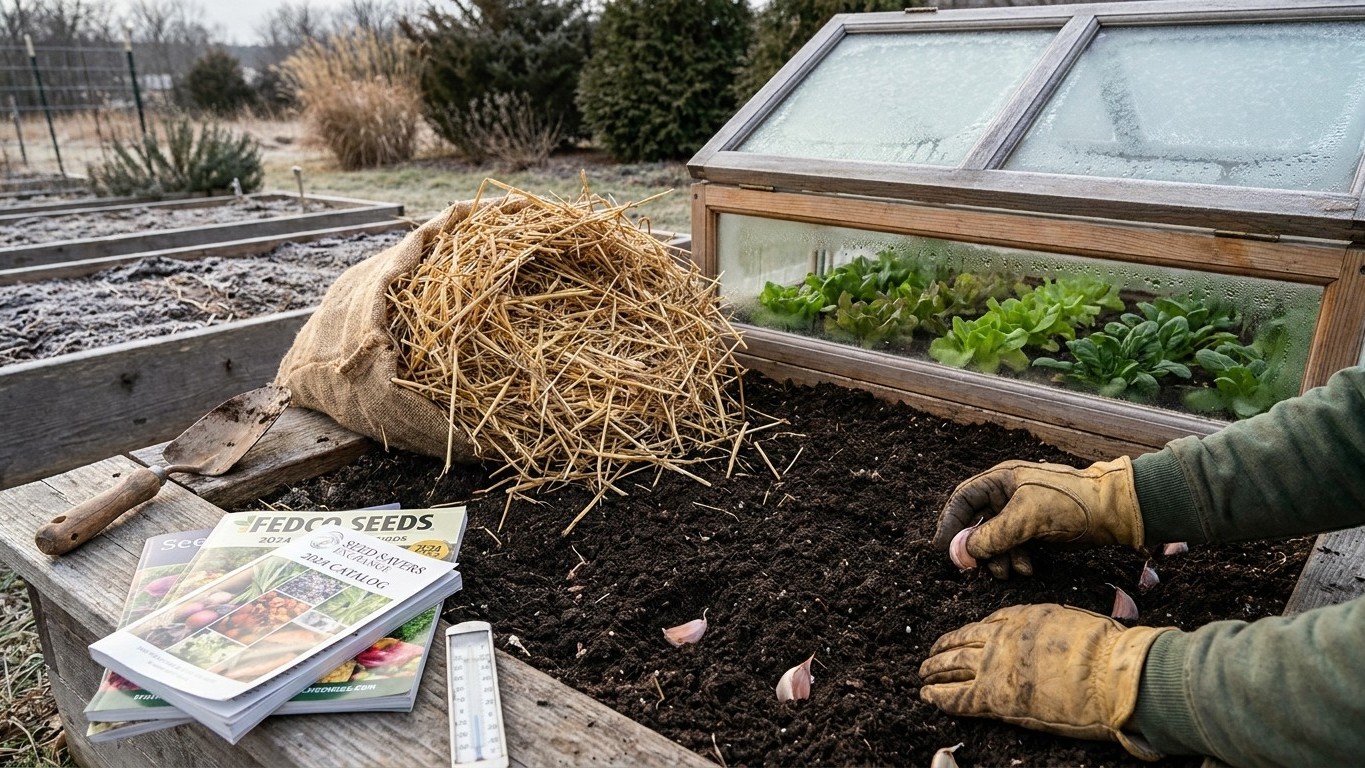

Little to nothing goes into open ground in Connecticut in December, and that’s the honest starting point. What still works: garlic and shallots if the soil hasn’t frozen solid, bare-root dormant plantings, cold frames and low tunnels protecting greens already established, and forcing rhubarb or chicory indoors. The real work this month is dormant pruning, soil testing, and ordering seed before catalogs sell out.
What goes in the ground in December

Soil temperature decides what’s possible here, not the date on the calendar. Connecticut sits in USDA hardiness zone 6a to 7b, and the last spring frost across the reference coastal station runs April 2 to April 12, with the first fall frost already behind us by early to mid November. December sits deep in the dormant stretch between those two windows, months from any safe outdoor seeding.
That doesn’t mean the garden is closed. If the ground is still workable, meaning you can push a trowel into it without hitting a frozen crust, garlic cloves and shallot sets can still go in. The goal is root establishment before a hard freeze locks the soil, so plant promptly and mulch heavily with straw or shredded leaves right after, four to six inches deep. Once the ground does freeze solid, stop. Forcing bulbs into frozen dirt tears roots and wastes the crop.
Cold frames, tunnels, and bare-root stock
Cold frames and low tunnels aren’t for starting anything new this month. They’re for keeping already-established hardy greens, spinach, mache, arugula, alive and pickable through a Connecticut winter. Vent them on sunny days above roughly 40 degrees to avoid cooking the plants, and close them tight before nightfall.
Bare-root fruit trees, berry canes, and some perennials can go into the ground on a workable-soil day, since they’re dormant and won’t push new growth until spring warms the soil. Skip this if the site is waterlogged or frozen; roots sitting in ice water rot before spring arrives.
Indoors, this is the month to force chicory roots or rhubarb crowns in a dark, cool cellar kept around 50 to 60 degrees. Both throw tender new growth within weeks, giving you a fresh harvest while the outdoor garden sleeps.
What to start under cover
Count backward from the last spring frost window of April 2 to April 12, and December still lands too early for almost every seed you’d start for transplanting. The slowest growers, leeks, onions, and celery, need roughly 10 to 12 weeks under lights before they’re ready to go outside, which puts their start date in mid-January at the earliest. Start them now and you’re looking at leggy, rootbound seedlings sitting under grow lights for four to six extra weeks with nowhere to go, a classic failure mode that stunts the whole crop before it ever sees dirt.
The other failure mode, starting too late, isn’t the risk this month. That problem shows up closer to the frost date itself, when a delayed sowing runs out of season before it can size up.
What does make sense under cover in December is anything on a fast, frost-independent clock. Microgreens and sprouts fall into that category, ready in one to two weeks regardless of what the calendar says outside, and they’re a reliable way to keep fresh greens coming from a windowsill or a shelf under a simple grow light. Forcing bulbs like amaryllis and paperwhite narcissus also belongs here: pot them in a container with the top third of the bulb exposed, water lightly, and they’ll bloom indoors over several weeks with no connection to the outdoor frost clock at all.
If you’re tempted to get a jump on tomatoes or peppers because the seed packets arrived early, resist it. Those crops start 6 to 10 weeks before the frost-free date, meaning February or March in most of the state, not December.
What is ready to pick
Outdoors, the pickings are thin but not empty. Kale, leeks, and Brussels sprouts that were left in the ground through fall often improve after a freeze, since cold triggers plants to convert starches to sugars as a natural antifreeze, and that shows up as sweeter flavor at the table. Parsnips and carrots left mulched under a thick layer of straw or leaves can be dug as needed through the month, as long as you can get a shovel through the mulch and the top inch of soil.
Cold frame greens, spinach, mache, arugula, keep producing light harvests as long as the frame stays closed against hard freezes and vented on mild days to prevent rot from trapped humidity.
Indoors, microgreens and sprouts are the most dependable harvest of the month, cut with scissors as soon as the first true leaves appear, usually seven to fourteen days after sowing.
This is also the month to walk the storage shelves. Check squash, potatoes, and onions weekly for soft spots, dark patches, or a sweet fermented smell, and pull anything showing those signs before it spreads to healthy stock sitting next to it. One soft squash left in a bin can take down half a shelf of otherwise good storage crops within a couple of weeks.
The jobs that matter this month
Dormant pruning tops the list for fruit trees and berry canes. With leaves gone, you can actually see the branch structure, and cutting now, while the tree is fully dormant, means the wounds seal before spring sap flow and before most fungal spores are active in the air. Apples, pears, and raspberry canes are safe targets; hold off on stone fruits like peaches and plums until later in the dormant season, since they’re more sensitive to cold injury at fresh cut sites.
Seed ordering has a real deadline too, even if it doesn’t feel like one. Popular varieties, especially heirloom tomatoes and specialty peppers, routinely sell out by late winter as home gardeners across the country place their orders early. Getting your list in now means you’re choosing from full availability instead of whatever’s left.
Soil testing pays off precisely because it’s slow. Lime takes months to shift pH, so a test done now through the UConn Extension soil lab gives amendments time to work before spring planting instead of scrambling in April.
Beyond that: turn the compost pile so it doesn’t go anaerobic under a wet snow cap, clean and oil pruning tools before they sit unused for weeks, and repair raised bed frames, trellises, and fencing while nothing is growing to work around. Mulch garlic beds and any exposed perennial crowns heavily if you haven’t already, since freeze-thaw cycles heave roots out of loose soil more than steady cold ever does.
What not to do in December
A stretch of 50-degree air after weeks of cold fools a lot of gardeners into thinking spring arrived early. It didn’t. Air temperature swings fast; soil temperature and the calendar-based frost window don’t move with it. Starting warm-season seeds indoors because the air felt mild just means an overgrown seedling sitting under lights for months longer than it should, with no outdoor destination until April at the earliest.
That same mild spell tempts people to pull back cold frame covers or strip mulch off garlic beds to “let things breathe.” Leave them alone. A hard freeze can return within days of a warm stretch, and plants that had hardened off under steady cold take real damage when they’re suddenly exposed and then refrozen. Steady cold is manageable; a freeze-thaw-freeze cycle is what actually kills roots and crowns.
Nitrogen fertilizer is the other trap. Dormant plants aren’t taking up nutrients the way they do in active growth, so feeding now does little for the plant and mostly just leaches through the soil before spring roots are active enough to use it. Save the feed for when growth resumes, and use this month instead for the soil test that tells you what’s actually needed.
Checking this against your own county
A statewide month is a starting point, not an instruction specific to your yard. The frost windows cited here come from a Long Island Sound coastal station, the mildest part of Connecticut. Inland areas and the northwest hills sit at higher elevation, freeze noticeably earlier in fall, and stay frozen weeks longer into spring than the coast does. Elevation and distance from the Sound can shift these windows by two to three weeks in either direction.
Check your own dates against the UConn Extension planting calendar and local frost data before committing garlic, bare-root stock, or cold frame timing to the ground.
Common questions
Can I still plant garlic in Connecticut in December?
Yes, as long as the soil is still workable and hasn’t frozen solid. Plant promptly and mulch four to six inches deep right after to insulate the cloves through the rest of winter.
What hardiness zone is Connecticut for planting purposes?
The USDA Plant Hardiness Zone Map places Connecticut in zones 6a to 7b, based on average annual extreme minimum temperature. That’s a statewide range; coastal areas run milder than the northwest hills.
Is it too late to plant bulbs in Connecticut in December?
For outdoor spring-flowering bulbs, yes, if the ground has already frozen. Indoor forcing bulbs like amaryllis and paperwhite narcissus are unaffected by outdoor soil conditions and can be potted and bloomed on a windowsill through the month.
What vegetables can survive winter in a Connecticut garden?
Kale, leeks, Brussels sprouts, and heavily mulched root crops like parsnips and carrots routinely survive in the ground under snow and mulch. Cold frame greens such as spinach, mache, and arugula also hold through the season with venting on mild days.