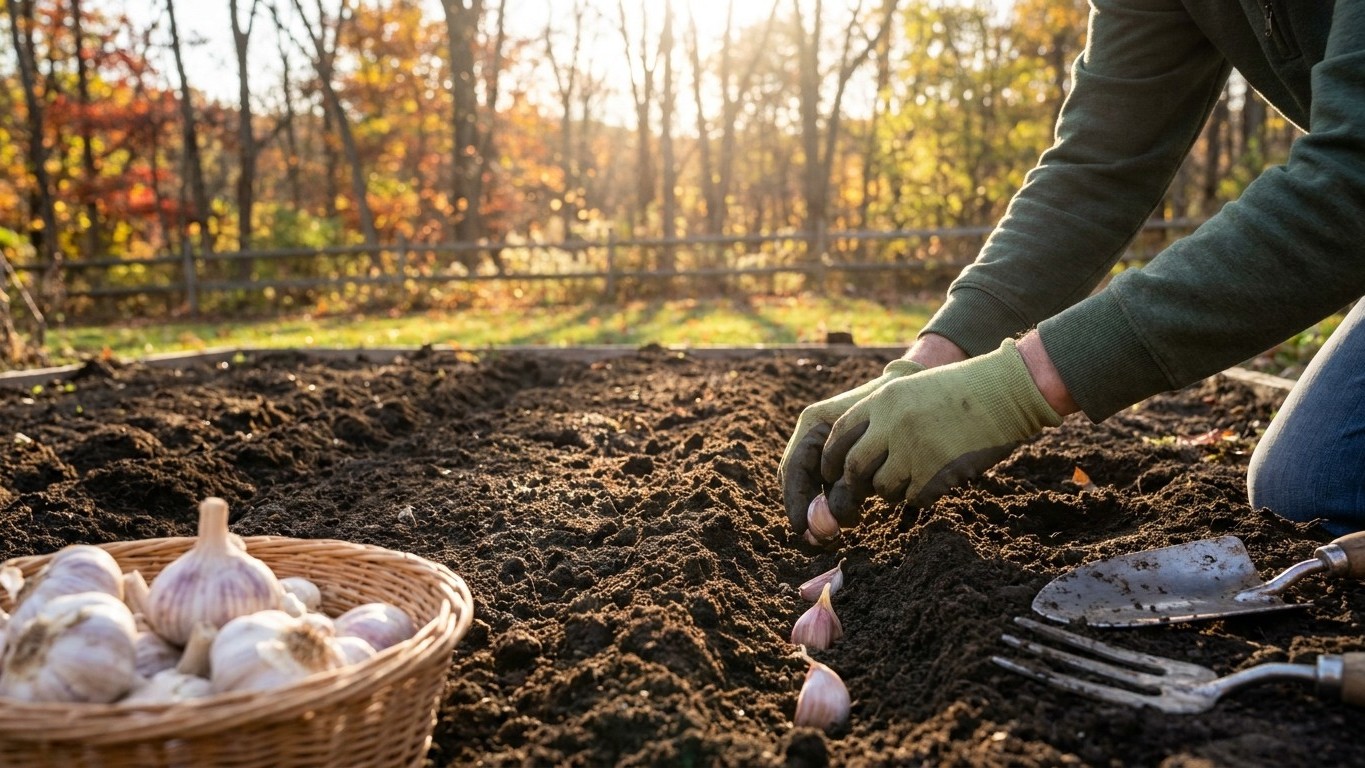

October is a planting month in Connecticut, not a shutdown month. Garlic and shallots go into the ground now, cover crops get seeded before the soil cools too far, and cold-hardy greens can still take root under a cold frame. The state’s first fall frost lands somewhere between October 28 and November 10, so the early and middle weeks of the month carry real growing time before that window closes.
What goes in the ground in October

Soil temperature and the frost window decide what belongs in the ground this month, not the date on the calendar. Connecticut’s first fall frost arrives between October 28 and November 10, based on NOAA’s 1991-2020 climate normals for station USW00094702 in Bridgeport. That station sits on Long Island Sound, the mildest corner of the state, so inland and northwest Connecticut should expect frost on the earlier edge of that range or before it.
Garlic and shallot cloves are the safest bet of the month. Planted four to six weeks ahead of a hard freeze, they root into the soil through fall and push up green shoots the following spring. October, before the ground stiffens, is close to the last practical window for getting cloves in. Spring-flowering bulbs like tulips and daffodils follow the same logic: they need weeks of cool soil contact before winter to bloom on schedule.
Cover crops belong on the same list. Winter rye and crimson clover seeded early in the month have time to establish a root mass that holds soil over winter and feeds it come spring. Hardy greens such as spinach, mache, and claytonia can still go in as direct-sown seed in the first half of the month, especially with a cold frame or low tunnel over them.
What is a gamble
Fall peas are a stretch by October in this state. Cool-season crops need weeks of mild growing weather before frost, and by October that window is closing fast. Lettuce and spinach sown outdoors without any cover late in the month are a gamble too. Shortening daylight slows germination, and a cold night can wipe out young seedlings before they get established. If the ground is workable and a frost-free stretch is forecast, hardy greens under cover are worth the try. Anything tender, tomatoes, peppers, beans, should already be out of the ground.
What to start under cover
Sowing this month works backward from the frost window rather than from a fixed date. With first frost landing October 28 to November 10, greens meant to overwinter in a cold frame or low tunnel need to go in with enough runway to reach three or four true leaves before that cold arrives. Spinach and mache typically need three to four weeks to hit that stage, which puts the ideal sowing window in the first half of October for most of the state, and slightly earlier inland where frost tends to come sooner.
The math changes by county. A gardener near the coast, working from the milder end of the frost range, can push sowing dates a week or so later than someone in the northwest hills, where cold settles in first. Counting backward from the local frost date, rather than copying a date from a neighboring county, keeps the timing honest.
Two mistakes show up every fall. Sowing too early in warm, humid conditions invites damping-off and rot before the plants ever toughen up for winter. Sowing too late leaves seedlings too small to survive once daylight drops and temperatures fall, and they simply stall out without ever producing a harvest. Splitting a sowing into two smaller batches a week apart is a simple way to hedge against guessing wrong on either end.
What is ready to pick
October is a harvest month more than a lean one. Winter squash and pumpkins should be coming off the vine once the stem has dried and hardened and the skin resists a thumbnail press. Potatoes are ready once the foliage has died back on its own, a sign the tubers have finished sizing up underground. Leeks and kale keep producing right through light frost, and both actually taste better once a cold night has hit them, since the plant converts starches to sugars as a defense against the cold.
Brussels sprouts follow the same pattern. A frost or two sweetens them noticeably, so there is little reason to rush the harvest at the first cold snap. Late carrots, beets, and turnips can stay in the ground under a layer of mulch and get pulled as needed, which keeps them fresher than pulling the whole row at once.
For anything already in storage from earlier harvests, October is a checkpoint. Squash, onions, and potatoes stored since late summer should get a look-over for soft spots or sprouting. One rotting squash in a bin can spread mold to its neighbors fast, so pulling the questionable ones out now protects the rest of the stash through winter.
The jobs that matter this month
The garlic planting deadline sits at the top of the list, since it is tied directly to the frost window rather than to convenience. Mulching perennial beds with straw or shredded leaves before the ground firms up protects roots through the winter ahead, and it is far easier to spread mulch on soft ground than on frozen ground in December.
Fall is also a strong window for planting bare-root trees, shrubs, and canes in Connecticut. Roots get weeks to settle into the soil before it freezes solid, which gives the plant a head start over anything planted in spring. Dividing overgrown perennials falls into the same window, since split clumps need time to root before winter locks the ground up.
Garden sanitation matters more in October than almost any other month. Pulling spent tomato, squash, and cucumber vines and getting them off the property, rather than into the compost pile, cuts down on disease and pest populations that would otherwise overwinter in the debris and reappear next season. Soil testing is worth doing now too, since results come back in time to plan amendments for spring rather than scrambling in April.
Practical maintenance rounds out the list: draining and storing hoses and irrigation lines before a hard freeze cracks them, bringing tender potted plants indoors ahead of the first frost, and cleaning and sharpening pruning tools before they sit unused all winter. Every one of these jobs is cheaper done now than fixed later.
What not to do in October
The classic mistake is trusting a warm afternoon over the calendar of frost risk. Tender crops like tomatoes, peppers, and basil left in the ground because the air felt mild can be wiped out overnight once frost arrives anywhere in the October 28 to November 10 window, and inland gardens often see it sooner. If a cold night is forecast, harvest what is left rather than betting on another mild stretch.
Feeding lawns or woody plants a high-nitrogen fertilizer late in the season is another common error. Nitrogen pushes soft new growth right when the plant should be hardening off for winter, and that tender growth is exactly what frost damages first. If any fall feeding is planned, it should happen earlier in the season, not in October.
Pruning trees and shrubs now is worth skipping too. Cuts made before full dormancy can trigger a flush of new growth that has no time to harden before cold weather, weakening the plant going into winter. And for anyone running a cold frame, opening it up on a mild afternoon and forgetting to close it before a cold night is a fast way to lose a whole planting overnight.
It is also worth remembering that Connecticut spans USDA hardiness zones 6a to 7b. A recommendation timed for the coast, where winters run milder, can be two or three weeks off for a garden in the northwest corner of the state. Treating the whole state as one zone is the mistake underneath most of the others on this list.
Checking this against your own county
A state-wide answer for October is a starting point, not an instruction sheet for one particular yard. Elevation, distance from Long Island Sound, and local cold pockets can shift frost timing by two or three weeks in either direction across Connecticut. A garden in Litchfield County behaves differently than one on the shoreline, even though both sit under the same state-wide recommendation.
For a planting calendar built around a specific county, and for soil test kits and current advisories, the UConn Extension service is the source built for that level of detail. It is the natural next stop for confirming any date mentioned here against local conditions.
Common questions
Is it too late to plant garlic in October in Connecticut?
No, October is generally within the planting window. Garlic cloves need four to six weeks of cool soil contact before a hard freeze to root properly, and with first frost landing between October 28 and November 10 statewide, most of the month still allows for that.
Can tomatoes still ripen outdoors in October in Connecticut?
Only in the earliest part of the month, and only with frost protection. Once frost risk enters the October 28 to November 10 window, any tomatoes still on the vine should be picked and ripened indoors rather than left exposed.
Do winter squash and pumpkins need to be harvested before frost?
A light frost on the foliage does not harm mature fruit, but the fruit itself should be brought in before a hard freeze damages the skin and shortens its storage life. Check that the stem has dried and hardened as the sign it is ready.
Why does Connecticut have two different USDA hardiness zones?
The state spans USDA zones 6a to 7b because the hardiness map is built on one measurement, the average extreme minimum winter temperature. Coastal areas near Long Island Sound stay milder than inland and northwest Connecticut, which pushes them into different zones on the same map.