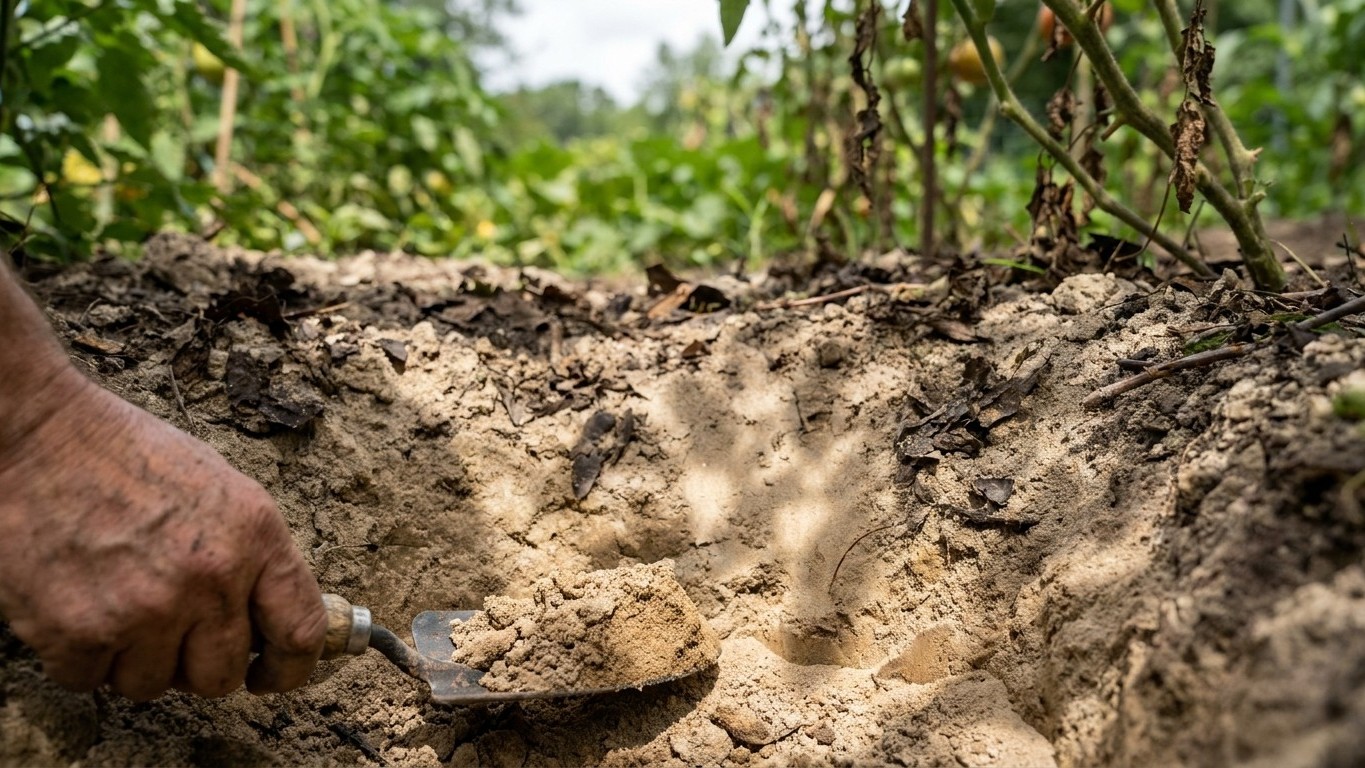

Connecticut’s official soil series is the Windsor series, a sandy, fast-draining ground that tells you almost nothing about what’s actually under your tomatoes unless you’ve checked. Here’s what the state series says, what it doesn’t say, and how to find out what you’re really working with.
What is under your garden

The soil USDA lists as representative of Connecticut is the Windsor series, an Entisol. That word matters: Entisols are young soils, barely developed, with almost no layered profile to speak of. They form fast, usually in loose sandy material left behind by glacial outwash, and they don’t hold onto much of anything for long.
The numbers from USDA’s Soil Survey Geographic Database, drawn from 188 mapped components of the series, are specific. Surface pH runs about 5.1, which is strongly acid. The texture is 82 percent sand, 2 percent clay, and 16 percent silt, about as sandy as cultivated ground gets in this part of the country. Organic matter is listed at roughly 95.0 percent, and drainage class is excessively drained.
That organic matter figure needs a pause before you take it at face value. A number that high doesn’t describe a garden bed with 95 percent decomposed leaves and roots mixed through mineral soil. It describes the mapped surface of certain Windsor series components where the top layer is a natural organic mat, forest litter or a peaty pocket, sitting over the sand. Nobody’s vegetable patch looks like that once it’s been turned, limed, and planted for a few seasons. Treat the pH and the sand percentage as useful signals for what this region’s ground tends to do. Treat the organic matter figure as a description of an undisturbed natural surface, not a promise about your raised bed.
None of this describes your yard, necessarily. A state the size of Connecticut holds hundreds of mapped soil series, from river-bottom silt loam to hardpan clay in the hill towns. And any lot a builder graded, filled, or scraped down to subsoil is playing by different rules entirely, no matter what county it’s in. The state series is a starting point for guessing what you might be dealing with, not a substitute for looking.
Read your own soil in five minutes
Two quick checks tell you more than any state average. First, the ribbon test: take a moist handful, work it between thumb and forefinger, and try to push out a ribbon. Sandy soil won’t ribbon at all, it just falls apart. Loam holds a short, crumbly ribbon. Heavy clay stretches into a long, slick ribbon that can run two inches or more before breaking.
Second, the jar test. Fill a clear jar a third full of soil, top it with water, shake hard, and let it sit overnight. Sand drops out within minutes and settles on the bottom. Silt follows over the next hour or two. Clay stays suspended longest and forms the top layer once it finally settles, sometimes leaving the water cloudy for a full day. The proportions you see in those bands are a rough version of the lab numbers above, done for free on your own kitchen counter.
Testing before you amend
Guessing at soil chemistry is how gardeners end up dumping lime on ground that didn’t need it, or watering in sulfur that never should have gone down. A soil test measures pH, nutrient levels, and sometimes organic matter directly. Your eyes and your ribbon test can’t do that. They tell you texture and drainage, not chemistry.
A representative sample takes a little more effort than most people put in. Pull eight to ten small cores from around the planting area, not just one scoop by the back step, and go down to the depth where roots actually feed, usually six to eight inches for vegetables and lawns. Mix those cores together in a clean bucket, remove stones and roots, and send in about a pint of the blended soil. One core from one spot can be wildly off from what the rest of the bed looks like, especially if there’s a buried patch of old fill or a spot where leaves have composted in place for years.
When results come back, the pH number is the headline, but look at the phosphorus, potassium, and organic matter lines too. Given that the state’s representative series runs strongly acid at 5.1, it’s reasonable to expect many Connecticut yards, especially those on sandy or glacial till ground, to test on the acid side as well. That’s an expectation, not a measurement. Plenty of yards built on old farmland that was limed for decades test close to neutral, and some sit on ledge-derived soil that swings alkaline. The only way to know which camp you’re in is the test itself.
Amending it
If your test comes back acid, in the range the state series suggests, below about 5.5, lime is the tool that actually works. Sulfur would be exactly backward here, pushing pH further down when the goal is to raise it. Acid soil below 5.5 locks up phosphorus so plants can’t take it up even when it’s present in the ground, and it makes life hard on brassicas like broccoli and cabbage, which are prone to clubroot in acid conditions. Lime is slow. It reacts with soil moisture over months, not days, so a fall application is working toward a spring pH change, not an overnight one. Expect to retest and reapply over two or three seasons before pH settles where you want it.
If a test comes back above roughly 7.3, alkaline, the instructions flip completely. Lime must never go on that ground, full stop, it would only make an already high pH worse. The honest fix is elemental sulfur, worked in and given time to convert through soil bacteria, paired with steady additions of organic matter, which naturally buffers pH downward as it breaks down. High pH also locks iron out of reach of plant roots, and that’s usually what’s behind yellow leaves with dark green veins on acid-loving plants like blueberries or rhododendrons growing in alkaline ground.
Texture asks for its own fix, separate from pH. Heavy clay, dense and slow to drain, improves with organic matter worked in over repeated seasons, compost, shredded leaves, aged manure. Adding sand to clay is a mistake gardeners keep making anyway; the two together can set up almost like concrete rather than loosening anything. Clay should also never be worked while wet, since that compacts it into clods that take a season to break back down. Sand, on the other end, close to what the state series shows at 82 percent, needs organic matter too, but for a different reason: it holds almost no water or nutrients on its own, so watering needs to be shorter and more frequent rather than one long soak a week.
| Condition | Right move | Wrong move | Timeline |
|---|---|---|---|
| pH below 5.5 | Lime, reapplied over seasons | Sulfur | 2-3 seasons |
| pH above 7.3 | Elemental sulfur, organic matter | Any lime | 2-3 seasons |
| Heavy clay | Organic matter, work when dry | Adding sand | 2-3 seasons |
| Sandy, fast-draining | Organic matter, frequent light watering | Deep, infrequent watering alone | 1 season |
Texture fixes on sandy ground show up fast, often within a single growing season, because organic matter starts holding water and nutrients as soon as it’s mixed in. Clay takes longer, closer to three seasons, since it depends on repeated additions breaking down the compacted structure bit by bit. pH correction sits in between, usually landing somewhere in that same two-to-three-season window no matter which direction you’re pushing it.
Drainage and compaction
The state series is listed as excessively drained, which in plain terms means water moves through it fast and doesn’t hang around long enough to feed roots between waterings. That’s a real pattern on the sandy, glacial-outwash ground common across parts of Connecticut. But plenty of yards sit on till or clay-influenced ground that does the opposite, staying soggy for days after a storm. Standing water in the garden 24 hours after rain is your first clue that drainage is a problem, not a soil texture guess.
A percolation test settles the question directly. Dig a hole about a foot deep and roughly the same across, fill it with water, and let it drain completely once to saturate the surrounding soil. Refill it a second time and time how fast the water level drops. A drop of one to three inches per hour is workable for most garden plants. Faster than that, and you’re looking at sandy, excessively drained ground that will need frequent watering and organic matter to hold moisture. Slower than half an inch an hour points to a compaction or clay problem that plain amendment won’t solve quickly.
Compaction is a separate issue from texture, and it shows up anywhere foot traffic or equipment has repeatedly pressed down on wet soil, driveways turned garden edge, spots where a mower or tiller crosses the same path season after season. Double digging used to be the standard fix, turning soil down two spade-depths to break up compacted layers, but it’s fallen out of favor because it destroys soil structure and beneficial fungal networks right along with the compaction, and the ground often settles back to where it started within a year or two.
On genuinely compacted or poorly draining ground, a raised bed is often the more honest answer than years of amendment. Building up six to twelve inches of good soil above a compacted base skips the fight entirely, and on some lots, particularly ones with heavy fill from construction, that’s simply the better bet over spending three seasons trying to rehabilitate soil that was never meant to grow anything.
Local help
The UConn Extension service runs soil testing for state residents through its soil lab, and it’s a low-cost way to get real numbers instead of guesses. Results come back with pH, nutrient levels, and organic matter, and county extension offices will walk through what the report means for your specific planting plans.
Common questions
Is all Connecticut soil sandy like the Windsor series?
No. Windsor is the series USDA lists as representative of the state, but Connecticut has hundreds of mapped soil types, including heavy clay till soils in the hill towns and richer silt loams in river valleys.
Why does my soil test differently from the state average?
Local geology, past land use, and any grading or fill during construction all change soil chemistry and texture far more than statewide averages suggest. A test of your own yard is the only reliable number.
How often should I retest after amending?
Once a year is reasonable while you’re actively correcting pH or texture, since lime and sulfur both take months to fully react and results shift gradually over two to three seasons.
Can I skip amendment and just build a raised bed instead?
Yes, and on compacted, poorly draining, or heavily filled lots it’s often the faster route, since it avoids years of working against soil structure that isn’t going to change quickly on its own.
Related guides
- New York Soil: What You Are Digging Into, and How to Improve It
- Massachusetts Soil: What You Are Digging Into, and How to Improve It
- Delaware Soil: What You Are Digging Into, and How to Improve It
- Wyoming Soil: What You Are Digging Into, and How to Improve It
- New Mexico Soil: What You Are Digging Into, and How to Improve It