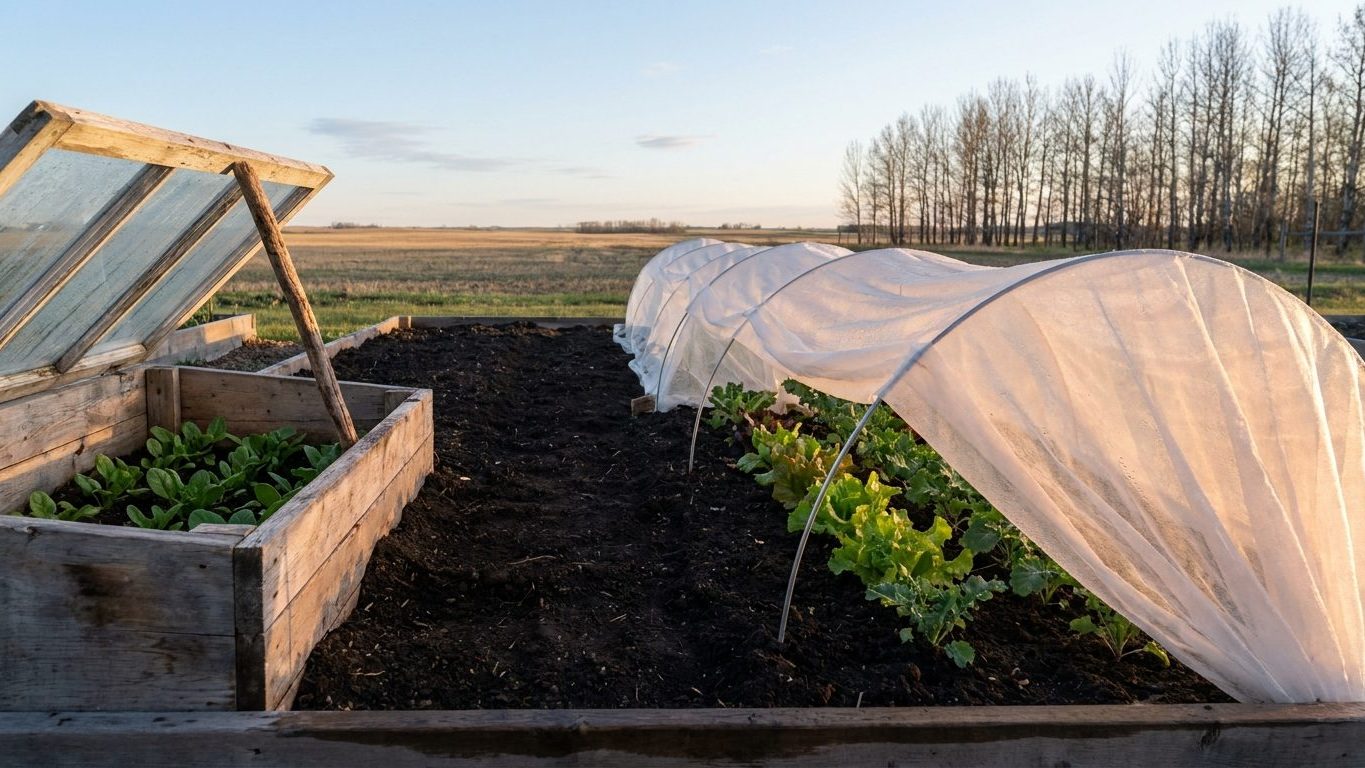

Floating row cover, low tunnels and cold frames are the season extenders that earn their keep in Connecticut. They push spring and fall out by a few weeks and carry hardy greens deeper into winter. Heated greenhouses and a single sheet of plastic in January are where money gets wasted. The right pick depends on something the state doesn’t offer evenly: whether your garden sits near Long Island Sound or up in the hills.
The short answer for Connecticut
Start with lightweight row cover on hoops, add a cold frame for seedlings and winter greens, and consider an unheated high tunnel only if you want to harvest through January. Those three match what Connecticut’s climate actually asks for. The wider strategy is laid out in Extending the Growing Season in Connecticut, and this page narrows it to the equipment.
Here is the mechanism behind that advice. At Bridgeport, the reference station for this page, the last spring frost falls April 2 to April 12 and the first fall frost October 28 to November 10. Those dates come from NOAA’s 1991-2020 Climate Normals and they are a probability of a 32°F freeze, not a calendar promise. They mark the band where the odds of a freeze run between 30 and 70 percent. Inside that band, a cold night is a coin flip. That is exactly the gap a few degrees of cover can close.
Winter is a different problem. The mean daily minimum of the coldest month at Bridgeport is 24.4°F. That is an average, so some nights run colder. Hardy greens can sit through nights like that under cover. Tomatoes and peppers cannot, which is why extenders here stretch the shoulder seasons for tender crops and the deep season for tough ones.
| Extender | What it does | Best Connecticut use | Main limit |
|---|---|---|---|
| Floating row cover | Adds a few degrees of frost protection, blocks wind | Spring transplants, fall lettuce and brassicas | Not enough alone for deep winter |
| Low tunnel on hoops | Holds more heat, lets you stack layers | Early spring beds, late fall harvests | Must be vented on sunny days |
| Cold frame | Sheltered, sun-facing box with a lid | Hardening off, winter spinach and mâche | Small footprint |
| Unheated high tunnel | Walk-in space that warms the air and soil | Winter greens, early tomatoes | Cost, snow load, ventilation work |
What will not work here
Planting tender crops outside on the Bridgeport frost date fails, even with protection. The April 2 to April 12 window describes freezes, not soil warmth. Tomatoes, peppers and squash sulk in cold ground, and a cover that keeps frost off the leaves does nothing for roots sitting in chilly soil. Wait for warmth first, then use the cover as insurance against a late cold snap.
A single layer of clear plastic in midwinter is the second failure. Connecticut sits at 41.16 degrees north (that’s Bridgeport’s latitude, so readers near the state’s edges should check their own). At that latitude, winter days get short enough that growth in most greens nearly stalls through the darkest weeks, commonly cited as the stretch when days fall under about 10 hours. Extra warmth can keep plants alive, but it cannot make light. Expect to harvest what you grew in fall, not to grow much new.
Humidity is the third trap. Connecticut’s damp, coastal-influenced air means a sealed tunnel on a sunny March morning turns into a steam room, and the condensation that follows invites gray mold and damping-off. Venting is not optional. Hoops that stay closed for a week because you were busy are worse than no hoops.
Snow is the fourth. New England winters bring wet, heavy snow, and flimsy wire hoops under a loaded sheet of plastic will fold flat. Sturdier conduit hoops, steeper profiles and a broom for knocking snow off matter more here than in milder states. A high tunnel built for light snow loads can fail the same way.
Last, heated structures rarely pay off for home growers. Getting a greenhouse through nights that average 24.4°F in the coldest month means real fuel bills for a few tomato plants. Passive methods, with layers of cover, do the work for a fraction of the cost. The timing side of that is covered in When to Cover Your Garden in Connecticut.
What changes across Connecticut
There is no single answer for the state. USDA’s 2023 Plant Hardiness Zone Map, built on average annual extreme minimum temperature, places Connecticut across zones 6a to 7b. That spread is a full four half-zones, and it plays out on the ground: the shoreline sits at the mild end, while the northwest hills run noticeably colder.
Every date above comes from a Long Island Sound coastal station, the mildest part of the state. Inland and northwest Connecticut freeze noticeably earlier in fall and later in spring. This page does not have dates for those areas, so treat the Bridgeport window as the most generous version of the season, not the average one.
What should a reader in the north or at elevation shift? Lean harder on the sturdier tools. Where spring frost lingers and fall frost arrives early, row cover alone buys fewer useful days, so a low tunnel or cold frame carries more of the load. Plan for deeper snow, too. Closer to the coast, a light row cover may be all you need to catch the odd frosty night in April or November.
Microclimate muddies it further. A south-facing slope against a stone wall in a cold town can behave like a milder zone, while a frost pocket at the bottom of a hill on the shore can behave like a colder one. To see where your area falls, look up your location on the USDA Plant Hardiness Zone Map rather than guessing from a neighbor’s experience.
Where to check this for your own county
Your state extension service is the next stop. UConn Extension is Connecticut’s land-grant extension, and it is where research meets local conditions. This page does not carry a Connecticut-specific planting calendar, so that is where to find one.
Look for two things there. First, the local planting calendar for the crop you want to grow, since calendars are usually written per crop rather than one-size-fits-all. A calendar for lettuce won’t match the one for tomatoes, and the right dates for each depend on which part of the state you garden in. Second, the varieties trialled near you. A variety that thrives through a Long Island Sound winter may stall in the northwest hills, and extension trials say which have been tested in conditions like yours.
Plainly put, a county recommendation beats a state one. This page is the state one: it relies on a single coastal station and a zone range that spans four half-steps. It’s a decent starting frame, but an extension educator who knows your county’s frost patterns and soil will outrank it. If the two disagree, go with them.
Checking this against your own garden
Your own observations outrank every date here. Three are worth watching, and none requires equipment.
- Soil warmth by feel. Push your hand a few inches into the bed in the morning. If it feels cold and clammy, tender seedlings will stall no matter what covers them. Beds that feel warm earlier than a neighbor’s tell you about drainage and sun exposure.
- The first male flowers on squash. Male blooms open before the females. Their arrival tells you the plants have settled into the site’s heat, and a bed that flowers a week ahead of another is your warmer microclimate.
- The first true leaves. Seedling leaves don’t count; the first set of true leaves means roots are established. Watch how quickly they show under cover versus uncovered, and you’ll see what your protection is really adding.
Write down the dates for a season or two. A notebook beats any state table, because it records your lot, not a station miles away.
Common questions
Is row cover enough for Connecticut winters?
Not by itself. With a coldest-month mean minimum of 24.4°F at Bridgeport, row cover alone suits spring and fall. For winter harvests of hardy greens, pair it with hoops or a cold frame.
Do the Bridgeport frost dates apply to my town?
Only if you garden near the shore. Bridgeport is the mildest part of the state, and inland and northwest Connecticut freeze earlier in fall and later in spring. Use the dates as a best-case window.
What does “April 2 to April 12” actually mean?
It is the band where NOAA’s 1991-2020 normals put the chance of a 32°F freeze between 30 and 70 percent. A freeze after April 12 is still possible, so watch the forecast.
Which hardiness zone is Connecticut in?
USDA’s 2023 map spans 6a to 7b across the state, so there is no single zone. Find your own location on the USDA map, since that map is based on average annual extreme minimum temperature, not on frost dates.