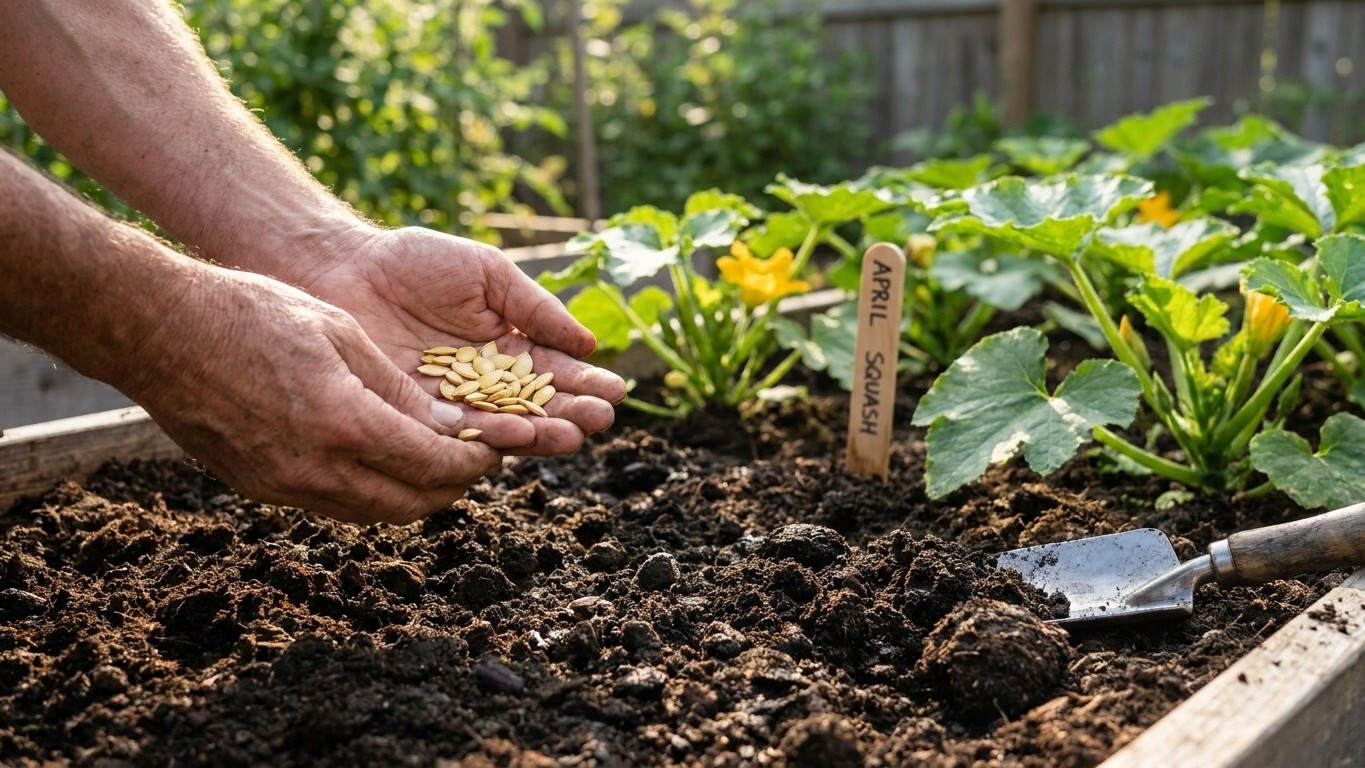

Summer squash goes into Connecticut soil once the frost risk has genuinely passed and the ground has warmed, which for most of the state lands in the second half of May. Coastal gardens near Long Island Sound can push a week earlier; inland and northwest corners should wait into early June.
The short answer for Connecticut
Start from the frost dates, not the calendar season. NOAA’s 1991-2020 Climate Normals put the last spring frost at Bridgeport between April 2 and April 12, and the first fall frost between October 28 and November 10. Those two windows describe a 30-70% probability band for a 32°F freeze at that one coastal station, not a guarantee. Read them as: by April 12, there’s a real but shrinking chance of frost; after that, the odds tip in your favor, though they never hit zero on any single date.
Summer squash won’t tolerate that residual risk well. The plant is frost-tender through and through, and its seeds barely germinate in cold soil regardless of air temperature. That’s why growers don’t direct-sow the day after the last frost date passes. They wait until the soil itself has shed its winter chill, which typically trails the air by two to three weeks. Applied to Bridgeport’s April 2-12 window, that pushes reliable outdoor sowing into the back half of April at the very earliest for the mildest coastal pockets, and more realistically into mid-May through early June for the rest of the state.
The fall side of the calendar is far less restrictive. Summer squash runs 45 to 60 days from seed to first harvest for most varieties, and even the latest-maturing types clear that hurdle with weeks to spare before the October 28-November 10 frost band arrives. A June 1 sowing date still leaves a full six to eight weeks of cushion before the earliest of those fall frost dates. In practice, the constraint on this crop in Connecticut is entirely a spring problem: getting the timing right on the front end, not racing the clock at the back end.
So the working answer is a range rather than a single date: outdoor sowing from mid-May near the coast to early June inland, governed by how far your specific spot sits from that Bridgeport reference point.
What will not work here
Planting right at the tail end of the frost date band, rather than well past it, is the most common misstep. April 12 marks the upper edge of the 30-70% probability window at the reference station, not a green light. Seeds sown into soil that’s still cold from a late April frost scare either rot before they sprout or sit dormant for weeks while weeds get a head start. Treating the frost date band as a starting gun, rather than a floor to build margin above, is a planting mistake specific to how these probability windows work, not a generic caution.
Assuming the Bridgeport dates apply statewide is the second failure mode, and it’s built into these very numbers. The NOAA station behind these frost dates sits on the Long Island Sound coast, the mildest part of Connecticut. Inland valleys and the northwest hills freeze later in spring and earlier in fall than that coastal record shows. A gardener in Litchfield County who plants by a Bridgeport-derived date is planting too early, full stop.
Heat and moisture stress mid-summer
Connecticut averages only 6.2 days a year at or above 90°F, so extreme heat isn’t the dominant threat here the way it is farther south. The bigger issue is the summer rainfall pattern layered on top of that heat. June brings about 3.77 inches of rain, July drops to the driest month at 3.32 inches, and August climbs back to 3.98 inches. That July dip, arriving right when squash plants are setting fruit heavily, is exactly when a once-a-week watering habit falls short. A single thunderstorm that dumps an inch of rain in twenty minutes mostly runs off rather than soaking into the root zone, so the monthly total can look adequate on paper while the plant still goes thirsty between storms.
Humidity works against tight spacing. Connecticut summers carry enough moisture, especially near the coast, that powdery mildew and other fungal issues move fast through squash plantings set too close together. Crowded plants trap moisture on their leaves overnight, and that’s the exact condition mildew needs to take hold before the first flowers even open.
What changes across Connecticut
Connecticut isn’t one growing zone, it’s a spread. The USDA Plant Hardiness Zone Map places the state across zone 6a to zone 7b, a range built entirely on average annual extreme minimum winter temperature. That’s a winter-survival measure, not a spring-planting guide on its own, but it’s a useful proxy for how much the state’s microclimates diverge: the mild end near the shoreline behaves quite differently from the colder inland hills and higher elevations.
A gardener working the zone 7b end of that range, generally the immediate coastline, can expect an earlier effective last frost and a longer stretch of warm soil days than someone gardening at the 6a end, typically the higher terrain in the northwest and along the state’s interior high ground. That gap isn’t cosmetic. It can shift a realistic sowing date by two to three weeks in either direction from the statewide midpoint described above.
There’s no single planting date that fairly represents all of Connecticut. If your yard sits inland, at elevation, or away from the moderating effect of the Sound, the safe move is to plant toward the later end of the stated window rather than the earlier one. Check the current USDA Plant Hardiness Zone Map for your specific address to see where you fall inside that 6a-7b spread. That map, not a guess based on which county you live in, is the right tool for placing yourself accurately.
Where to check this for your own county
This page describes Connecticut as a whole, anchored to one coastal reference station. Your county deserves better than a statewide average, and the resource for that is the UConn Extension service.
Two things are worth hunting for once you’re there. First, a local or regional planting calendar built from data closer to your own soil and elevation than the Bridgeport station cited throughout this page. UConn’s extension offices and research farms track frost patterns and growing degree days at multiple points across the state, and that granularity is exactly what smooths out the coastal-versus-inland gap discussed above. Second, look for summer squash varieties that UConn’s trial gardens or county educators have actually grown and evaluated in Connecticut conditions. Variety trial results, when available, tell you which cultivars handled the state’s humidity and mid-summer dry stretch well, something a national seed catalog description can’t tell you.
A county-level recommendation will always beat a state-level one, for the simple reason that it’s built on data closer to your own backyard. This page works from one coastal weather station’s 1991-2020 normals, useful as a baseline but blind to the specific hills, valleys and soil types scattered across Connecticut’s eight counties. Treat what’s written here as the wide frame, and treat whatever your local extension office publishes as the fine-tuned version worth following when the two disagree.
If you follow the almanac, here is when to plant zucchini by the moon. It is a tradition, not a proven method.
Checking this against your own garden
No frost date, however well sourced, knows your actual yard. Your own observations settle the question every calendar can only estimate.
Start with the soil itself. Reach a hand into the bed where you plan to sow. If it feels cold and clammy rather than cool and crumbly, the ground hasn’t caught up to the calendar yet, regardless of what date the frost probability band suggests. Squash seed sitting in soil that still feels raw to the touch typically stalls rather than germinates.
Next, watch the flowers once plants are up and growing. Summer squash produces male blooms first, often by the dozen, before a single female flower opens. That first flush of male flowers is a useful signal of accumulated warmth in your specific spot, but it isn’t yet a harvest signal. Wait for female flowers, easy to spot by the tiny swollen bulge behind the petals, before expecting any fruit to actually form.
Last, track how fast true leaves follow the seedling’s first round cotyledon leaves. A quick push to true leaves within a week or so suggests your microclimate is running warm and on schedule with the wider regional pattern. A sluggish stretch, where cotyledons sit alone for ten days or more, is your own garden telling you it runs cooler or shadier than the state average, and that next year’s sowing date should probably slide later rather than earlier.