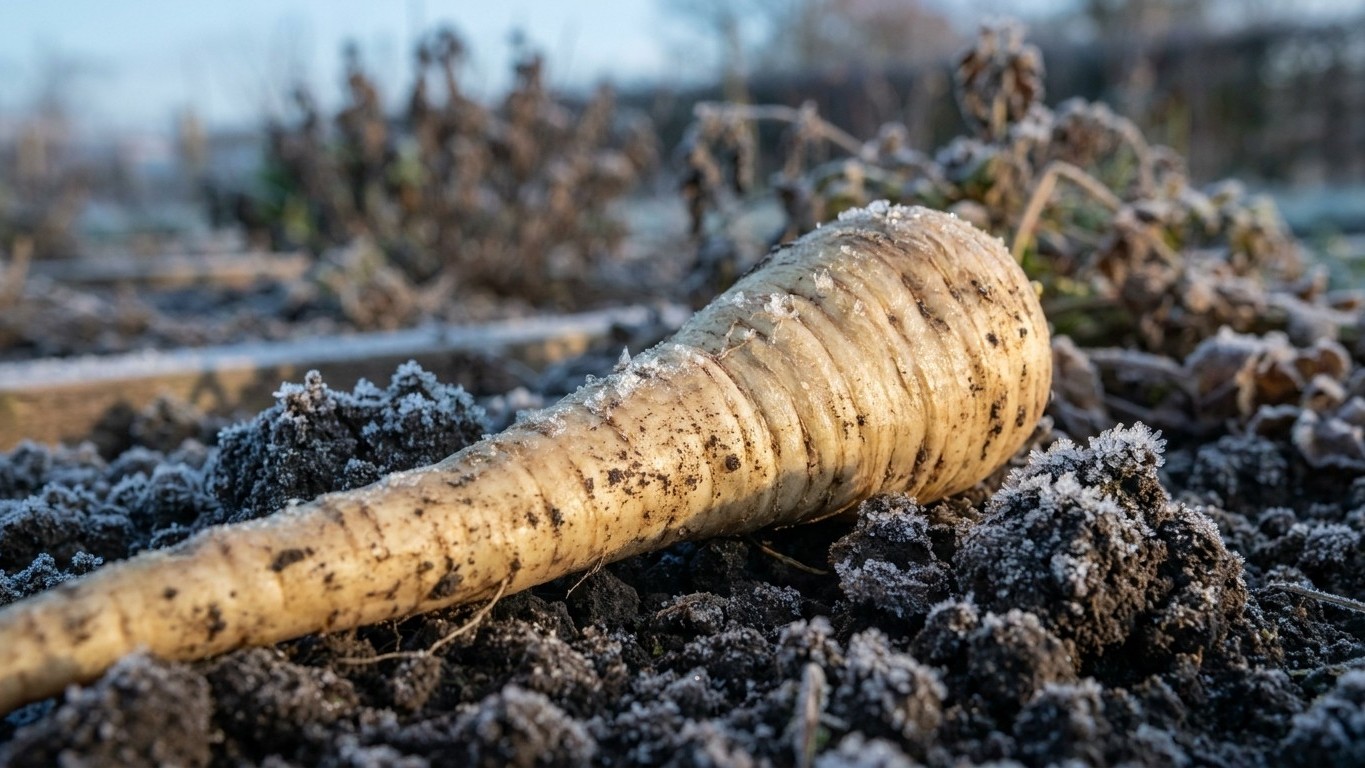

Lift parsnips when the roots are full size, 100 to 120 days after seeding. A late-winter sowing is ready in late spring or early summer, and those roots are sound but mild because no frost has touched them. For sweetness, sow later and let the roots sit through the coldest weeks of winter before lifting. Once out of the ground, parsnips keep four to six months under ideal cold storage, and far less in a typical kitchen.
The short answer
Does a Mississippi winter deliver several frosty weeks? Mostly no. The mean daily minimum of the coldest month at the Jackson reference station is 36.6°F, according to NOAA NCEI Climate Normals. That average night sits above freezing. Frost shows up on scattered nights instead of in an unbroken run, so a parsnip here gets far fewer cold days than one grown in the northern states.
That matters because parsnips taste best after several weeks of cool, frosty weather, which converts stored starch to sugar (Utah State University Extension). A parsnip grown in the Deep South will grow. Whether it sweetens depends on the winter. After a cold one you may get a properly sweet root. After a mild one you get a good, plain-tasting parsnip that never turned sweet. The odds lean toward the second outcome, and Will Parsnips Sweeten in Mississippi? covers how much sweetening to expect.
A comfortable hardiness zone says only that the plant survives the winter, and parsnips survive almost anything. Sweetening depends on how many nights actually reach freezing, and no zone number counts those for you.
When should you lift parsnips in Mississippi?
The clock runs from seeding, since parsnips are sown in place and never transplanted. A sowing made in the last weeks of winter reaches full size from late spring to early summer, and that is a fair time to lift if you want the roots out before the heat and the pests. If sweetness matters more, a later sowing that finishes in the cooler months can stay in the ground through the coldest stretch, roughly December through February, and come out after the frosts you actually got. The reference-city dates are only a guide, so ask your county extension office what your own garden sees. The full calendar sits in Growing Parsnips in Mississippi.
How long do parsnips keep after lifting?
USDA Agricultural Handbook 66 says parsnip roots can be stored 4 to 6 months at 32 to 34°F with 98% relative humidity (USDA Handbook 66). That is a long keeper by any standard, but it assumes temperature and humidity held steady, and almost no house does that. A refrigerator crisper runs warmer and drier, so expect less.
Cold is not the danger, because parsnips are not chilling sensitive. Ethylene is. A parsnip makes very little of it, yet low levels in cold storage turn the root bitter. Keep parsnips well away from apples, pears and any ripening fruit, even when the temperature is right. Top the leaves off after harvest, but do not trim into the crown.
Does the season fit?
It fits with room to spare. The reference station sees its last spring frost between March 6 and March 22 and its first fall frost between November 7 and November 22. Suburban and rural gardens usually see the last spring frost later and the first fall frost earlier, often by one to two weeks, and more at elevation. Treat the station dates as a reference for the Jackson area, then check your own county.
Does a late-winter sowing finish before the first fall frost?
- Find your last spring frost. At the station it falls from March 6 to March 22. A garden outside town should plan on one to two weeks later.
- Sow 2 to 3 weeks before that date, straight into the bed where the roots will grow. For the station dates, that means roughly mid-February to early March.
- Wait out germination, watching for the seedlings to emerge. Bare soil at the two-week mark is normal. Keep the seedbed moist and mark the row so you do not dig it up and re-sow.
- Count 100 to 120 days from the day you seeded, not from the day you saw sprouts. A mid-February to early March sowing puts mature roots from late May to early July.
- Compare that with the first fall frost in November. The roots are finished months ahead of it, so even a sowing that slips by several weeks still fits.
The season is not the tight part. Heat is. Roots finishing in early summer have no frost behind them, which is why the spring sowing produces a mild parsnip. Counting back 100 to 120 days from the November frost dates points to a sowing from about mid-July into mid-August. That is the hottest stretch for keeping a seedbed damp through three weeks of germination. It is the trade-off for a root that finishes into cold weather, and your county extension office can help you pick a date that suits your own ground.
What goes wrong here
Most parsnip failures in the Deep South come from the ground or the calendar. Parsnips want deep sandy soil, and heavy ground has to be loosened well below the surface before seed goes in. Each failure below has its own cause and its own remedy.
How do you fix each parsnip problem?
- Forked or stunted roots in heavy or stony ground. The tip hits clay or a stone and splits. Heavy soil must be double dug, loosened to two spade depths with stones removed, before sowing. A heavy clay bed is common across the region, so check yours by pushing a spade down after rain.
- Forked roots from overwatering. This is a separate cause and happens even in good soil. Keep the seedbed evenly moist until the seedlings are up, then water deeply and less often. Waterlogged ground after a wet spell encourages side roots, so raise the bed if yours holds water.
- Nothing coming up. Keep the row moist, mark it, and resist the urge to re-sow before the third week is over.
- A season that runs out. A late-winter sowing that slips into April or May may reach 100 to 120 days in the heat. Sow 2 to 3 weeks before your last frost. Roots left in the ground through summer also draw insects, and What Eats Parsnip in Mississippi, and When lays out the calendar.
- A winter too mild to sweeten. If few nights reach freezing, the starch never converts and the root stays plain. Leave a later sowing in the ground through the coldest weeks, test one root with the taste check, and treat a mild year as a good cooking parsnip.
- Bitter roots from the kitchen. Parsnips stored near apples or other ripening fruit pick up ethylene. Store them alone, topped but with the crown intact.
If you grow only one row, take care of the soil first. A well-loosened bed solves the most common problem before the first seed goes in.
Common questions
Can parsnips stay in the ground all winter in Mississippi?
Yes. Parsnips are not chilling sensitive, so ordinary Deep South winters do not harm them. Lift them before new top growth restarts in spring. Watch for rot after long wet spells.
How long do lifted parsnips keep at home?
Under ideal storage of 32 to 34°F at 98% humidity they keep four to six months. Home conditions rarely hold that, so use them sooner. Soft or rubbery roots have gone too long.
Why do my stored parsnips taste bitter?
The likely culprit is ethylene from nearby fruit. Apples and any ripening fruit give off enough to turn a parsnip bitter in cold storage, even at the right temperature. Keep parsnips in their own bag or bin.
Should I cut the crown off when I top parsnips?
Cut the leaves off, but do not trim into the crown. Top them after harvesting, but do not trim into the crown.