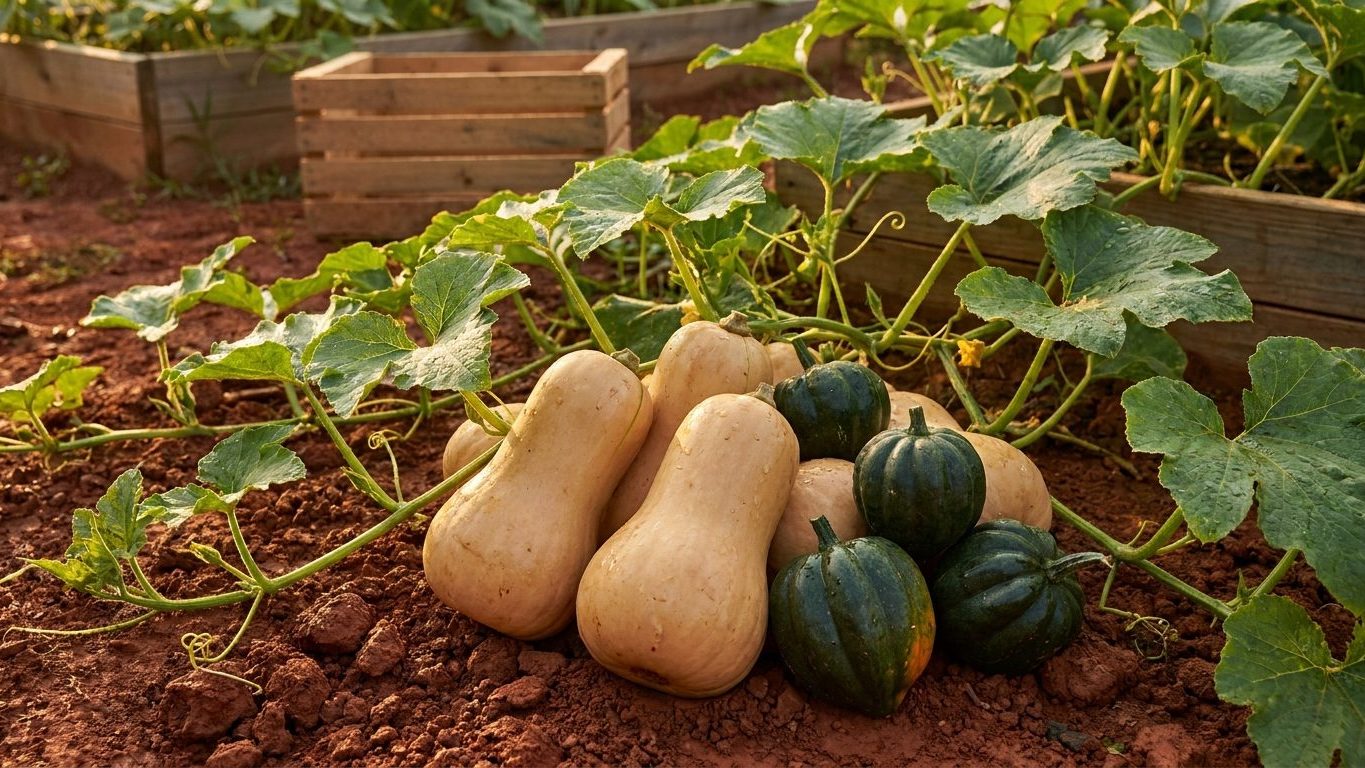

Connecticut’s frost-free window and modest summer heat point toward mid-season winter squash: butternut, acorn, delicata and buttercup all mature comfortably within the state’s growing season. The longest-season Hubbard types and squash bred for hotter climates are the ones that struggle, particularly away from the coast.
The short answer for Connecticut
Start with the frost dates, because they set the outer limits of everything else. At the reference station in Bridgeport, the last spring frost falls between April 2 and April 12, and the first fall frost arrives between October 28 and November 10. That gives a frost-free stretch of roughly six and a half to seven months at the coast, which is generous by New England standards. But Bridgeport sits on Long Island Sound, the mildest pocket of the state, so treat that window as the best-case scenario rather than the statewide default.
Within that frame, the winter squash that fit best are the ones needing 80 to 110 days from transplant to harvest: acorn (typically 80-85 days), delicata (around 100 days), and butternut (100-110 days). All three finish well before the earliest fall frost date even in a shorter inland season, which leaves margin for a cool, wet spring that delays transplanting.
Heat load matters just as much as season length, and this is where Connecticut’s numbers tell a specific story. The reference station averages only 6.2 days a year at 90F or hotter. That’s a mild summer by the standards of squash-growing regions farther south or west, and it means varieties bred to soak up long stretches of high heat units, the kind that push sugar development in some Southern-adapted squash, won’t get that heat here. Buttercup and kabocha types, which are bred for cooler summers and still deliver dense, sweet flesh, are a better match for Connecticut’s climate profile than heat-hungry Southern selections.
Larger Hubbard-type squash, often running 100 to 120 days or more, sit right at the edge of what the coastal window allows and can run short inland. They’re not off the table on a warm, well-drained coastal lot with an early transplant date, but they carry the least buffer of any type discussed here.
This page draws its answer from the frost dates and heat data for Connecticut as a whole. If a reader’s specific county has a documented planting calendar with local variety trial results, that source should take priority over this state-level answer.
What will not work here

The clearest failure point in Connecticut is season length stacked against the slowest winter squash. A giant Hubbard or a long-season heirloom pumpkin-type squash that needs 120 days or more is gambling against a fall frost that can arrive as early as October 28 at the mildest station in the state. Inland and northwest Connecticut, which run colder and see frost sooner in fall, leave even less room for that gamble. A transplant set out even a week late in a wet spring can push harvest past the point where an early frost catches the vines.
The second failure mode is subtler and easy to miss: heat-hungry varieties. With only 6.2 days a year above 90F, Connecticut simply doesn’t generate the sustained heat load that some squash varieties rely on to fully sweeten and cure. A variety selected in a hot-summer state may vine well here, set fruit, and still finish with flesh that’s watery or under-flavored because it never got the heat units it was bred to expect. This isn’t a disease or a pest problem, it’s a mismatch between the plant’s genetics and the local climate, and no amount of extra fertilizer fixes it.
Watering schedules built around a “dry summer” assumption also miss the mark here. Connecticut’s summer rainfall averages about 11.1 inches across June, July and August, with July as the driest month at 3.32 inches. That’s meaningfully wetter than a genuinely dry-summer climate, so a grower importing a once-a-week watering habit from a drier region risks overwatering during a normal Connecticut summer, which encourages root rot and fungal disease rather than preventing drought stress.
That same rainfall pattern, combined with summer humidity, is exactly what favors powdery mildew and vine diseases on winter squash. Tight spacing that might get away with itself in a drier climate becomes a liability here, because damp leaves that don’t dry off between rain events are a foothold for mildew. Squash planted too close together, or trained up structures with poor airflow at the base, are the plants most likely to show mildew by late summer, right when the fruit is trying to finish ripening.
What changes across Connecticut
Connecticut is not one growing season. The USDA Plant Hardiness Zone Map places the state across zones 6a to 7b, a spread built on average annual extreme minimum winter temperature, not on frost dates directly, but it’s a useful signal of how much the state’s climate varies from the coast inland. The warmer end of that range sits along Long Island Sound, near the Bridgeport reference station used for the frost dates above. The colder end runs through the northwest hills and higher inland terrain.
That spread means there’s no single frost-free window that applies to the whole state. A coastal garden working with Bridgeport’s April 2-12 last frost and October 28-November 10 first frost has real breathing room for a 100-day butternut. A garden in the colder inland or northwest zones should assume a later last frost in spring and an earlier first frost in fall, which compresses the season on both ends. For those gardens, leaning toward the shorter end of maturity ranges, acorn and delicata over butternut, and butternut over Hubbard types, is the more reliable strategy.
Elevation adds another layer inland, since higher ground tends to run colder at night and can see frost settle in valleys before it reaches surrounding slopes. A garden in a low-lying inland spot may see frost before a garden on a nearby hillside, even at similar latitude. None of this changes the heat-load picture much, Connecticut’s summers stay mild statewide, but it does mean the safety margin for the slowest-maturing squash narrows the farther a garden sits from the coast.
This page can’t tell an individual reader which zone their own property falls into. The USDA hardiness zone map is searchable by ZIP code, and it’s the right tool for narrowing that down before picking a variety close to the edge of what the season allows.
Where to check this for your own county
The state-level answer above is a starting point, not a substitute for local data. UConn’s Cooperative Extension system publishes planting calendars and variety trial results specific to Connecticut growing conditions, and it’s the right next stop for anyone trying to narrow this down past a state average.
Two things are worth looking for specifically once there. First, a local planting calendar, if the county or region has one, will reflect actual frost data and growing degree days recorded closer to the reader’s own garden rather than the Bridgeport coastal station used throughout this page. Second, look for variety trial results or recommended cultivar lists, since UConn extension programs periodically test winter squash varieties under Connecticut conditions and report which ones perform reliably against local disease pressure and season length, information no state-level overview page can replicate.
A county-specific recommendation, when one exists, should always outrank the general guidance given here. This page works from statewide climate normals, useful for framing the decision but blunt by design. An extension agent or a county-level trial report is working from soil, disease pressure and microclimate data specific to a much smaller area, and that specificity is exactly what separates a squash that merely survives from one that finishes strong before the first frost.
If no county-specific calendar exists yet, the extension office itself is still the right contact. Local agents often have unpublished observations from years of fielding questions from gardeners in that exact area, and a phone call or email can surface details that never make it into a formal document.
Checking this against your own garden
No frost date on this page beats what’s actually happening in the soil. Before setting out winter squash transplants or direct-sowing seed, feel the soil at planting depth with a bare hand in the early morning. Squash seed germinates poorly in cold soil, and a soil that still feels cool and damp rather than warm to the touch is telling the gardener to wait, regardless of what the calendar says the average last frost date should be.
Once vines are established, watch for the first flush of male flowers, the ones on long thin stems without a swelling at the base. They typically show up before the female flowers that will actually set fruit, and their timing is a rough signal of how far along the plant is relative to a typical season. A patch that’s slow to flower compared to a neighbor’s garden a few miles away is a hint that the local microclimate, shade, wind exposure, or a low spot that holds cold air, is running behind the regional average.
The appearance of the first true leaves, the ones that look like the plant’s mature squash leaves rather than the rounded seed leaves that emerge first, marks the point where the plant has moved past its most fragile stage. A garden where true leaves appear noticeably later than expected for the variety’s stated timeline is running cooler than the regional average, which is useful information heading into fall: it means the harvest window may close earlier than the frost dates above would suggest, and it’s worth watching the extended forecast a little more closely as October approaches.