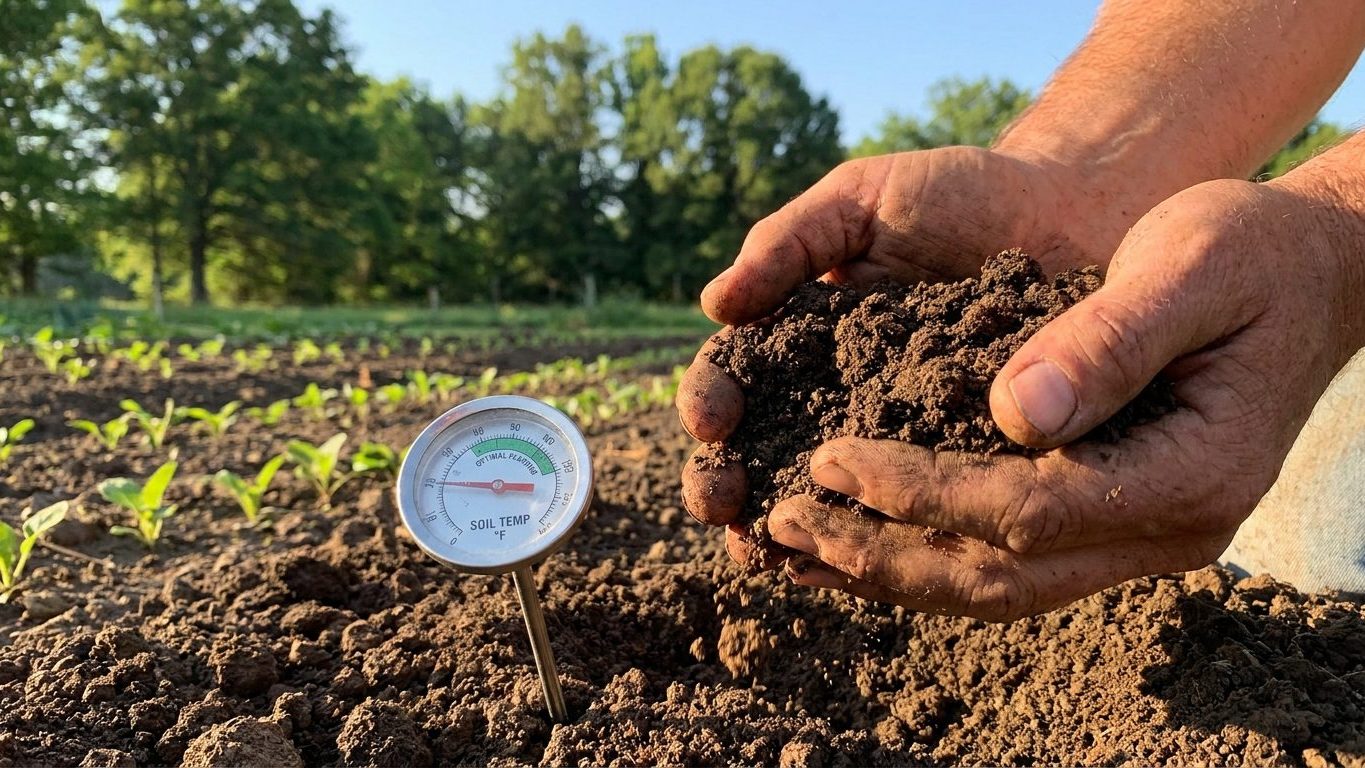

Connecticut gardeners can set out winter squash transplants or direct-sow seed once soil temperatures hold reliably above 60F, which in most of the state lines up with mid-to-late May. The safer marker isn’t the calendar, though. It’s what’s happening underground, and that’s a different question from when the frost risk passes.
When the soil is warm enough in Connecticut

The last spring frost at the Bridgeport reference station (USW00094702) falls between April 2 and April 12, according to NOAA’s 1991-2020 Climate Normals, based on the 30-70% probability band for a 32F freeze. That’s a coastal reading, and it’s the mildest one you’ll find in the state. Inland spots and the northwest corner freeze later in spring and earlier in fall, sometimes by two or three weeks, so anyone gardening away from the shoreline should treat that early-April date as optimistic.
Here’s the part that trips people up: that frost date is a probability, not a promise, and it’s also not the signal winter squash actually needs. Squash seeds rot in cold, wet soil, and transplants sulk or stall when the ground stays chilly even after the air has warmed. The frost date tells you when freezing becomes unlikely. It doesn’t tell you when the soil, several inches down, has warmed enough for squash roots to get moving.
In practice, that gap between “frost risk gone” and “soil actually warm” runs several weeks in Connecticut. A garden bed can look perfectly fine in late April and still be too cold for squash to thrive. Waiting until the soil itself reads warm, not just waiting out the calendar, is what separates a strong stand from a patchy one.
Reading your own ground
A simple soil thermometer pushed a few inches into the bed removes the guesswork. Beyond that, raised beds and black plastic mulch both speed up warming, which matters more in Connecticut’s inland and upland gardens than it does along the coast. If you’re gardening in one of those cooler inland pockets, lean toward transplants rather than direct seeding, since transplants give the crop a head start the soil itself isn’t providing yet.
For variety choice, this is where local trial data actually matters more than a generic planting calendar. UConn Extension (extension.uconn.edu) tracks which types perform reliably across the state’s different microclimates, and that’s a better source than guessing from a seed packet written for a national audience.
How long the season lasts here
Subtract the two frost windows and you get the shape of the Connecticut growing season: spring frost risk clears sometime between April 2 and April 12, and fall frost risk arrives between October 28 and November 10, both from the same Bridgeport normals. That’s roughly six and a half to seven months of frost-free window at the coast, narrower inland. Winter squash needs most of that time, because it isn’t a crop you can rush at the end. The fruit has to mature and start curing on the vine before a hard freeze, and there’s no fixing an immature squash after the fact.
What that length allows is the real question. A season stretching from early April into early November gives Connecticut gardeners enough room, in most years, for a single planting to mature fully, sometimes with margin for a second, later-maturing sowing if the first planting fails or if you want to stagger harvest. It is not, generally, a season built around two full plantings of the same slow-maturing squash type the way a longer southern season might be. The margin exists, but it’s not generous, especially for anyone gardening inland where both ends of the frost window shift against you.
That margin question is exactly why succession sowing decisions matter here more than in warmer territories. If you’re weighing a second planting or trying to figure out how to stagger harvest without running out of season, the succession sowing guide on this site walks through how to make that call territory by territory.
Transplanting versus direct seeding also comes down to this window. Where the frost-free stretch is shorter, inland especially, starting seed indoors and setting out strong transplants buys back two or three weeks that direct seeding would spend just germinating. Where the season runs closer to the coastal end of the range, direct seeding is less risky, since squash generally resents root disturbance and grows just as well, or better, without ever seeing a nursery pot.
Heat and water in Connecticut

This is the section where a lot of generic squash advice falls apart for Connecticut, because the state simply doesn’t get the heat load that drives most of that advice. The Bridgeport reference station logs a mean of just 6.2 days a year at or above 90F. That’s a modest heat count, nowhere near the stretches of 90-degree days that push irrigation to the top of the priority list in warmer territories.
Summer rainfall tells a similar story. Connecticut sees about 11.1 inches of rain across June, July and August combined, broken down as 3.77 inches in June, 3.32 in July (the driest of the three), and 3.98 in August. That’s a reasonably wet summer by national standards, and it changes the whole risk profile for winter squash here.
Where a hot, dry territory has to worry about squash stalling from water stress during fruit fill, Connecticut’s risk runs the other direction. Low heat load combined with regular summer rain means the bigger threats are fungal: powdery mildew on the leaves, slower fruit ripening in cool, damp stretches, and vines that stay wet longer after rain because there simply isn’t enough heat to dry them out fast. This is not a territory where irrigation is the main lever. It’s one where airflow, spacing, and morning watering (so foliage dries before evening) do more work than any hose ever will.
What that means for the actual garden
Spacing plants wider than a seed packet might suggest, choosing a planting site with good air movement, and avoiding overhead watering late in the day are the practical responses to Connecticut’s cool, damp summer pattern. None of that requires naming a specific fungicide or a spray schedule. The practice, disease-resistant siting and airflow, matters more than any product applied after the fact. Rainfall figures like these are normals for one reference station over three decades, not a forecast for any single yard; a rain gauge on your own plot, especially if you’re gardening on heavy clay that holds water longer than the sandy loam common near the coast, is what actually settles whether you need to water at all in a given week.
Which winter squash suit Connecticut
Given a season that runs roughly six and a half months at the coast and less inland, a modest heat load, and summer rain that keeps foliage damp more often than dry, three things should drive variety choice here: maturity speed, disease resistance, and airflow-friendly growth habit. Earlier-maturing types give more margin against an early inland frost. Types bred or trialled for resistance to powdery mildew matter more in Connecticut than they would in a hotter, drier state, because the humidity here gives mildew exactly the conditions it needs. And a growth habit that doesn’t sprawl into a dense, wet mat helps foliage dry out between rain events, which cuts disease pressure without any spray at all.
What this page won’t do is name a specific cultivar. That’s not caution for its own sake, it’s the honest answer. Seed catalogs are written for a national audience, and a variety that thrives in a hot, dry climate can underperform badly in Connecticut’s cooler, damper summers, or ripen too late for an inland frost. The varieties actually trialled and recommended for Connecticut conditions, tested against this state’s specific frost windows, heat load, and disease pressure, are tracked by UConn Extension, and that’s the resource worth checking before buying seed: extension.uconn.edu.
Extension trial data changes from year to year as new varieties get tested and regional performance data accumulates. A generic list here would go stale, or worse, steer a gardener toward a type that fails in exactly the conditions this page has just described. Reasoning by type, earlier-maturing, mildew-resistant, airflow-friendly, gives you the criteria. Matching those criteria to an actual variety is a decision best made with current, local trial data in hand.