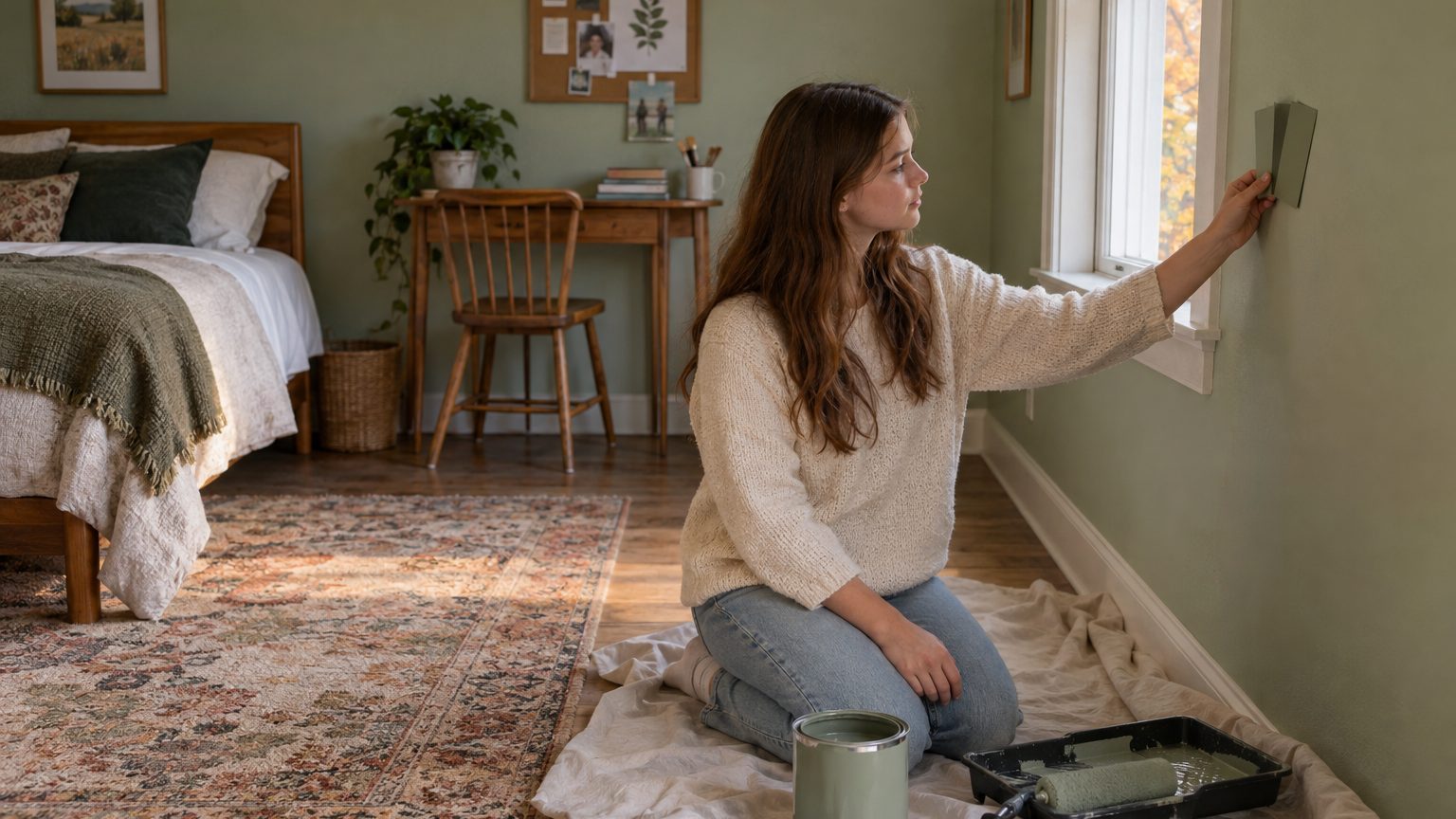

Let her choose the color family, and keep four decisions for yourself: the undertone that works with the room’s light, the paint finish, the prep work, and a plan for repainting. That split settles most arguments. Teenage girl bedroom colors that last tend to be muted mid-tones (sage, dusty blue, clay, soft lavender) or deep shades used on part of the room. Neon and very saturated hues usually get tiring within a year or two.
Paint is cheap compared with most things in a teenager’s life. A gallon covers roughly 350 to 400 square feet, and a 12-by-12 bedroom with 8-foot ceilings has about 340 square feet of wall once you subtract a door and a window. One gallon, maybe two coats’ worth, is the whole bill. The expensive part is the time and the standoff if you handle the decision badly.
Start With the Light, Not the Color Chip
A paint chip under store fluorescents tells you almost nothing about how it will look at 9 p.m. in a bedroom with one window. The same color can read as a calm gray-green on a south-facing wall and as a cold, flat gray on a north-facing one. North light is cooler and dimmer, so it pulls blues and grays toward a chilly look. South light is warm and strong, so it can make a soft yellow-leaning color look louder than the chip suggested. East rooms are bright and warm in the morning, then turn neutral. West rooms look dull until late afternoon, then glow orange.
Check the Light Reflectance Value, or LRV, printed on the back of most chips. It runs from 0 (absorbs all light) to 100 (reflects all of it). Colors under about 20 will make a small or north-facing room feel like a cave, which some teens want and some regret. Colors in the 50 to 70 range hold their color without swallowing the room. Whites and very pale tints sit above 80.
Test properly. Paint two-foot squares on at least two walls, or use large sample boards that you can move around, and live with them for three days. Look at them in the morning, in the afternoon, and at night under her actual lamps. Teens use their rooms mostly in the evening, doing homework, scrolling, filming videos, so the artificial-light version of the color matters more than the noon version. Bulbs labeled 2700K to 3000K give a warm glow, while 4000K and up pushes everything bluer. If she uses a ring light for video, check the color under that too, since it can wash out pale pinks and yellows.
One more habit to build in: let her paint the test patches herself. People hold stronger opinions about colors they have chosen, and a fifteen-year-old who has watched a swatch go from “obsessed” to “meh” over three days will often talk herself out of the first impulse without a word from you.
Colors That Tend to Hold Up, and the Ones That Fight Back
Research on color and mood is messier than the paint aisle suggests. Studies are mixed, and effects tend to be small and heavily shaped by personal association. A teenager who loves purple because it reminds her of a favorite band will feel better in a purple room than one who was told purple is calming. So treat the usual lists (“blue for sleep, yellow for energy”) as a starting point, not a prescription.
With that caveat, certain families keep showing up in rooms where the owner has not tired of the color after a couple of years:
- Sage and muted greens. They read as neutral in most light and pair easily with wood furniture, white bedding and plants. Pick grayed versions; bright mint can turn sugary.
- Dusty blue and blue-gray. Good in south and west rooms. In a north room, choose one with a touch of green or warmth so it doesn’t turn icy.
- Clay, terracotta and warm blush. These work in dim rooms because they add warmth. A blush with a gray or brown undertone ages better than bubblegum pink.
- Soft lavender and lilac-gray. Popular with teens and forgiving, as long as the gray is in there. Pure violet-leaning lavender can look childish or harsh depending on light.
- Deep navy, plum or forest green. Striking, and they photograph well, but they need good light or a smaller footprint (more on that below).
The colors that fight back are usually the most saturated ones. Hot pink, electric teal and lime look great for one weekend and are loud for 300 square feet of wall. They also bounce color onto skin and bedding, which is not what anyone wants at 7 a.m. on a school day. If she is drawn to a bright color, push it toward an accent: one wall behind the bed, the inside of a closet, a dresser, or a door.
Dark walls deserve a separate conversation, because the request comes up often and the answer depends on the room. The reasoning in A Teenage Boy’s Room, Including the Black Wall Question applies here too: a dark color works when there is a window, decent lamps and a plan for the ceiling, and it struggles in a small north-facing room with one overhead fixture. A deep green or navy gets you the cozy, dramatic effect with fewer downsides than true black, since dark colors with a visible hue look richer and show fewer roller marks and scuffs.
Undertone is where most paint mistakes happen. Hold the chip next to the flooring, the bedspread she already owns, and the trim. A pink with a yellow undertone beside cool gray carpet looks muddy. A blue-gray beside honey-colored wood looks fine. If the existing furniture or floor is staying, the undertone of the paint should agree with it, and that is a reasonable place for you to exercise a veto.
How to Handle the Negotiation Without a Fight
Handing a teenager a blank check on color rarely ends well, and neither does vetoing everything. A bounded choice works better. Before she starts browsing, narrow the field by light and budget, then let her pick from the survivors. Something like: “Any color from these four families, any shade, as long as it passes the three-day sample test.” She gets real authority, you get rooms that don’t need repainting by spring.
Decide in advance which decisions are hers and which are yours:
- Hers: the main color, the accent color, whether to go bold on one wall.
- Yours: the sheen, the prep, the primer, and the ceiling and trim colors if the rest of the house is affected.
Sheen deserves attention because teenage rooms take a beating from tape, posters, string lights, shoes against the wall and the occasional spilled drink. Flat paint hides wall flaws but marks easily and doesn’t wipe clean. Eggshell or satin is a better fit for most bedrooms, since it can handle a damp cloth without showing every scuff. Shinier paint highlights every dent and patch in the drywall, so skip it for walls. A short note on adhesives: strips and poster putty can pull paint off with them, especially if the previous coat was applied over dust or glossy old paint, so washing walls and sanding any gloss before painting matters more than it seems.
Dark-to-light and light-to-dark changes carry hidden costs. Covering a deep color with a pale one often takes a coat of primer plus two coats of paint, and the reverse needs primer too, ideally tinted gray for navy or charcoal. Budget a gallon of primer and an extra weekend. Planning for that now keeps “we can always repaint” from turning into an unpleasant surprise in three years. The same goes for texture: if the walls have been painted many times, a bold color will highlight roller texture and patch marks more than a light one.
Splitting the Work
Painting together is a decent bargaining chip. A teen who rolls the walls herself learns to cut a line, handle a drop cloth and fix a drip, and she is much less likely to ask for a redo of a color she put up with her own hands. Younger teens can roll the main wall while you cut in the edges and corners. Keep the painter’s tape sharp: remove it while the final coat is still slightly tacky, pulling slowly at a 45-degree angle, and the lines come out clean.
Choose the ceiling with some care. White ceilings bounce light and keep a colored room from closing in. Painting the ceiling the same color as the walls in a pale tint can look soft and wrapped, but it is a harder look to carry off with a saturated color. If she wants drama, put it on the walls and leave the ceiling alone.
When the Walls Aren’t Yours to Paint, or Her Taste Moves On
Renters and parents of fast-changing teens face the same problem: the color needs to be easy to undo. The practical options, and what lease rules typically allow, are laid out in Renting: What You Can Actually Change. In short, a large share of a room’s color comes from things that are not wall paint at all. Bedding, a rug, curtains, a headboard, a lamp shade and a bulletin board each carry a lot of visual weight, and they can follow her to college.
Removable wallpaper and peel-and-stick tiles can cover a feature wall without a lease dispute, and they come off cleanly on smooth, well-adhered painted walls. They are less forgiving on textured walls or on cheap flat paint, where they may lift the finish. Test a small piece in a closet and leave it for a week before committing the whole wall.
For owners, the smart structure is a quiet base with the bold choices layered on top. A soft neutral or pale tint on three walls and her chosen color on one, or a bold color on the lower half with a pale upper wall, keeps the repaint to a single wall when she turns seventeen and wants something completely different. If she wants the whole room in a strong shade, accept that and plan for a primer coat when it is time to change.
Teens’ tastes shift faster than paint wears out. Interior paint on bedroom walls generally lasts 5 to 10 years before it looks tired, and the average teenager’s favorite color will not hold for that long. That mismatch is the reason to keep the decision small, cheap and reversible.
Last, a small habit that saves money: when the job is done, write the brand, color name, sheen and purchase date on the lid and on a piece of tape inside the closet door. Sealed and stored somewhere that doesn’t freeze, leftover latex paint often stays usable for years, so the quart you keep can fix the scuffs and thumbtack holes she leaves behind, or match the wall after the next round of posters comes down. For more room-by-room guidance, the Decor section covers the rest of the house.