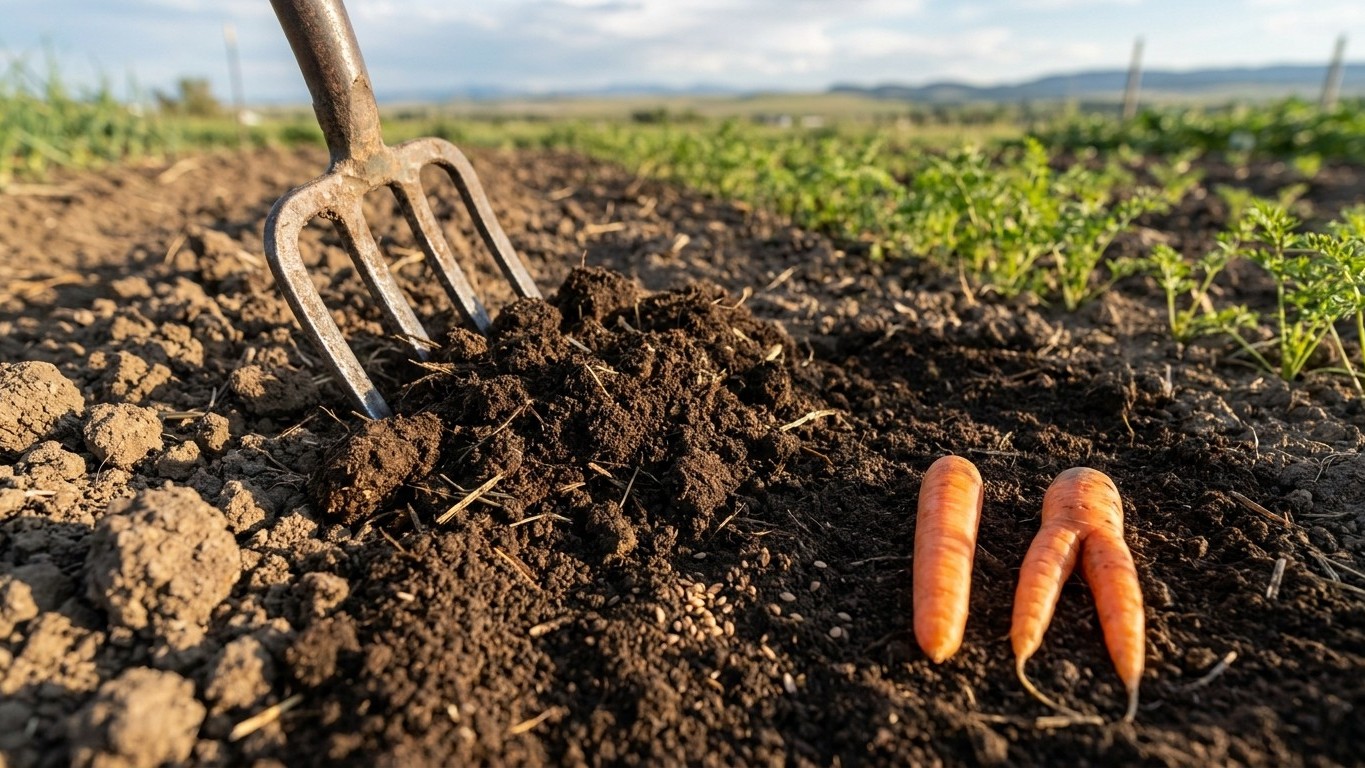

Carrots don’t ripen on a fixed date, they ripen on a signal: the shoulder of the root pushing up through the soil, full-colored and thick, while the leafy top starts to sag rather than stand bright green. Counted from the day seed went into the ground, since carrots are never transplanted, that signal in Delaware usually shows up somewhere between 65 and 100 days. Pull too soon and the flavor is thin. Wait too long in this state’s heavier ground and the root can split.
When carrots are ready in Delaware
Carrots don’t announce themselves the way a ripening tomato does, so the calendar only gets you close. What actually tells you the root is finished is the shoulder, the top half-inch or so of the carrot, showing above the soil line with full color and a diameter close to what the seed packet described. Once that shows, and the feathery tops start to look tired instead of upright and glossy, the root has mostly stopped developing sugar.
Because carrots go straight into the ground and are never moved as seedlings, the only date worth counting from is the day seed was sown. Clemson Cooperative Extension puts harvest at about 65 to 75 days after planting. Utah State University Extension gives a broader window of 70 to 100 days, since variety and growing conditions both stretch or shrink that figure. Treat 65 to 100 days from seeding as the working range for Delaware gardens, and start pulling a test root well before the top end of it rather than waiting for a specific week.
Soil plays a bigger role in that timing than most gardeners expect. Delaware’s official state soil, the Greenwich series, runs 48 percent sand, 9 percent clay and 43 percent silt, slightly acid at a surface pH near 6.0, and well drained. That’s a workable medium for a root crop, but it describes a mapped state average, not any one backyard. Utah State University Extension is direct about what happens once a plot runs heavier or rockier than that: the root forks instead of growing straight, and the fix is deep compost or a raised bed, not a different carrot variety. A soil test done before spring seeding is the quickest way to know whether your own ground behaves like that state average or nothing like it.
Because the window runs wide, many Delaware gardeners split it into two sowings, one timed to spring soil warming up and a second in mid-summer aimed at a fall harvest, when cooler nights tend to sweeten the roots further. No frost-date figures are published for this page, so exact spring and fall sowing dates aren’t given here. What’s certain is that whichever week seed goes in, the countdown to those 65 to 100 days starts then, and nowhere else.
Keeping them, and for how long
Pulling a carrot at the right moment only pays off if it survives the weeks after. Clemson Cooperative Extension is specific: store carrots at 33°F and high humidity, and cut the leafy tops off before storage. Left attached, the tops keep drawing moisture out of the root long after harvest, which is why bunched carrots, tops still on, hold for only about 10 to 14 days, while trimmed roots kept the right way last well beyond that.
That 33°F figure is worth writing down because it sits just above freezing, not at the merely cool range a lot of people picture when they hear “cold storage.” A carrot held at 50°F, easy to reach in an unheated porch during a mild Delaware fall, will soften and sprout in a fraction of the time a properly cold, humid spot allows. Clemson’s numbers describe a ceiling under close-to-ideal conditions, not a promise: a warm afternoon, a container that dries out, or roots bruised at harvest will shorten that window no matter what the thermometer says.
Humidity gets less attention than temperature, but it matters just as much. Carrots kept cold and dry turn rubbery fast, since dry air pulls moisture out of the root the same way an untrimmed top does. Packing trimmed carrots in slightly damp sand, or a perforated bag in the coldest part of a refrigerator, keeps humidity high enough that the roots stay firm for the 10 to 14 days Clemson attributes to bunched storage, and longer once tops are off and the temperature holds near that 33°F mark.
Handling before storage matters too. Carrots nicked at harvest, or left piled in the sun while the rest of the row gets pulled, bruise and rot faster once they’re in a cold, humid space, because broken skin gives decay organisms an easy way in. Brushing garden soil off rather than scrubbing the roots, and setting aside any carrot with a split or a fork for the kitchen that week instead of the storage bin, keeps one bad root from souring a whole batch.
Where in the house that actually is
A refrigerator crisper drawer usually reads somewhere between 34°F and 40°F, close to the cold edge of Clemson’s 33°F target, and close enough to work for most Delaware households without a root cellar. A heated living space sits nowhere near that range: even a cool interior room during a Delaware heating season runs 65°F to 70°F, warm enough to soften a carrot and start it sprouting within days.
An unheated garage or detached shed is the tricky middle ground. It tracks outdoor temperature closely, and in this state that means summer humidity swinging into winter nights that dip well below freezing without staying there. A garage can move from carrot-friendly to a hard freeze and back within the same week, and a hard freeze turns the water inside a stored carrot to ice, which ruptures cell walls and leaves the root mushy once it thaws. The closest match to Clemson’s 33°F and high humidity in most Delaware homes is the back of the refrigerator, in a perforated bag or a container of damp sand, away from the door where temperature swings every time it opens.
A basement, where a Delaware home has one, is usually too warm for the same reason a heated room is, since a finished or semi-finished basement in this region tends to sit in the 60s year-round. An unfinished, unheated corner near a foundation wall runs cooler and can work if it stays reliably above freezing, but the same rule applies before trusting it. An appliance thermometer left in the storage spot for a full day, checked morning and night, costs a few dollars against losing an entire winter’s harvest to a corner that runs warmer than the dial suggests.
What goes wrong here
Delaware’s climate creates a specific set of failures, and most trace back to moisture. The Greenwich series that represents the state’s soil is well drained, but plenty of home gardens sit on heavier, wetter ground, and a damp autumn on top of dense soil is exactly the combination Utah State University Extension warns about: it forks roots pushing against compacted, waterlogged clay, and it invites rot on carrots left in the ground past their window while a gardener waits for drier weather to harvest.
Storage rot is the second common failure, and it usually starts with tops left on, or a garage that swung above freezing and back a few times in a week. Damp fall weather makes it tempting to skip letting roots air-dry for an hour in a shaded, ventilated spot before brushing off soil and trimming tops, but that step cuts down on the surface moisture rot organisms need to get started, and skipping it can spread soft rot from one carrot to its neighbors in the same bin.
The last failure has nothing to do with weather and everything to do with arithmetic: a home row sized for a family can produce more carrots in one 65-to-100-day window than anyone eats fresh, and without a cold, humid spot to hold the surplus, part of the harvest ends up in the compost instead of the kitchen. Staggering seeding so the whole row doesn’t mature the same week keeps the storage space from being asked to chill more than it can handle at once.
Common questions
Can carrots stay in the ground over a Delaware winter instead of being stored indoors?
The figures collected here cover storage after harvest, not roots left buried through winter, and no published duration for that practice is given on this page. Heavier, wetter soil and freeze-thaw cycles both raise the risk of rot on anything left in the ground once cold weather sets in.
Does the variety change the 65 to 100 day window?
Yes. Utah State University Extension’s wider range exists partly because different varieties mature at different rates, alongside soil and weather. A seed packet’s own days-to-maturity figure, checked against how the season actually behaved, narrows that range for a specific planting.
Should carrots be washed before they go into storage?
Brush off loose soil rather than scrubbing or rinsing. Extra surface moisture before cold storage encourages the rot problems described above; washing right before cooking is a safer time for it.
What’s the quickest way to check whether soil is right for carrots?
A soil test, done before spring seeding, is the tool Utah State University Extension points to. It tells a gardener whether their ground is closer to the well-drained loam the state’s Greenwich series represents, or heavier and rockier, which changes whether compost and a raised bed are needed before carrots go in.