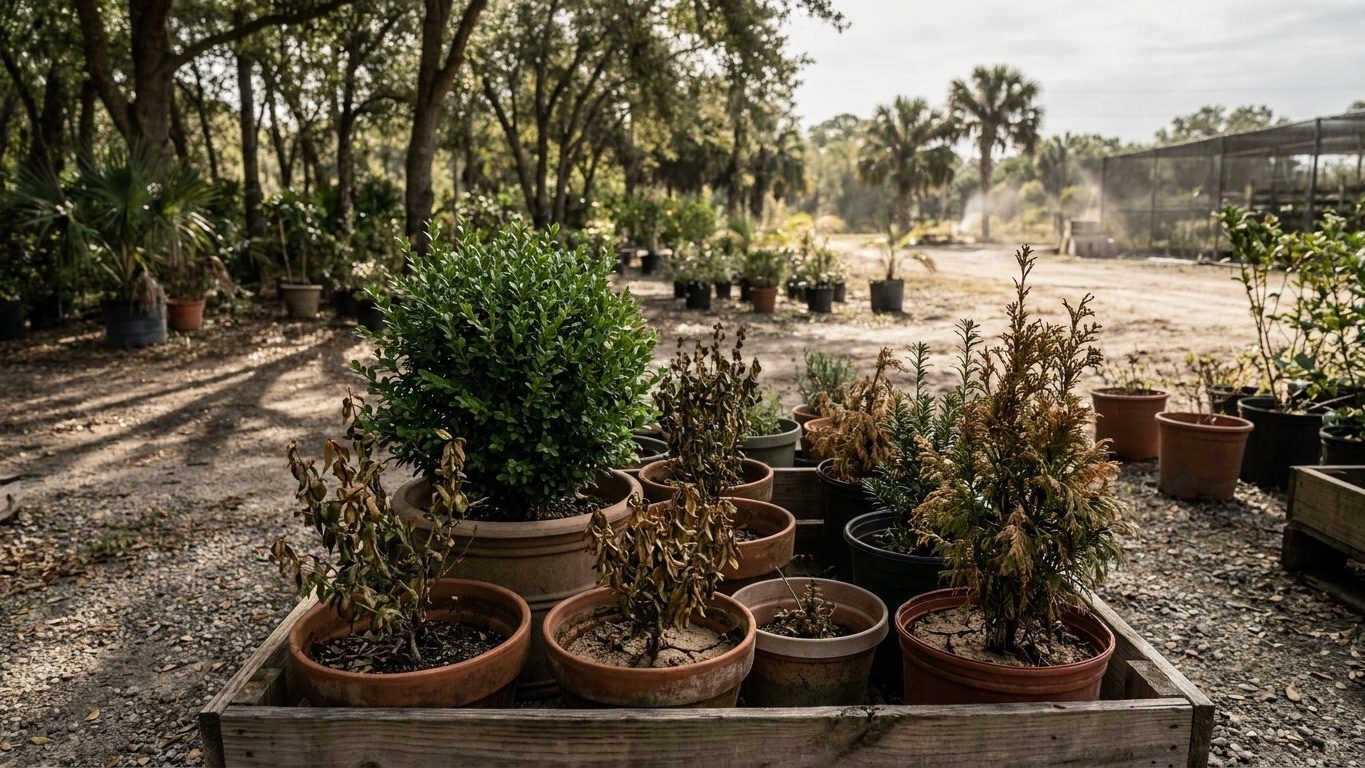

Of twelve widely planted hedge species, eight survive winter anywhere in Delaware’s 7a to 8a range (USDA system). Four stop short: privet, yew, arborvitae and eastern hemlock hold only in zones 7a and 7b. None of the twelve fails everywhere. Three of the eight statewide survivors share a different trap, because once they outgrow their spot they can never be cut back to size.
What actually holds in Delaware
A USDA hardiness zone rests on one number, the average annual extreme minimum temperature, and the 2023 map (built on 1991-2020 normals) puts the state across three half-zones: 7a, 7b and 8a. That is a wider spread than it sounds. A hedge that sails through a 7b winter can still fail in an 8a garden, and the reason is rarely cold. The upper edge of a plant’s range is often a heat limit, so hedge plants in Delaware’s warmest pockets can struggle in humid summers even though winter never bothers them.
Start with the four that do not cover the whole state. Privet (Ligustrum vulgare), yew (Taxus x media), arborvitae (Thuja occidentalis) and eastern hemlock (Tsuga canadensis) are documented for 7a and 7b only. In an 8a garden they may limp along for a few seasons, but “survives” is the most you should expect, and often not even that. Check your own zone on the USDA map by ZIP code before buying any of the four.
The other eight are safe bets across the range: boxwood, American hornbeam, Leyland cypress, inkberry holly, winterberry holly, eastern red cedar, cherry laurel and arrowwood viburnum. “Holds” here means the plant survives, not that it will look its best in every yard. Site, drainage and summer stress still decide how it performs.
| Plant | Where it holds | Regrows from old wood? |
|---|---|---|
| Privet (Ligustrum vulgare) | 7a and 7b only | Yes |
| Yew (Taxus x media) | 7a and 7b only | Yes |
| Arborvitae (Thuja occidentalis) | 7a and 7b only | No |
| Eastern hemlock (Tsuga canadensis) | 7a and 7b only | Yes |
| Boxwood (Buxus sempervirens) | 7a through 8a | Yes |
| American hornbeam (Carpinus caroliniana) | 7a through 8a | Yes |
| Leyland cypress (x Hesperotropsis leylandii) | 7a through 8a | No |
| Inkberry holly (Ilex glabra) | 7a through 8a | Yes |
| Winterberry holly (Ilex verticillata) | 7a through 8a | Yes |
| Eastern red cedar (Juniperus virginiana) | 7a through 8a | No |
| Cherry laurel (Prunus laurocerasus) | 7a through 8a | Yes |
| Arrowwood viburnum (Viburnum dentatum) | 7a through 8a | Yes |
Neighboring states shift the list in useful ways. The guides for Hedge Plants for Maryland: What Holds, and What Only Looks Hardy and Hedge Plants for North Carolina: What Holds, and What Only Looks Hardy show how the same species sort differently as zones move north or south.
The hedges you can never cut back down
The last column of that table matters more than the zone column. Three evergreen conifers on the list do not sprout from old, leafless wood: Leyland cypress, eastern red cedar and arborvitae. Cut into brown interior wood and you leave a bare patch that stays bare. No amount of fertilizer or patience changes that.
Leyland cypress is the one that catches people. It grows 3 to 4 feet a year and reaches 15 to 25 feet as a screen, so a row planted along a property line can outrun a 10-foot plan within a few seasons. Trimming it back to size in year six is not an option, because the cuts would land in dead-looking wood. The only safe approach is to start shaping in late spring to midsummer while growth is still green and keep every cut within the current foliage. If the mature height does not fit your lot, pick something else on day one.
Eastern red cedar behaves the same way, with 12 to 24 inches of growth a year and a screen height of 8 to 20 feet. It takes light cuts only, in late winter. Arborvitae is slower, 6 to 9 inches a year, and can be pruned in late winter before growth starts or in midsummer. It also holds only in 7a and 7b, so it carries two warnings at once: do not plant it in an 8a garden, and do not plan to rescue it with a hard cut.
The ones that forgive you
Most of the rest regrow from old wood, which makes them the safer choice for anyone who tends to put off pruning. Boxwood, yew, privet, hemlock, hornbeam, both hollies, cherry laurel and arrowwood viburnum can all be cut hard and will sprout new growth. Hemlock is the exception that still asks for restraint: it regrows, but the pruning advice is light cuts only, in late spring.
Regrowth is a safety net, not a license. Hard renovation cuts still cost you a season or two of a thin, gappy hedge. The difference is that with these plants the hedge comes back, while a cypress cut too deep does not.
Matching the plant to the job
Height and speed sort the list faster than any other trait. For a low, formal edge of 2 to 6 feet, boxwood grows only 3 to 6 inches a year and takes its trim in late spring, after the last frost. Yew at 6 to 12 inches a year suits 3 to 8 feet, trimmed in late spring after new growth hardens, though it holds only in 7a and 7b.
For a middle-height hedge of 5 to 15 feet, the choices widen. Inkberry holly is evergreen, while winterberry holly loses its leaves in winter. Both grow 6 to 12 inches a year and are pruned in late winter while dormant. Cherry laurel adds 1 to 2 feet a year and reaches 6 to 15 feet, cut in late spring after flowering. American hornbeam grows about 12 inches a year to the same height range and gets its trim in midsummer after the first flush. Arrowwood viburnum, at 6 to 10 feet and 12 to 24 inches a year, is cut right after flowering so you do not remove next year’s blooms.
Privacy screens are where growth rate becomes a trade-off. Eastern hemlock adds 12 to 24 inches a year and reaches 10 to 20 feet, but only in 7a and 7b. Privet moves 2 to 3 feet a year and needs cutting twice a season, in spring and midsummer. If you are building a screen in 8a, the statewide options are Leyland cypress and eastern red cedar, and you now know their limits.
A rough calendar helps. Late winter belongs to the hollies, red cedar and arborvitae. Late spring covers boxwood, yew, hemlock and cherry laurel. Midsummer is for hornbeam, the second privet cut and optional arborvitae shaping. Spring frost at the reference weather station (NOAA NCEI 1991-2020 normals, 32°F, 30-70% probability band) lands between April 3 and April 14, but suburban and rural yards often see it one to two weeks later. Wait for your own last frost before shearing boxwood. More species pages sit in the Hedges section, including Hedge Plants for Indiana: What Holds, and What Only Looks Hardy for comparison with a colder state.
The ground you are planting into
The Greenwich series, an Ultisol, is Delaware’s official state soil (named by law in 2000). Ultisols are old, heavily weathered and leached, which makes them naturally acid and low in nutrients. USDA NRCS records for the surface layer show a pH of about 6.0, a loam to silt texture (48 percent sand, 9 percent clay, 43 percent silt), organic matter near 1.7 percent, and good drainage.
That describes the state’s representative soil, not necessarily yours. A river-bottom lot, a clay pocket or any yard where a builder scraped and filled the topsoil can differ completely. What the Greenwich profile does tell you is what ground in this region tends to do: it sheds water rather than holding it, it runs mildly acid, and it is thin on organic matter. Newly planted hedges in that kind of soil dry out faster than gardeners expect, so a new row needs deep watering through its first seasons.
The fit matters for specific plants. Inkberry and arrowwood tolerate acid conditions comfortably, and boxwood and yew resent soggy feet, which a well-drained soil gives them. Winterberry is the one to watch if your yard drains fast and dries in summer. Where drainage is poor instead, skip yew and boxwood.
Before planting, get your own numbers. The University of Delaware Cooperative Extension can point you to soil testing and your county’s conditions. Mid-October is still a workable planting window. At the reference station the first 32°F freeze falls between October 26 and November 7 (30-70% probability band), and rural yards usually see it a week or two sooner. Plant now, mulch, and water until the ground freezes.
Common questions
Which hedge plants are hardy across all of Delaware?
Boxwood, American hornbeam, Leyland cypress, inkberry holly, winterberry holly, eastern red cedar, cherry laurel and arrowwood viburnum all survive zones 7a through 8a. Survival does not guarantee thriving, so match each one to your site.
Can I plant arborvitae anywhere in the state?
No. Arborvitae holds only in 7a and 7b. If your garden sits in 8a, choose a statewide plant instead. Arborvitae also cannot regrow from old wood, so a hard cut is permanent.
Which hedges can I cut back hard if they get too big?
Boxwood, yew, privet, hemlock, hornbeam, inkberry, winterberry, cherry laurel and arrowwood viburnum regrow from old wood. Leyland cypress, eastern red cedar and arborvitae do not, so keep cuts within green growth.
Do I need a soil test before planting a hedge?
Yes, especially for a long row. The state soil is acid, well drained and low in organic matter, but your yard may differ. Your county’s extension office can explain how to submit a sample.