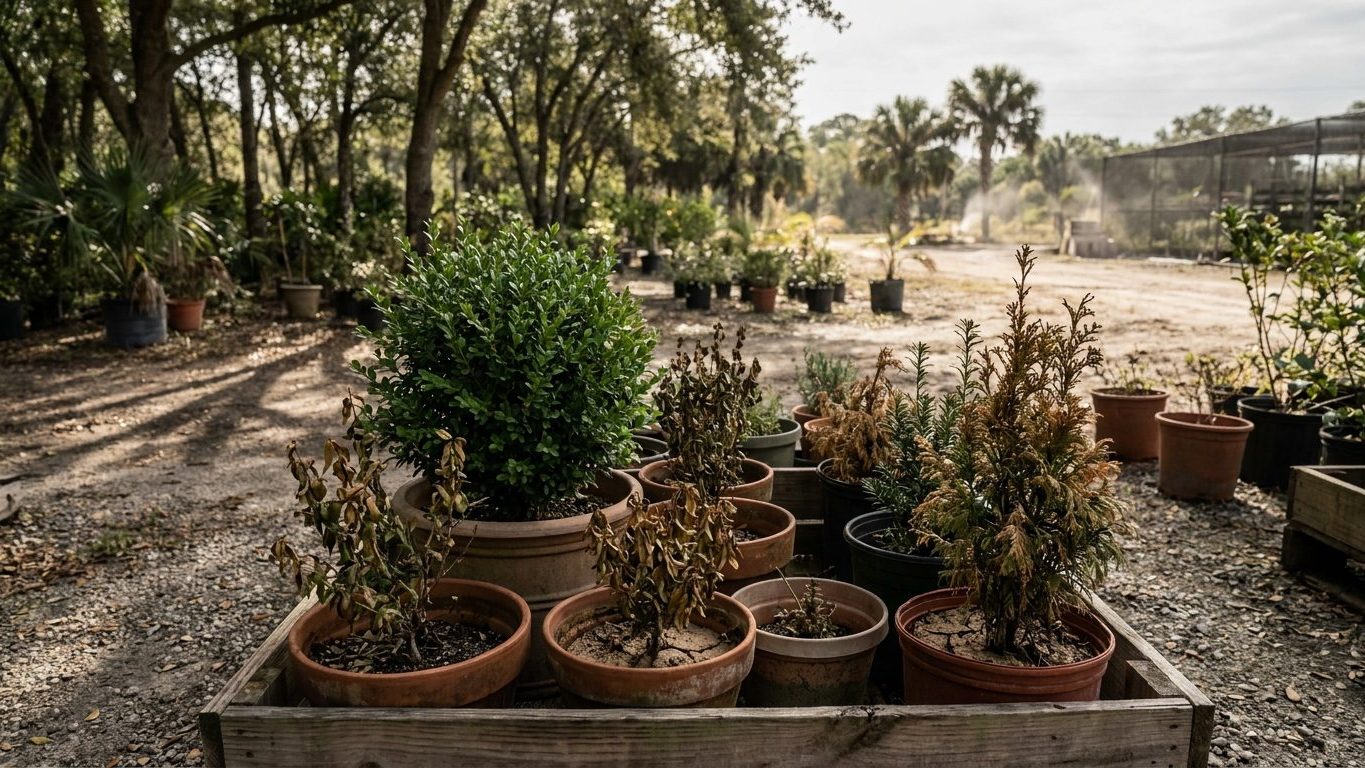

Ten of the twelve hedge species documented on this site survive the full range of Indiana winters, USDA zones 5b to 7a. Two do not: Leyland cypress and cherry laurel hold only in 6a, 6b and 7a, so a gardener at the cold end would be paying for a plant that may not make it. Cold isn’t the only trap. Three species, cut back too hard, never grow back at all.
What actually holds in Indiana
The USDA Plant Hardiness Zone Map 2023 places Indiana across zones 5b to 7a. That system rests on one variable, the average annual extreme minimum temperature, and the state covers enough of that spread that a plant can be safe at one end and gambling at the other. Each of the 12 hedge species here was checked against that range using hardiness data from the NC State Extension Gardener Plant Toolbox. The result: ten hold across the whole state, two hold in part of it, and none fail everywhere.
The two that hold only in part of the state
Leyland cypress (x Hesperotropsis leylandii) and cherry laurel (Prunus laurocerasus) are listed for 6a, 6b and 7a only. Zone 5b is out. Look up your ZIP code on the USDA map before you fall for either one at the nursery, because a tag reading “evergreen privacy hedge” won’t mention your zone.
Leyland adds 3 to 4 feet a year and reaches 15 to 25 feet as a screen. It is also a plant that can never be cut back to size later (more on that below), which makes a wrong choice expensive twice. Cherry laurel is slower, at 1 to 2 feet a year, and settles at 6 to 15 feet as a hedge. It does regrow from old wood, so it forgives mistakes that Leyland won’t.
Even inside 6a to 7a, “holds” means survives. A plant living through a winter at the edge of its range can still look battered by spring, and a survivor is not automatically a good hedge.
The ten that hold across all of it
These are boxwood, American hornbeam, inkberry holly, winterberry holly, eastern red cedar, common privet, yew, arborvitae, eastern hemlock and arrowwood viburnum. Same caution applies. The published ranges also have a warm end, and that end is often a heat limit rather than a cold one. Being hardy statewide tells you the plant survives the winter. How well it performs on a hot, exposed site is a separate question that the range can’t answer.
The hedges you can never cut back down
Three of the twelve species have regrows_from_old_wood set to false: Leyland cypress, eastern red cedar and arborvitae. That single field is the most useful one on the page. It decides whether a mistake can be repaired or has to be replaced.
What the trap looks like
Conifers in this group carry their green growth on the outside of the branch. Cut into the bare interior and there are no shoots waiting to break. The hedge stays as tall as you left it, with a hole where you cut, and no amount of patience fixes that. A hedge that grew taller than planned cannot be topped and rebuilt the way a boxwood or a privet can.
- Leyland cypress (only in 6a, 6b, 7a): 3 to 4 feet a year, 15 to 25 feet as a screen, pruned late spring to midsummer. Never regrows from old wood.
- Eastern red cedar: 12 to 24 inches a year, 8 to 20 feet as a screen, light cuts only in late winter. Never regrows from old wood.
- Arborvitae: 6 to 9 inches a year, 4 to 15 feet as a hedge, pruned in late winter before growth starts, or in midsummer. Never regrows from old wood.
Arborvitae is the gentlest of the three, and the slowest. Leyland is the harshest, since its growth rate is the fastest on the list and its tolerance for correction is nil. The fastest growers leave the least room for regret.
The ones that forgive you
Boxwood, American hornbeam, both hollies, privet, yew, arrowwood viburnum, cherry laurel and eastern hemlock all regrow from old wood. Two carry a footnote: hemlock takes light cuts only, even though it regrows. Privet asks for the most attention, with pruning twice a season, in spring and midsummer, and growth of 2 to 3 feet a year. Check with your county Purdue Extension office about privet before planting, since some states discourage it.
If a hedge might outgrow its spot, choose from this forgiving group. If you want a conifer screen, plant it for the height you want at maturity and leave the shears in the shed. The rule with a non-regrowing hedge is to pick the right plant at planting time, because you can’t correct the choice later.
Matching the plant to the job
Height and growth rate settle most decisions. The table lays out the ten plants that hold across all of Indiana, using the same measurements for each.
| Plant | Height as hedge or screen | Growth a year | Regrows from old wood |
|---|---|---|---|
| Boxwood | 2 to 6 feet | 3 to 6 inches | Yes |
| Yew | 3 to 8 feet | 6 to 12 inches | Yes |
| Arborvitae | 4 to 15 feet | 6 to 9 inches | No |
| Privet | 4 to 12 feet | 2 to 3 feet | Yes |
| Inkberry holly (evergreen) | 5 to 15 feet | 6 to 12 inches | Yes |
| Winterberry holly (deciduous) | 5 to 15 feet | 6 to 12 inches | Yes |
| American hornbeam | 6 to 15 feet | 12 inches | Yes |
| Arrowwood viburnum | 6 to 10 feet | 12 to 24 inches | Yes |
| Eastern red cedar | 8 to 20 feet | 12 to 24 inches | No |
| Eastern hemlock | 10 to 20 feet | 12 to 24 inches | Yes (light cuts only) |
Low and formal, or tall and private
For a knee-high to shoulder-high edge, boxwood and yew are the clear picks. Boxwood is the slowest on the list, gaining 3 to 6 inches a year, so trimming is light work. For a screen that blocks a neighbor’s view, hemlock, red cedar and arborvitae reach the heights that matter, and only hemlock can be renovated later. Winterberry loses its leaves, so it will not screen in January, while inkberry keeps its foliage.
The same crossing done for a different zone range gives a different list. The neighboring pages for Hedge Plants for Delaware: What Holds, and What Only Looks Hardy and Hedge Plants for Rhode Island: What Holds, and What Only Looks Hardy show it. The full overview sits on the Hedges page.
What this month allows
Today is late September, and none of the pruning windows above is open. Boxwood, yew, hemlock, cherry laurel and Leyland want late spring or midsummer. Hollies, red cedar and arborvitae come next in late winter. Leave the shears alone and spend the month on planning and planting.
For frost timing, Indianapolis is the reference point in the NOAA NCEI 1991-2020 Climate Normals. Its 32°F freeze odds put the last spring frost between April 9 and April 21, and the first fall frost between October 21 and October 30. Those dates describe the middle band of the odds, not a guarantee. Southern Indiana runs a fortnight or more earlier in spring and later in autumn than the north. Purdue also warns of roughly a 10% chance of a 32°F event after the published spring date.
The ground you are planting into
USDA lists the Miami series as the state soil of Indiana. It is an Alfisol, a forest soil of moderate fertility that holds nutrients reasonably well. The representative surface values are a pH of about 6.5 (slightly acid), 30 percent sand, 20 percent clay and 49 percent silt, which reads as loam to silt. Organic matter is about 2.0 percent, and drainage is moderately well drained. The figures come from USDA NRCS Soil Data Access, covering 627 mapped components of the series.
What that tells you, and what it doesn’t
Those numbers describe what the ground in much of the state tends to do, not what your yard does. A state has hundreds of soil series. River bottoms, hill country and any lot a builder has scraped or filled can differ completely from the Miami series. The 6.5 pH is the mapped value for the series, not yours.
As a rule, a moderately well drained loam suits most plants on this list. Yew and boxwood are commonly said to resent soggy ground, so a low spot that holds water after rain is a poor place for either. Winterberry and inkberry are usually the choice for wetter sites. A scraped new-construction lot often shows compaction before it shows anything else.
Test before you buy
A soil test gives you a real number for pH and nutrients in the bed you plan to plant. Your county Purdue Extension office can point you to a lab. Do it before ordering, because a pH that surprises you is far cheaper to learn about in September than after a row of shrubs is in the ground.
Common questions
Can I grow Leyland cypress anywhere in Indiana?
Only in zones 6a, 6b and 7a. It is not listed as hardy at 5b, the cold end of the state. It also cannot regrow from old wood, so a Leyland that outgrows its spot has to be replaced rather than cut down to size.
Which hedge plants can I cut back hard?
Boxwood, American hornbeam, inkberry holly, winterberry holly, privet, yew, arrowwood viburnum and cherry laurel all regrow from old wood, though cherry laurel only holds in 6a to 7a. Eastern hemlock regrows too, but takes light cuts only. Arborvitae, eastern red cedar and Leyland cypress do not regrow from old wood.
When should I prune my hedge?
It depends on the plant. Hollies, eastern red cedar and arborvitae are pruned in late winter (arborvitae can also be done in midsummer). Boxwood, yew, hemlock and cherry laurel are pruned in late spring. Hornbeam gets midsummer cuts, and arrowwood viburnum right after flowering. In late September, no window is open.
Is it too late to plant a hedge this fall?
Indianapolis usually sees its first 32°F freeze between October 21 and October 30, with southern Indiana later and the north earlier. A planting deadline based on soil temperature is not published here. Ask your county Purdue Extension office how your local conditions affect fall planting.