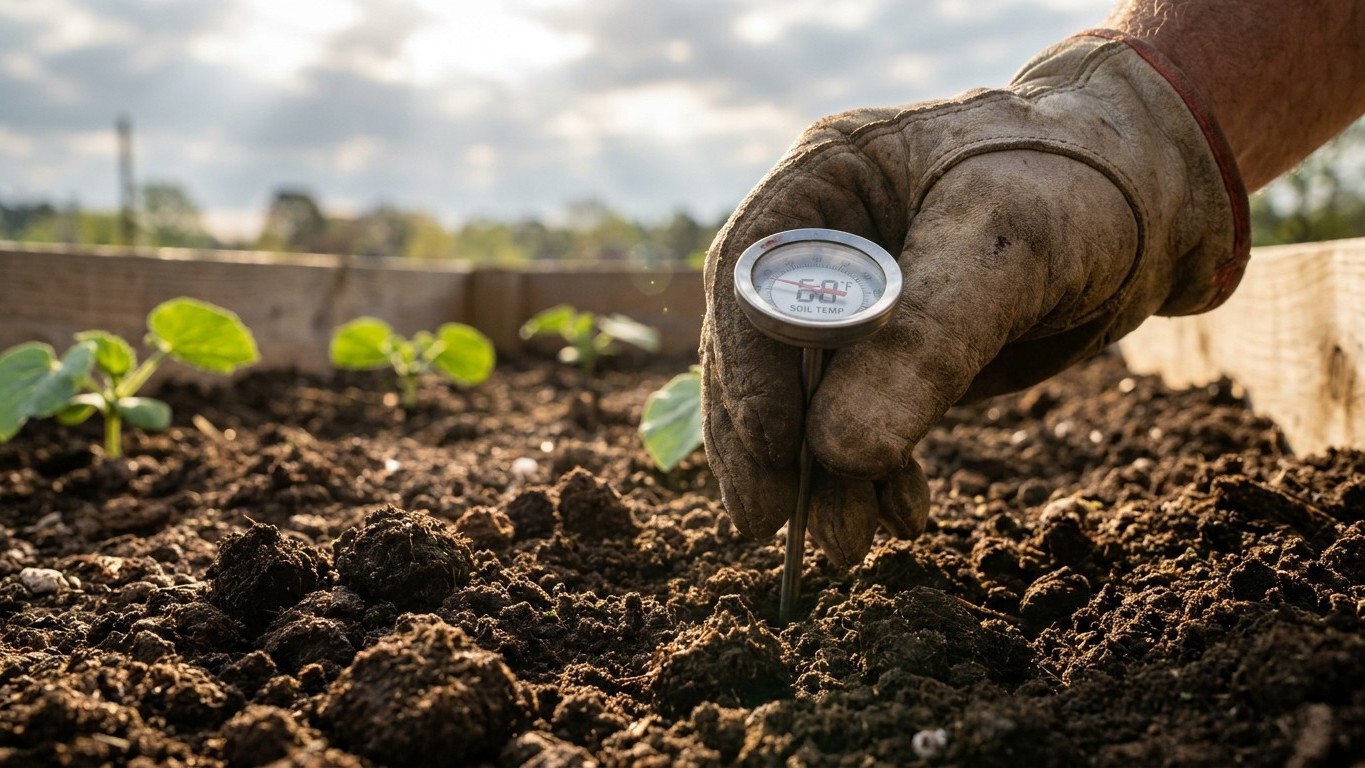

Nova Scotia can grow melons, but only with help: soil-warming tricks, short-season types, and constant watch for mildew in a cool, damp summer. The reference station shows zero days above 90°F and a frost-free window built around a mid-May mean frost date, so timing and technique matter more here than in almost any other spot on this site.
When the soil is warm enough in Nova Scotia

The average last spring frost at Halifax Stanfield Int’l A is May 7, according to Environment and Climate Change Canada’s Canadian Climate Normals for 1981-2010. That date answers the wrong question, though. Melon seeds and transplants don’t care about frost risk directly. They care about soil temperature, and soil in Nova Scotia doesn’t reach the 65°F-plus range melons want until well after the frost danger has technically passed.
There’s a second catch with that May 7 figure: it’s a mean, not a guarantee. In roughly one year out of two, frost arrives later than May 7 at that station. Treat it as the midpoint of a window, not a green light, and remember that the number comes from one coastal airport station. Inland valleys, the Annapolis basin’s cold pockets, and anywhere upland will run behind that date by days or weeks.
This region sits in Canadian hardiness zone 6b, based on Natural Resources Canada’s Plant Hardiness Site using 1991-2020 normals for the reference city. That’s worth naming carefully: the Canadian zone system is built from seven climate variables, not the single minimum-temperature measure the USDA uses, and NRCan itself says there’s no clean conversion between the two. A Canadian zone 6b tells you about growing-season character broadly, but it isn’t a USDA zone and shouldn’t be read as one when comparing this territory to others on this site.
What actually warms the soil faster
Because ambient warmth is slow to arrive and slower to sink into the ground, gardeners here lean on a handful of practices rather than an earlier calendar date:
- Dark plastic mulch laid over the bed two to three weeks before planting, to trap solar heat in the soil itself
- Raised beds or mounded rows, which drain faster and warm quicker than flat, heavy ground
- Row cover or low tunnels held over young plants through cool nights, removed once temperatures steady
- Starting seed indoors and transplanting hardened-off seedlings, rather than direct-seeding into cold ground
None of this moves the frost date. It compensates for a soil that’s slow to catch up with it. For rootstock or specific cultivar recommendations bred for a short, cool season, the province’s extension service keeps the current trial list, and that’s a better source than any generic name.
How long the season lasts here
Subtracting the two mean dates from the same station gives a frost-free window of about 164 days: from May 7 to October 18, the average first fall frost. On paper that’s a respectable stretch, comparable to many mid-latitude US gardens. In practice it overstates what a melon vine actually gets to use.
The gap between “frost-free” and “melon-growing” matters more in Nova Scotia than in warmer territories. Soil doesn’t reach planting temperature right at the frost date, it lags behind it by two to four weeks depending on the season and the bed. So the real working window for a heat-loving vine crop is closer to five months than five and a half, and it opens later than the frost math implies while the end point, October 18, stays fixed and comes with its own caution: frost can also arrive earlier than that mean in half of all years.
Does that length allow a second sowing?
In warmer parts of the melon-growing map, a long frost-free season allows a second sowing after the first vines finish, stretching the harvest into fall. Nova Scotia’s compressed and delayed window doesn’t really support that approach for melons specifically. The first sowing, made once soil has genuinely warmed, is effectively the only sowing most seasons will accommodate. That changes the transplant decision too: with no slack to lose, checking that transplants haven’t gone root-bound in their trays before they go in the ground is worth the extra five minutes, since a stalled start here often means the difference between a ripe melon and one still coloring up when the October frost lands. Readers weighing whether their own timeline allows a second round of any vine crop should check the site’s succession sowing guide for the mechanics of staggered planting.
Heat and water in Nova Scotia

The reference station records zero days a year averaging 90°F or above. That’s not a rounding artifact: Nova Scotia’s summers simply don’t deliver the heat load melons evolved to expect. Melons ripen on accumulated warmth over the season, not on the calendar, and a territory with no 90°F days is one where every degree of heat has to be captured and held, not just waited for.
That reframes the whole growing strategy. In a hot, dry territory, irrigation would decide fruit size and the final two weeks before harvest would decide sugar content. That’s not the story here. With essentially no extreme heat days, the soil-warming techniques already discussed and the choice of an early-maturing type matter more than the exact sowing date ever will.
Rainfall through the summer
Summer rainfall averages about 11.2 inches across June, July and August, with August the driest month at 3.68 inches, against an annual total of 55 inches. Broken down by month:
| Month | Average rainfall |
|---|---|
| June | 3.79 in. |
| July | 3.76 in. |
| August | 3.68 in. |
That’s a wetter, steadier summer than the sunny, thirsty gardens melons often associate with. Combined with modest heat, it’s a recipe for slow ripening and pressure from foliar disease, powdery and downy mildew in particular, rather than for drought stress. Good airflow around vines, spacing that lets leaves dry between showers, and avoiding overhead watering late in the day do more good here than any irrigation schedule built for a hot, dry territory would. These are normals for one reference station, over a 1981-2010 period that isn’t directly comparable to the 1991-2020 figures used for US territories on this site, and a home garden’s own microclimate, a sheltered south wall, a foggy coastal lot, a raised inland field, will shift the real picture. A rain gauge on the actual plot settles more than any regional average can.
Which melons suit Nova Scotia
Everything in this territory’s numbers points the same direction: short-season types, chosen for earliness rather than size, stand the best chance of reaching a usable ripeness before the October frost arrives. A vine bred to need a long, hot stretch of accumulated warmth is fighting a climate that recorded zero days above 90°F at its reference station and a growing window that opens late once soil temperature is factored in.
Disease resistance deserves equal weight, and for a specific reason tied to the rainfall numbers above: a summer averaging close to 11.2 inches of rain, spread fairly evenly rather than concentrated in brief storms, keeps foliage damp for longer stretches than a drier territory would. That favors types selected for resistance to powdery and downy mildew, and it favors garden layouts that prioritize airflow, wider spacing, trellising where practical, over the tight rows that work fine in a hot, dry climate.
Which varieties perform in Nova Scotia
No single cultivar name fits every season here. Which specific varieties actually perform in Nova Scotia’s short, cool, damp season changes as trial results come in, and those trials are run locally, not from a general content page. The Nova Scotia Department of Agriculture publishes current guidance and trial results at novascotia.ca/agri, and that’s the source worth checking before buying seed, not a name picked for a page that has no way to confirm it still performs well in this zone.
What can be said with confidence, from the territory’s own numbers, is the shape of a good choice: early to mature, bred or selected for resistance to the fungal pressure a wet, mild summer brings, and grown behind plastic mulch or row cover to make up the soil-heat gap the frost dates alone don’t reveal.