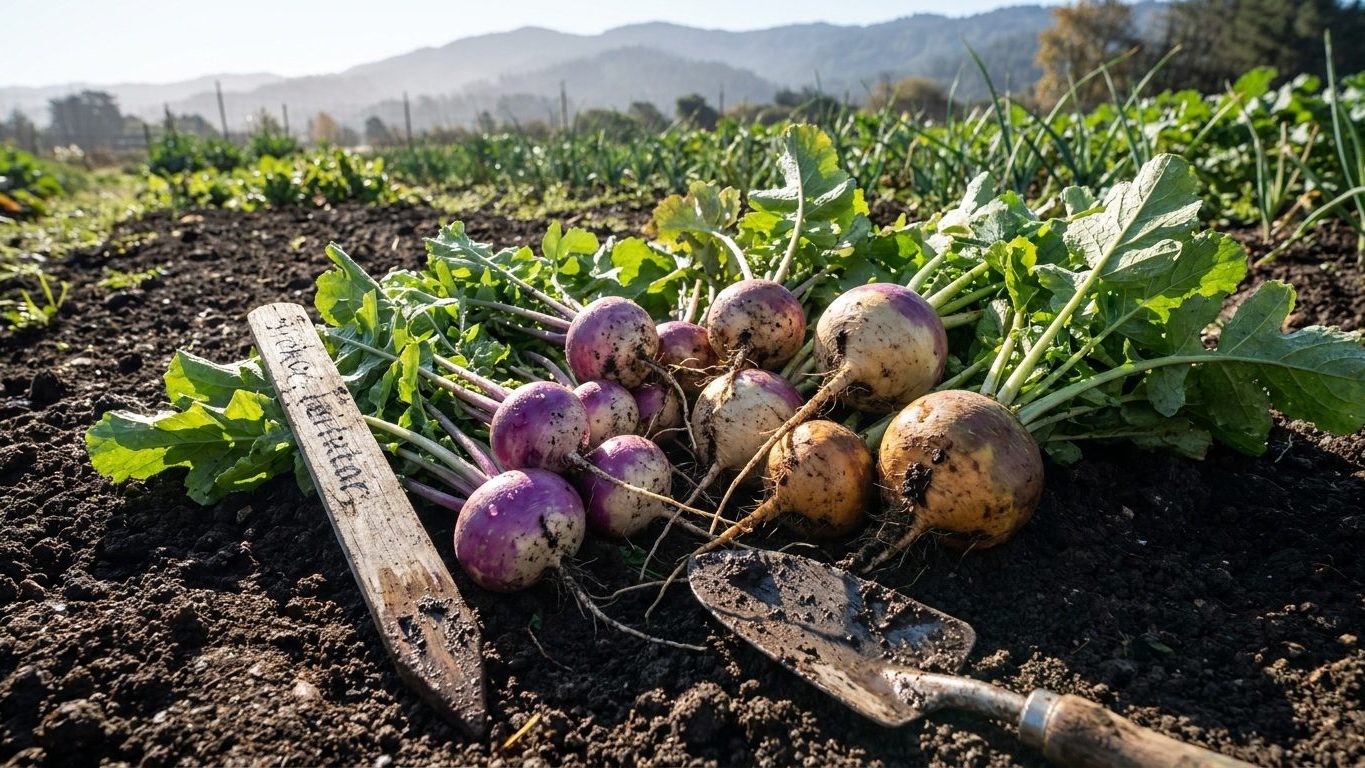

On the BC coast, the best choices are quick salad turnips for spring and fall sowings, a sturdy storage turnip for autumn and winter, and rutabaga sown early enough to finish before the cold, wet months. Inland and northern gardens should lean toward the fastest types. The numbers below come from the Vancouver airport station, so they describe one corner of a very large province.
The short answer for British Columbia
Start with the season. Environment and Climate Change Canada puts the average last spring frost at Vancouver International Airport on March 18 and the average first fall frost on November 10, which leaves a bit under eight months between them. These are mean dates from the 1981-2010 normals, not safe dates. In one year out of two, frost arrives later than March 18 in spring and later than November 10 in fall. Treat each date as the middle of a window.
The cold end of the year matters just as much. The mean daily minimum of the coldest month at that station is 0.8 °C (33.5 °F), barely under freezing. Under Natural Resources Canada’s system, the reference city sits in hardiness zone 9a. That is the Canadian system, built on seven climate variables, and it does not convert to a USDA zone. Together these figures describe a coast where roots can sit in the ground much of the winter, and that shapes which type you pick.
This page has no summer temperature figure for the station, so it does not claim a heat threshold. The decision rests on season length and winter mildness, which are the facts available.
| Type | Where it fits in coastal BC | Sowing idea |
|---|---|---|
| Quick salad turnips (Japanese types such as Hakurei) | Spring and fall, when the weather is cool | Succession sowings, a few weeks apart |
| Storage turnips (classic purple-top globe types) | Fall harvest and winter keeping | Late summer sowing |
| Rutabaga | The longest-season root, so it uses the generous frost-free window | Early summer sowing for a late fall harvest |
Exact sowing dates by month are on the companion page, When to Sow Turnips in British Columbia. The overview of both crops lives in Growing Turnips and Rutabaga in British Columbia.
What will not work here
Sowing on March 18 and calling it done. That date is the midpoint, so half of all years still have frost after it. Young turnip seedlings tolerate a light frost better than a tomato does, but a spring sowing set out on the mean date can still stall or bolt in a cold snap. A first sowing a couple of weeks after the average works better than one on the date itself.
Rutabaga sown late is the second failure. It is the slowest root in this group, often needing three months or more from sowing. Plant it in late summer and the first fall frost, which falls on November 10 in an average year and earlier in a bad one, arrives before the roots have bulked up. The coast has room for rutabaga. A short-season district does not, and a gardener inland or in the north who copies a Vancouver schedule will end up with thin, woody roots.
Close spacing is the third. The Pacific coast is known for wet fall and winter weather, and although this page has no rainfall figure, wet soil plus crowded plants means poor airflow, slow drying and rot. Thin turnips to the spacing on the seed packet, and give storage types and rutabaga more room than you think they need.
Then there are the soil-borne problems that thrive on repetition. Turnips and rutabaga are brassicas, the same family as cabbage and broccoli. Clubroot, a disease of that family, is a known concern in parts of BC, and it builds up in beds where brassicas follow brassicas year after year. Rotate on a multi-year schedule rather than planting turnips where last year’s kale stood. Root maggots, which tunnel into the roots, are another reason to cover early sowings with floating row cover.
One more trap is leaving the crop in the ground “because winters are mild.” A coldest-month mean minimum of 0.8 °C is gentle, but it is an average. A hard cold snap can still turn up in a given year, so mulch heavily or lift the roots you want to keep, and use the mild average as a cushion rather than a promise.
What changes across British Columbia
There is no single answer for the province. The 9a figure belongs to the reference city, and British Columbia is a coastline, several mountain ranges, dry interior valleys and a cold north. Natural Resources Canada publishes Canada’s Plant Hardiness Site by municipality, with 1991-2020 normals. This page has only the one reference value, so it cannot give you the spread across the province. The map can. Look up your own municipality there rather than assuming a zone from a neighbor or a seed catalogue.
Two different date ranges are in play on this page. The frost dates are the 1981-2010 Canadian normals, while the hardiness zone uses 1991-2020. The US figures elsewhere on this site cover 1991-2020 as well. Do not stack a Canadian zone next to a USDA zone as if they matched. Natural Resources Canada says plainly that there are no simple conversions between the two systems.
What should a gardener in the north or at altitude shift? Everything moves later in spring and earlier in fall, so the frost window is shorter than Vancouver’s, in some places by weeks. Choose the fastest salad turnips, sow once the soil can be worked rather than by the coastal calendar, and treat rutabaga as optional unless a local source says it finishes in your area. A short season pushes the decision from “which variety” to “does this type finish at all.”
On the coast the logic runs the other way. The long window is the asset, and the work becomes planning successions so you are not harvesting forty turnips in one week.
Where to check this for your own county
Start with the Government of British Columbia’s agriculture and seafood pages. They are the provincial starting point for growing guidance. This page does not have a BC planting calendar for turnips from that source, so it does not quote one. Look there for two things: a local sowing calendar for your region, and any list of varieties that have been trialled near you.
Be clear about what this page is. It is the provincial view, drawn from one station on the south coast. A recommendation written for your own district beats it every time, because the real spread between a Fraser Valley field, a Kootenay valley and a northern town can be bigger than the whole range of choices discussed here.
Two other sources are worth a call or a visit. A local garden club or seed exchange usually knows which varieties finished in your last three summers, and regional garden centres tend to stock what suits the area. Treat both as evidence to weigh, not as official guidance. If a local source and this page disagree on dates, go with the local one.
Checking this against your own garden
Your garden’s own signals outrank every date here. Three are worth watching, and none needs equipment.
- Soil warmth by feel. Push a hand a few inches into the bed in the morning. If the soil is cold and clumps into a wet ball, wait. Soil that crumbles and feels merely cool tells you seed will sprout. Compare a sunny bed with a shaded one, and you learn how much your site differs from the airport.
- First true leaves. The first pair after the seed leaves marks a seedling that has settled in. If sowings reach that stage slowly in early spring or late fall, your site runs cooler than the station numbers suggest, and slow types such as rutabaga are a gamble.
- Morning frost patterns. Note where white frost lingers on the grass after a cold night. Low spots hold cold air. Put hardy storage crops on the higher, drier ground and keep tender early sowings away from those pockets.
Write down the dates you see for a couple of seasons, and you will have a calendar that fits your own yard better than any average.
Common questions
What is the best turnip variety for British Columbia?
There is no single best variety. On the coast, pair a quick salad turnip with a storage type, and in short-season districts favor the fastest salad types. Check what local growers and your regional garden centre have found reliable.
Can I grow rutabaga everywhere in BC?
Not reliably. Rutabaga is the slowest of these roots and needs a long, cool season to size up. The coast has the window for it, but a short-season area may not, so look for local guidance before committing bed space.
Is March 18 safe for sowing turnips?
No. March 18 is the average last spring frost at the Vancouver airport station, so in one year out of two, frost comes later. It also describes one station, not your garden.
Do turnips survive winter on the coast?
Often, but not always. The mean daily minimum of the coldest month at the reference station is 0.8 °C (33.5 °F), which is mild, yet an average hides cold snaps. Mulch the bed or lift what you plan to keep, and leave the roots in only as long as the weather allows.