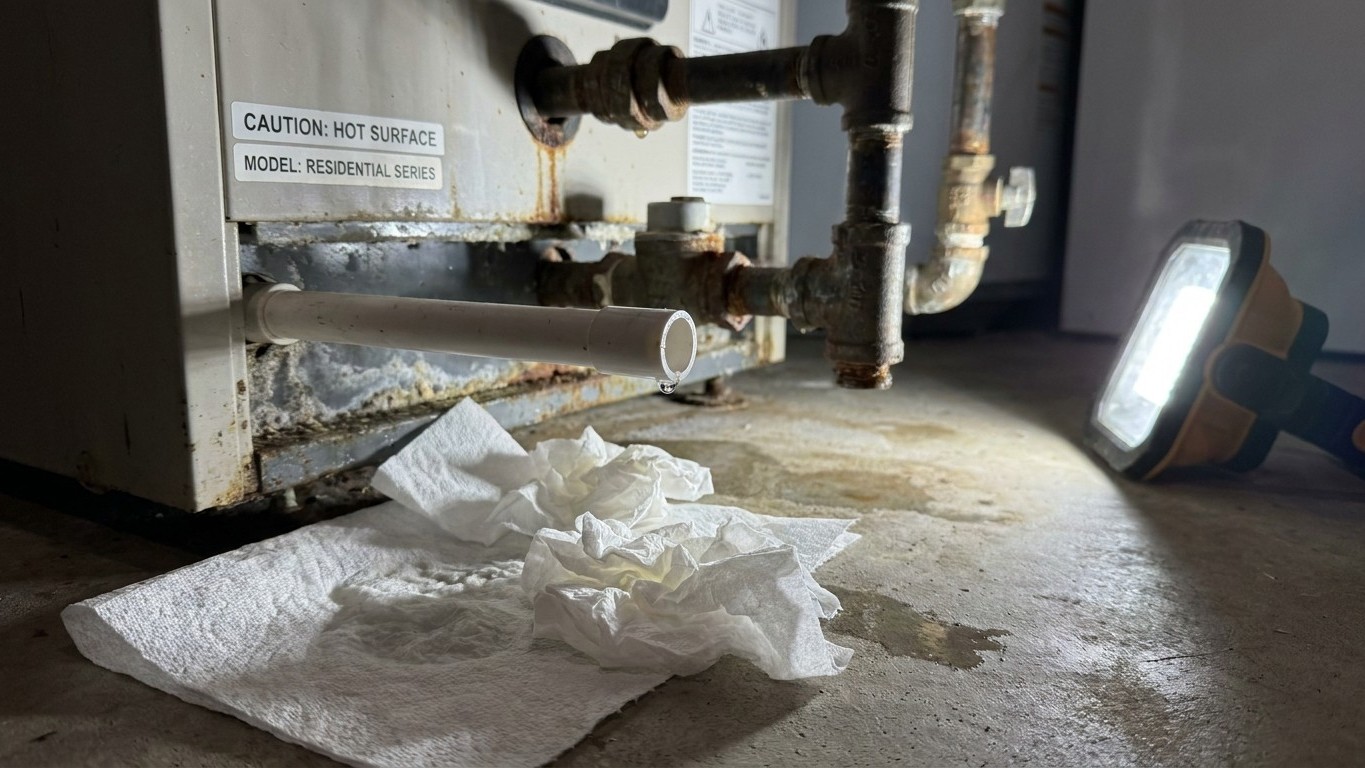

Most leaks that get blamed on “the boiler” trace back to one of four places: a condensate pipe doing its job, a pressure relief valve venting because something upstream is wrong, a corroded joint, or the heat exchanger itself. The first two are usually simple fixes. The last one is the one that decides whether you repair the unit or replace it.
Find whether it is the boiler at all

Water on the floor near a boiler doesn’t always start at the boiler. Pipework runs above and around most units, and a joint two feet up can send water trickling down the casing until it looks like the appliance itself is weeping. Condensing boilers add another wrinkle: they produce acidic condensate as a normal byproduct of combustion, and that liquid is supposed to drip out through a dedicated condensate pipe, often a white plastic pipe running to a drain or, on many installs, out through an exterior wall. Seeing a small, steady drip from that pipe is not a leak. It’s the appliance working as designed.
The way to sort a real leak from a red herring is almost embarrassingly low-tech. Wipe every surface dry, including pipe joints, valve bodies, and the base of the casing. Lay a line of paper towels or a strip of tissue paper along the floor beneath the unit and along any pipe runs overhead. Then let the system go through a heating cycle, or run the hot water if it’s a combi boiler, and watch where the paper gets wet first. Whatever spot darkens first is your starting point, not necessarily the spot with the most water pooled by the time you check back.
What the pattern tells you
A wet trail that starts high and runs down the front of the casing usually means a leak above the boiler, not in it, often at a pipe union, a radiator valve, or a fitting serving an upstairs room. A puddle that appears directly under the unit with no trail above it points to something internal: a seal, a valve, or the heat exchanger. And a slow drip from that dedicated condensate pipe, especially in cold weather when it can also freeze and back up, is routine maintenance territory rather than an emergency.
This sorting step matters because it changes who you call and how urgently. A leaking radiator valve on the second floor is a plumbing fix on your own schedule. A boiler shedding water from its own casing is a different conversation, and it’s the one the next section walks through.
The usual sources
Once you’ve confirmed the water is coming from the appliance itself, the list of likely culprits is short. Each one points to a different kind of problem, and some are far more serious than others.
- The pressure relief valve discharging. This valve exists to release water if system pressure climbs too high, and if it’s dripping or spraying, the valve is very likely doing exactly what it’s built to do. That means the real issue is upstream, often a pressure or expansion tank problem rather than a fault in the valve itself. Our guides on boiler pressure and the expansion tank cover what pushes pressure out of range in the first place.
- A corroded joint. Pipe fittings and valve connections degrade over years, especially in systems with older or unlined pipework. A corroded joint tends to weep slowly at first, then worsen, and it’s typically a straightforward repair for a heating technician rather than a sign of a failing boiler.
- A failed pump seal. The circulator pump moves water through the system continuously whenever the boiler is calling for heat, and its seal wears out like any moving part. A failed pump seal often shows up as water pooling specifically near the pump housing, and it’s a component swap rather than a full boiler replacement.
- The heat exchanger itself. This is the part that decides everything. A cracked or corroded heat exchanger means the boiler’s core is compromised, and depending on the unit’s age and the cost of parts, a technician may recommend replacement over repair.
When a heat exchanger is the reason a boiler needs replacing rather than patching, efficiency becomes part of that decision. The U.S. Department of Energy uses AFUE, the ratio of a boiler’s annual heat output to the total annual fossil fuel energy it consumes, to compare models: an AFUE of 90% means 90% of the fuel’s energy becomes heat in the home and 10% leaves up the flue and elsewhere. The Federal Energy Management Program, which writes purchasing guidance for federal buyers rather than homeowners, notes that an ENERGY STAR-qualified residential gas boiler meets 0.90 AFUE, and its own worked example compares models at 0.84, 0.90, and 0.97 AFUE. That framework is built for federal procurement, so treat its cost thresholds as background context rather than a household buying rule, but the AFUE number itself is worth asking about when a heat exchanger forces a replacement decision.
It’s also worth knowing that even a healthy heat exchanger doesn’t guarantee a system running at its best. A separate DOE study on hydronic heating in multifamily buildings found that “control settings are often best guesses and are not typically optimized.” That research covers central hydronic systems in multifamily buildings specifically, and its savings figures, an average of 11% and a maximum of 33% in gas use, apply to that building type, not a single-family home. Still, it’s a useful reminder that a leak isn’t the only thing worth having a technician check while they’re in there.
What to do now
If you’ve traced water to the boiler itself, the sequence is the same regardless of which of the four sources is behind it. Isolate the water supply feeding the boiler first, using the shutoff valve on the supply line. Switch the boiler off, both the appliance switch and, if you’re comfortable doing so, the power supply to it. Put something down to catch the water, a bucket, a shallow pan, old towels, whatever stops it spreading to flooring or nearby electrical outlets. Then call a licensed heating technician rather than attempting a repair on the pressure vessel or heat exchanger yourself.
When the sequence changes
Two situations override that order entirely. If water is leaking onto or near electrical wiring, outlets, or the boiler’s control panel, cut power at the breaker before doing anything else, including drying up the water. And if you smell gas at any point, whether it’s near the boiler or elsewhere in the house, leave the water and the diagnosis for later. Get out, call your gas utility’s emergency line from outside the home, and don’t turn switches on or off on your way out.
A boiler is a fuel-burning appliance (unless it’s electric, which burns nothing at all), and that means the carbon monoxide rules that apply to any combustion appliance apply here in full. CO is colorless and odorless, which is exactly why a working CO alarm in the home isn’t optional around a gas or oil boiler. A leak that coincides with any CO alarm sounding, or with headaches, dizziness, or nausea in the household, is a leave-the-house-now situation, not a wait-for-the-technician one.
Beyond the immediate leak, the U.S. Fire Administration’s standing advice is worth folding into your routine regardless of what caused this particular drip: “Maintain heating equipment and chimneys by having them cleaned and inspected each year by a professional.” An annual inspection is what catches a corroding joint or a failing pump seal before either turns into the kind of leak that puts you in a bucket-and-towel situation on a weeknight.
Common questions
Is it safe to run the boiler while it’s leaking?
Not until you know why. A condensate drip is harmless to keep running past, but a pressure relief valve discharging, a corroded joint, or anything leaking near the electrics means the boiler should stay off until a technician has looked at it.
Why does my boiler only leak when it’s heating up?
That pattern often points to a pressure relief valve responding to pressure that climbs as the system heats, which usually traces back to an issue with system pressure or the expansion tank rather than a fault in the valve itself.
Can a small drip from the condensate pipe turn into a bigger problem?
On its own, no, that’s normal operation. But if the condensate pipe is frozen, blocked, or disconnected, the condensate can back up into the boiler instead of draining outside, which is worth mentioning to a technician even if it isn’t an emergency.
Do I need a carbon monoxide alarm even if I’ve never smelled anything unusual?
Yes. Carbon monoxide from a fuel-burning boiler has no color and no smell, so a working alarm is the only way most households would know there’s a problem before it becomes dangerous.