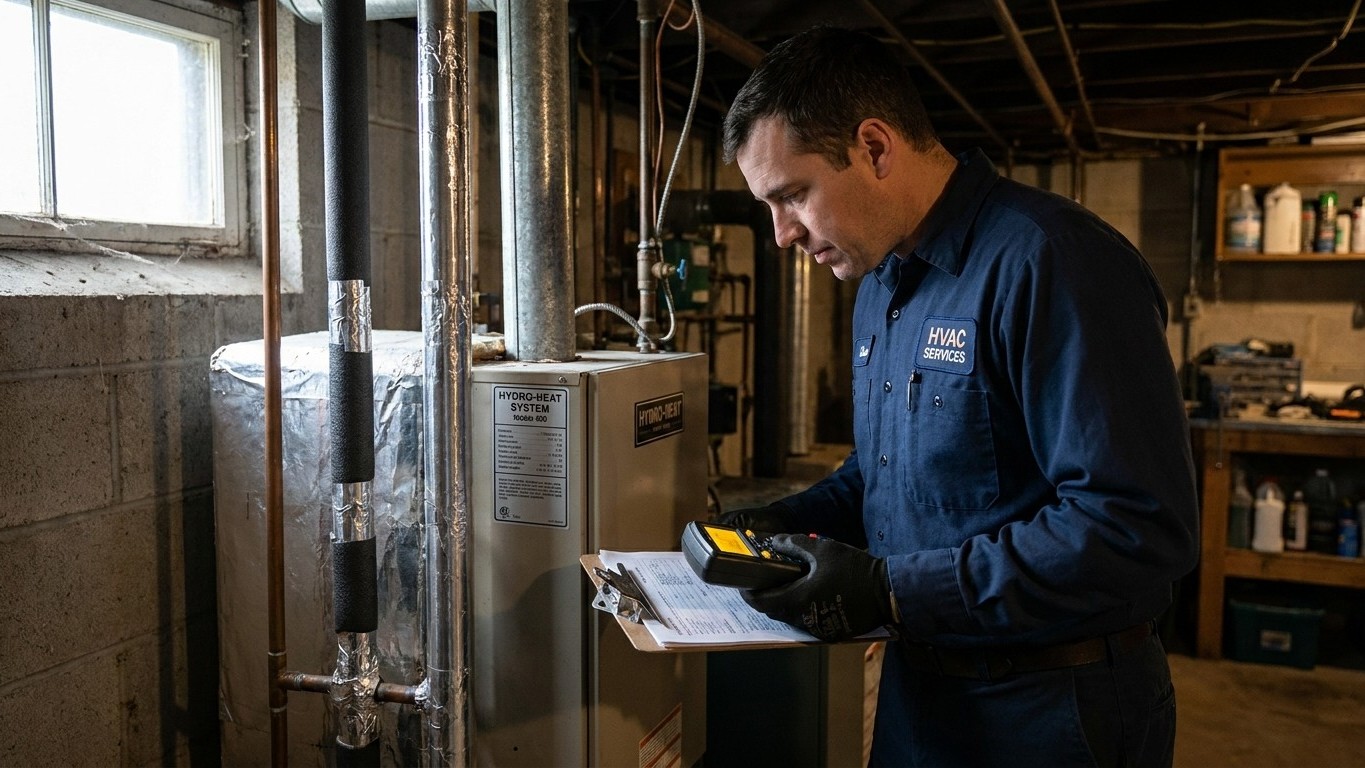

Boiler sizing means matching the unit’s heat output to the actual heat loss of the house, calculated room by room, not to whatever BTU rating was stamped on the boiler being replaced. The correct number comes from a load calculation that accounts for insulation, windows, air sealing, and local design temperature. Oversizing, the most common mistake, leads to short cycling, uneven comfort, and a condensing boiler that rarely gets to condense.
The house sets the number, not the old boiler
A proper sizing job starts with what heating professionals call a Manual J heat-loss calculation, or something equivalent to it. The contractor walks the house, measures every exterior wall, window, and door, checks the insulation levels in the attic and walls, and factors in the local outdoor design temperature for that ZIP code. The output is a number in BTUs per hour that represents how much heat the house actually loses on the coldest expected day of the year. That number, and nothing else, should determine which boiler goes on the wall.
What replaces this calculation in a lot of real-world jobs is far simpler and far less accurate: an installer looks at the nameplate on the old boiler and orders a new one with a similar or slightly higher output. It’s fast, it’s familiar, and it avoids an uncomfortable conversation about price. The problem is that this shortcut assumes the old unit was sized correctly in the first place, and there’s no reason to believe that.
Old boilers were often oversized to begin with
Boilers installed decades ago were frequently sized with rules of thumb that padded the number “to be safe,” or sized for a house that has since been renovated. A basement that used to leak heat through an uninsulated rim joist may have been sealed and insulated since. Old single-pane windows may have been swapped for double-pane units. An attic that had four inches of insulation might now have twelve. Every one of those changes lowers the heat loss of the house, sometimes by a wide margin, while the replacement boiler keeps climbing in size because each installer copies the last one.
The result compounds over multiple replacement cycles. A house that needed a certain output forty years ago may need meaningfully less today, but if nobody re-runs the calculation, the boiler on the wall keeps growing relative to the actual need. Sizing a boiler correctly means treating the current condition of the house as the only relevant input, and treating the old equipment’s rating as irrelevant history.
What oversizing costs
An oversized boiler doesn’t just waste capacity sitting idle. It changes how the entire system behaves, and not for the better. Because the unit can satisfy the thermostat’s call for heat much faster than a correctly sized one would, it fires, reaches temperature, shuts off, and repeats the cycle in short bursts throughout the day. This pattern is called short cycling, and it’s hard on the equipment: more ignition cycles, more thermal stress on the heat exchanger, and more wear on components that are only rated for a certain number of start-stop cycles per year.
Comfort suffers too. A boiler that blasts full output for a few minutes and then shuts down produces a sawtooth pattern of room temperature instead of steady, even warmth. Rooms farther from the boiler or served by longer runs of piping may lag behind, then overshoot once the system finally reaches them, then cool again once the short burn ends.
The efficiency rating that never gets used
Modern condensing boilers are built to extract extra heat from flue gases by cooling them enough that water vapor condenses out, which is where the technology gets its name. That process only works well when the boiler runs at lower, sustained firing rates, the kind a correctly sized unit produces on a mild day or even during steady operation on a cold one. An oversized boiler tends to run at or near full output whenever it fires, which is exactly the condition under which flue gases stay too hot to condense efficiently. The result is a boiler with a high condensing efficiency rating on paper that spends most of its life operating more like a standard, non-condensing unit.
That rating is usually expressed as AFUE, the ratio of a boiler’s annual heat output to the total annual fuel energy it consumes. An AFUE of 90% means 90% of the fuel’s energy becomes heat in the home and 10% leaves up the flue and elsewhere. For context, the U.S. Department of Energy’s Federal Energy Management Program treats 0.90 AFUE as the threshold for an ENERGY STAR-qualified residential gas boiler, and its own worked examples for federal purchasers compare models at 0.84, 0.90, and 0.97 AFUE. That guidance is written for federal procurement decisions, not for a homeowner sizing a replacement, but it’s a useful reminder that the AFUE number on the box only reflects reality when the boiler is sized and operated the way it was tested.
What to ask before a quote
The single question that separates a careful installer from one running on habit is straightforward: will you perform a heat-loss calculation for my house, and can I see the results? An installer who has actually done the math should be able to show room-by-room or whole-house numbers, the design temperature they used, and how those numbers led to the boiler model they’re proposing. An installer who answers with something vague about “matching what’s there” or “going a little bigger to be safe” is skipping the step that determines whether the new system will perform the way its rating suggests.
It’s worth asking about controls at the same time, since sizing and control settings work together. A U.S. Department of Energy study on hydronic heating in multifamily buildings, “Optimizing Hydronic Heating for Comfort and Performance,” found that “control settings are often best guesses and are not typically optimized.” That study covers multifamily buildings and central hydronic systems, and its savings figures, an average of 11% and a maximum of 33% in gas use, apply to that building type and shouldn’t be assumed for a single-family home. But the underlying point translates: a correctly sized boiler paired with poorly set controls still won’t deliver its potential, so it’s fair to ask how the installer plans to set up reset curves, aquastat settings, or zone controls once the unit is in.
Safety and upkeep don’t disappear once the size is right
Getting the sizing right doesn’t remove the need for ongoing maintenance or basic combustion safety. Any fuel-burning boiler produces carbon monoxide as a byproduct, an invisible, odorless gas that requires a working CO alarm in the home; this doesn’t apply to an electric boiler, which burns no fuel at all. The U.S. Fire Administration recommends straightforward, annual upkeep: “Maintain heating equipment and chimneys by having them cleaned and inspected each year by a professional.” That’s worth asking about at quote time too, since a properly sized boiler installed without a maintenance plan will still lose efficiency and reliability over the years.
No single BTU-per-square-foot rule can substitute for these questions. Climate design temperatures swing widely across the country, insulation levels vary house to house even on the same street, and a number that works in one region can be badly wrong in another. The heat-loss calculation exists precisely because a shortcut number can’t account for that variation.
Common questions
Is it better to size a boiler slightly larger than needed, just in case?
No. A boiler sized above the house’s calculated heat loss tends to short cycle, wear out components faster, and run at firing rates that keep a condensing model from actually condensing. The heat-loss calculation already accounts for the coldest expected day, so there’s no hidden margin to add on top of it.
Can I use the size of my old boiler as a starting point?
It’s a poor starting point on its own. Older boilers were often oversized when installed, and homes frequently gain insulation, air sealing, or window upgrades over the years that lower heat loss. A fresh calculation based on the house’s current condition is the only reliable way to size a replacement.
What should I ask an installer before accepting a quote?
Ask directly whether they will run a heat-loss calculation and whether you can see the numbers behind their recommendation. Also ask how they plan to set controls once the boiler is installed, and confirm their plan for annual professional inspection and cleaning.
Does an oversized boiler affect efficiency ratings like AFUE?
Yes, indirectly. AFUE reflects how much fuel energy becomes usable heat under tested conditions. An oversized condensing boiler tends to run at high firing rates whenever it operates, which keeps flue gases too hot to condense efficiently, so the real-world performance can fall well short of the rated AFUE.