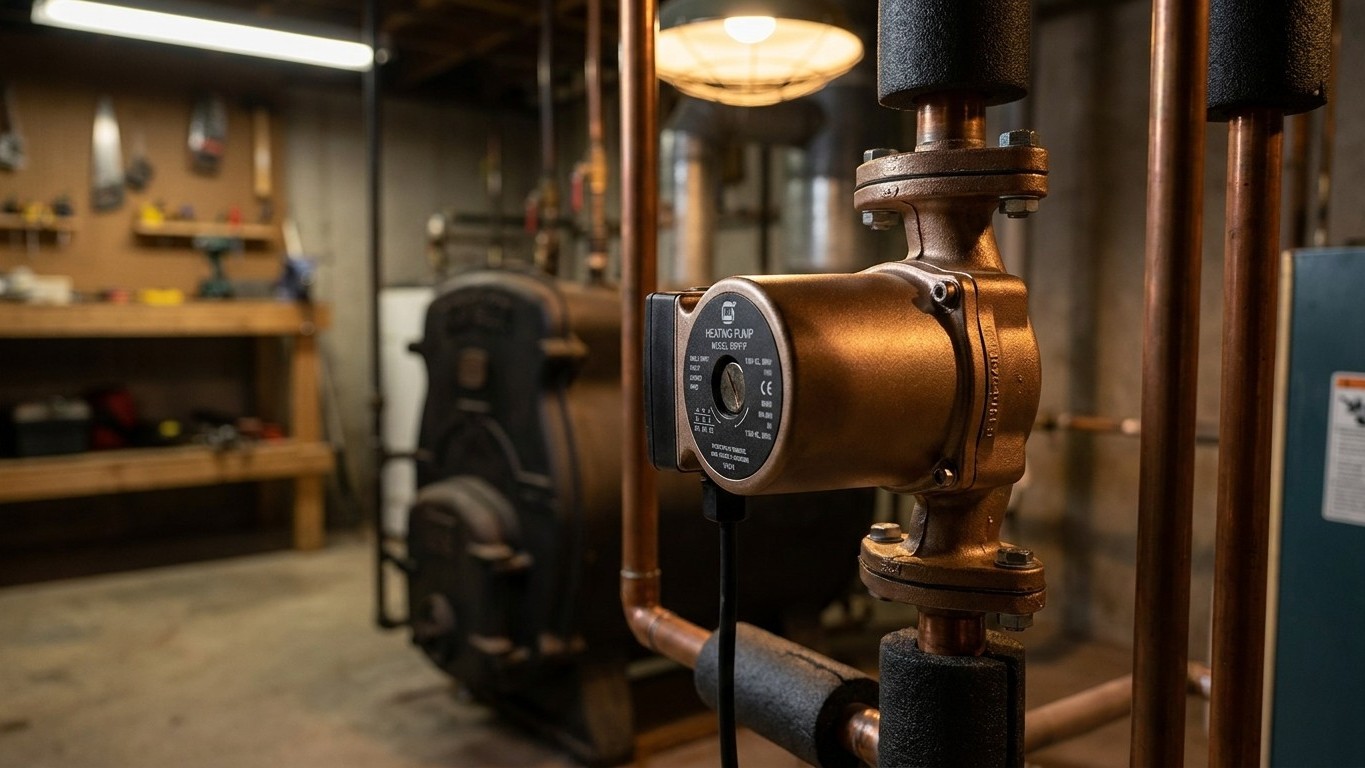

A circulator pump is a small electric pump, usually about the size of a large fist, mounted on the boiler or on the near-boiler piping. Its job is simple: push hot water out to the radiators, baseboards, or radiant loops, then pull the cooled water back to the boiler to be reheated. No circulator, no delivery. The boiler can be perfectly healthy and still leave every room cold.
A boiler heats; the circulator delivers

Split the system into two jobs and the troubleshooting gets a lot simpler. The boiler’s only task is to turn fuel (or electricity) into hot water. The circulator’s only task is to move that water where it needs to go. When a circulator seizes or fails electrically, the boiler doesn’t know the difference. It keeps firing, keeps heating the water sitting in its own jacket, and keeps climbing in temperature because nothing is carrying that heat away. Eventually the boiler’s high-limit control trips, shuts the burner down, waits for the water to cool a few degrees, then fires again. That short-cycling, on and off every few minutes with no heat reaching the rooms, is one of the more reliable signs that the circulator, not the boiler, is the problem.
Where it sits varies by system age and layout, but it’s almost always on visible piping close to the boiler, sometimes bolted directly to the boiler’s cast-iron or steel body, sometimes inline a foot or two away. A running circulator has a distinct sound: a steady, low electrical hum, sometimes with a faint vibration you can feel through the pipe with a bare hand. It should not click, rattle, screech, or grind. Any of those, or a sudden new sound after months of quiet operation, is worth a call to a licensed technician before it gets worse.
Efficiency numbers get attached to the boiler, not the circulator, and it’s worth knowing what they mean since the two get confused often. AFUE, or Annual Fuel Utilization Efficiency, is the ratio of a boiler’s annual heat output to the total annual fossil fuel energy it consumes. An AFUE of 90% means 90% of the fuel’s energy becomes heat in the home and 10% leaves up the flue and elsewhere. A circulator has no AFUE rating of its own; it just decides whether that 90% actually reaches the living room or stays trapped in the boiler.
One more point belongs here because it gets skipped often: a gas or oil boiler is a fuel-burning appliance. That means the same carbon monoxide rules that apply to any combustion appliance in the house apply here in full. CO is colorless and odorless, and a working CO alarm on the same level as the boiler is not optional. An electric boiler, by contrast, burns nothing and produces no combustion byproducts at all.
How a failing one shows itself
A circulator rarely fails without leaving clues. The signs tend to cluster into a short, recognizable list:
- No flow anywhere in the system even though the boiler itself is hot to the touch
- A pump that hums when powered but whose shaft doesn’t actually turn, felt as vibration with no water movement
- The pump housing running unusually hot to the touch, hotter than the pipe around it
- A grinding, screeching, or knocking noise that wasn’t there a week or a month earlier
That last one deserves a closer look, because it points to one of the most common circulator failures in the entire heating season: the seized-after-summer pump. A circulator that ran fine all last winter sits completely idle for five or six months once the heating season ends. Some homes have systems set up so the pump gets a brief exercise cycle even in summer; a lot don’t. Either way, months of stillness let mineral deposits and light corrosion build up around the pump’s internal bearing or the seal where the motor shaft passes into the wet part of the pump. Come the first cold snap in fall, the motor gets power, hums, and tries to turn a shaft that’s partially bound up. Sometimes it frees itself after a few minutes of straining. Sometimes it doesn’t, and the motor just hums uselessly (or trips its own internal overload) until someone intervenes.
This is exactly why the first cold day of the season is such a common day for a “no heat” service call. It’s not usually the boiler failing. It’s a circulator that’s been sitting still since spring, finally being asked to do its job again, and struggling. A technician can often free a mildly seized pump, but a pump that’s seized hard, or one that’s simply worn out after years of service, gets replaced rather than repaired, since circulators are a relatively low-cost, high-labor part compared to the boiler itself.
Age matters too. A circulator that’s five, ten, or fifteen years old and starting to show any of the signs above is a candidate for replacement on its own timeline, not just as an emergency fix after it dies completely. Waiting for total failure in January, rather than swapping a tired pump in September, is how a lot of these “no heat” calls end up happening on the coldest night of the year instead of on a mild afternoon when it’s a lot easier to fix.
More than one, in a zoned house
Houses with a single heating zone, one thermostat, one loop of pipe, usually have exactly one circulator, and diagnosing it is straightforward. Houses split into multiple zones (upstairs and downstairs, for instance, or a separate loop for a finished basement) get more complicated, and that complexity is exactly what confuses a lot of homeowners troubleshooting a cold room.
There are two common ways a multi-zone system is built. Some houses have one circulator per zone: three zones, three separate pumps, each one dedicated to moving water through its own loop only. Other houses have a single circulator serving the whole system, paired with a zone valve on each individual loop that opens or closes to let water in or shut it out, controlled by that zone’s own thermostat. Both layouts are common, and a lot of basements have a mix depending on when additions or renovations happened over the years.
The diagnostic logic changes depending on which setup a house has, and this is where zoned heating systems deserve a closer look on their own. In a house with one circulator per zone, a single cold zone while the rest of the house heats normally points straight at that zone’s individual pump, not at the boiler and not at the other zones’ equipment. In a house with one shared circulator and multiple zone valves, that same single cold zone with everything else working points instead at that zone’s valve, which may be stuck closed or wired incorrectly, while the shared circulator itself is clearly fine since it’s serving the other zones without a problem.
Either way, the pattern that matters is the same: one zone cold, the rest of the house warm. That’s a strong signal the boiler is doing its job correctly and the fault sits downstream, in that zone’s own delivery hardware. A U.S. Department of Energy study on hydronic heating in multifamily buildings, titled “Optimizing Hydronic Heating for Comfort and Performance,” makes a related point that applies conceptually to zoned single-family systems too, even though its own energy-savings figures are specific to multifamily central systems and shouldn’t be borrowed for a house: “Unfortunately, control settings are often best guesses and are not typically optimized.” A zone valve or circulator that was set up correctly during installation but never revisited as the house’s use changed is a common, quiet source of an uneven-heating complaint years later.
Common questions
Does the circulator affect my boiler’s AFUE rating?
No. AFUE measures how efficiently the boiler itself converts fuel into heat energy in the water, independent of whether that heat ever reaches a room. The U.S. Department of Energy’s Federal Energy Management Program, in guidance written for federal purchasing decisions, notes that an ENERGY STAR-qualified residential gas boiler meets an AFUE of at least 0.90, and its own worked example compares boiler models at 0.84, 0.90, and 0.97 AFUE. That figure describes the boiler alone. A worn or seized circulator can leave a high-AFUE boiler unable to actually heat the house, but it won’t change the boiler’s rated efficiency number.
Can I just replace a circulator pump myself?
The part itself is inexpensive relative to the rest of the system, but the work involves draining piping, working around an electrical connection, and getting the new pump correctly oriented for flow direction. Given that a boiler is a fuel-burning, pressurized appliance, this is work best left to a licensed heating technician who can also confirm the rest of the system is drawing correctly once the new pump is running.
How often should the whole heating system be checked?
The U.S. Fire Administration recommends homeowners “maintain heating equipment and chimneys by having them cleaned and inspected each year by a professional.” An annual visit is also the easiest time to catch a circulator that’s starting to wear, hum abnormally, or run hot before it fails completely at the start of the next heating season.
My boiler is hot but no radiators are warming up. Is that always the circulator?
It’s one of the most likely causes, but not the only one. A stuck zone valve, an air-locked loop, or a closed manual valve somewhere in the system can produce the exact same symptom. The distinguishing clue for a circulator problem specifically is the pump itself: check whether it hums but doesn’t vibrate with actual water movement, and whether it feels unusually hot to the touch compared to the pipe around it. If those signs are present, tell your technician exactly what you noticed; it narrows the diagnosis considerably before they even open a panel.