
Every boiler sold in the United States fits into two separate categories at once: how it moves heat around the house (its layout) and what it burns to make that heat (its fuel). A combi, system or conventional boiler can run on gas, oil, propane or electricity, and a small but stubborn share of older homes still run steam instead of hot water at all. Knowing which box your appliance checks changes how you shop, service and troubleshoot it.
Three layouts, one appliance
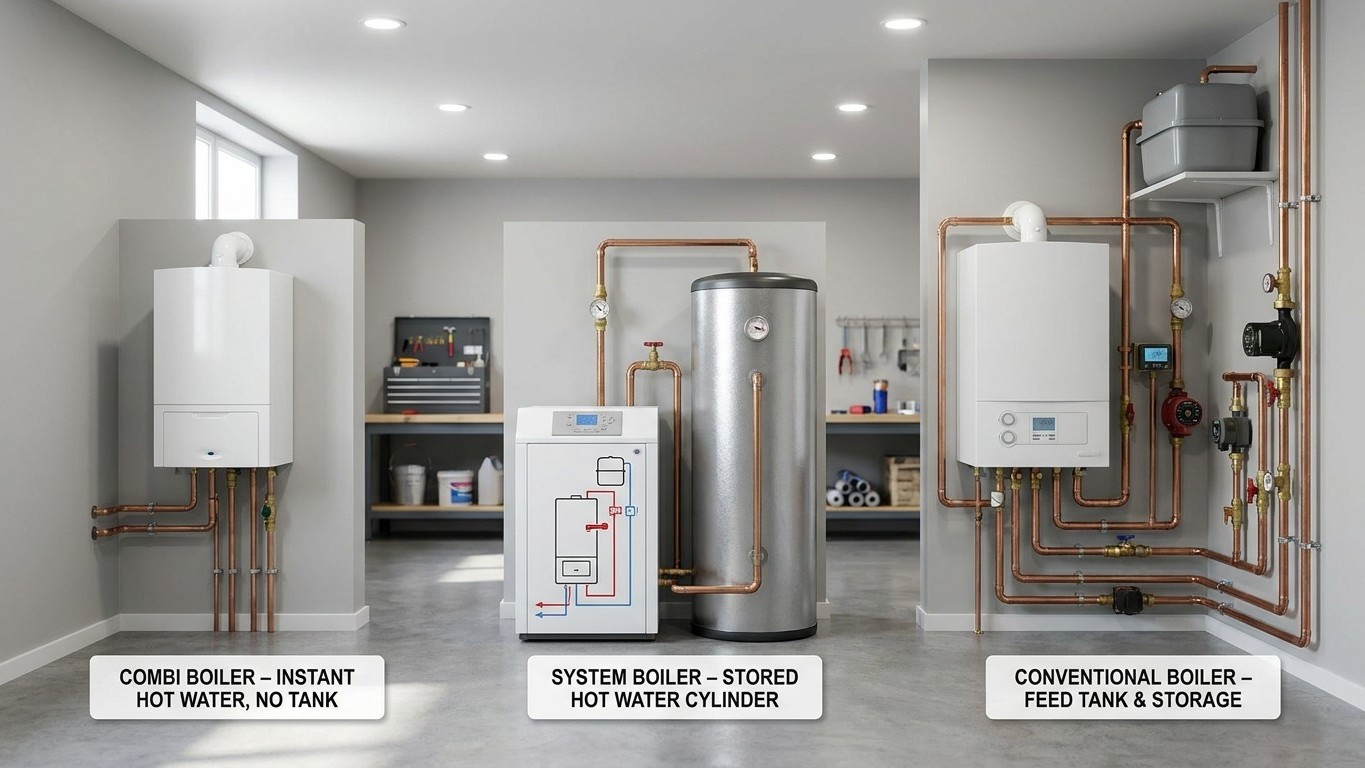
The layout question comes down to where the hot water lives before it reaches your tap or radiator. A combi boiler heats water instantly as it flows through the unit, so there’s no tank sitting around holding a reserve. A system boiler still heats on demand but sends that hot water to a dedicated cylinder, which stores it for use later. A conventional boiler, sometimes called a regular or heat-only boiler, goes a step further and adds a cold-water feed tank, usually installed in the attic, that gravity-feeds the whole system.
Each arrangement suits a different household rhythm, and the clearest way to see the difference is to line them up side by side.
| Layout | What it needs | Best suited to | Two taps running at once |
|---|---|---|---|
| Combi | No cylinder, no tank; just the boiler and the mains connection | Smaller homes, apartments, one bathroom | Hot water output can drop noticeably since both draws share the same instant heat source |
| System | A hot-water cylinder, often insulated, fed directly by the boiler | Homes with more than one bathroom and steady demand | Handles simultaneous use better since the cylinder holds a ready supply |
| Conventional | A cylinder plus a cold-water feed tank in the loft or attic | Older homes already plumbed this way, or homes with low mains pressure | Generally copes well, since both the cylinder and the tank act as reservoirs |
The practical takeaway is that a combi trades storage for simplicity, while a system or conventional setup trades a bit of extra hardware for the ability to run two showers without one going cold. Neither is universally “better.” A single-occupant condo rarely needs a cylinder taking up closet space, while a household of five sharing two bathrooms will feel the limits of a combi fast.
Layout also affects how forgiving the system is when the schedule isn’t quite dialed in. The U.S. Department of Energy’s study on hydronic heating, which covers multifamily buildings and central hydronic systems specifically, put it plainly: “Unfortunately, control settings are often best guesses and are not typically optimized.” That’s a reminder that even a well-matched layout can underperform if nobody has actually verified the settings against how the building is really used.
Gas, oil, propane, electric
The second axis, fuel, decides what maintenance and safety questions actually apply. A natural gas boiler needs a gas line and proper venting, and it’s rated using AFUE, the ratio of a boiler’s annual heat output to the total annual fossil fuel energy it consumes. An AFUE of 90% means 90% of the fuel’s energy becomes heat in the home and the remaining 10% leaves up the flue and elsewhere. According to federal purchasing guidance from the Department of Energy’s Federal Energy Management Program, an ENERGY STAR-qualified residential gas boiler meets 0.90 AFUE, and FEMP’s own worked example compares models at 0.84, 0.90 and 0.97 AFUE side by side. That guidance is written for federal purchasers weighing procurement costs, not a homeowner shopping for a replacement, so its dollar comparisons don’t transfer directly to a household budget. Still, the AFUE numbers themselves are a useful yardstick for comparing any gas, oil or propane model you’re considering.
Storage and venting differences
Oil-fired boilers add a wrinkle gas doesn’t have: an on-site fuel tank, which means periodic deliveries and a tank that itself needs inspection over the years. Propane runs similarly to natural gas in terms of venting requirements but, like oil, depends on a storage tank rather than a utility line, so supply planning becomes part of ownership. Electric boilers are the outlier in this group. They burn nothing at all, which means no flue, no venting, and no combustion byproducts entering the home. An electric boiler produces no carbon monoxide, full stop.
That last point matters because every other fuel type on this list does burn something, and burning fuel indoors is exactly when carbon monoxide becomes a real question. Carbon monoxide is colorless and odorless, which is precisely why a functioning CO alarm isn’t optional in a home with any gas, oil or propane appliance. Whatever the fuel, service intervals matter more than most homeowners assume. The U.S. Fire Administration is direct about this: “Maintain heating equipment and chimneys by having them cleaned and inspected each year by a professional.” That single sentence covers gas, oil and propane systems alike, though it obviously has nothing to answer for on an electric unit with no chimney to inspect.
And then there is steam
Every layout and fuel combination discussed so far assumes the boiler is circulating hot water, either through radiators, baseboards, or a radiant floor loop. A steam boiler works on a completely different principle: it does not circulate water at all. Instead it boils water into steam, which travels through pipes to radiators under its own pressure, releases heat as it condenses, and the resulting water drains back down to the boiler to be heated again. No pump pushes it. No cylinder stores it. The physics of rising steam and falling condensate do the work.
This is not a niche category. A large number of older American homes, particularly in the Northeast and Midwest where cast-iron radiators were standard for decades, still run on steam heat today, decades after the original boiler would have been considered state of the art. Many of these systems have been repaired, patched and re-fired so many times that identifying the original manufacturer is its own small research project.
Steam systems still burn a fuel (gas, oil, or occasionally propane), so everything said above about carbon monoxide, alarms and annual professional inspection applies just as much to a steam boiler as to a hot-water one. What’s different is nearly everything else: how pressure behaves, how radiators are sized and balanced, how a system is diagnosed when one room runs cold while another overheats. Those details deserve their own explanation rather than a summary here. Anyone living with, or considering, a steam system is better served by reading through what steam heating actually involves before deciding how to maintain or replace it.
Common questions
Can a combi boiler be converted into a system boiler?
It’s a job for a licensed installer, since it typically means adding a cylinder and re-piping the hot-water side of the system. Whether it’s worthwhile depends on household size and hot-water demand, which is a conversation to have with a professional who can look at the actual plumbing.
Does fuel type affect how often a boiler needs servicing?
The annual professional inspection recommended by the U.S. Fire Administration applies across gas, oil, propane and steam systems alike, since all of them involve combustion and venting. An electric boiler, burning no fuel, doesn’t carry that same combustion-related maintenance need, though it still benefits from routine checks per its manufacturer’s manual.
Is a higher AFUE always worth paying for?
A higher AFUE means less fuel energy is lost up the flue, which is a real efficiency gain. Whether the higher upfront cost pays off depends on local fuel prices, climate and how long you plan to stay in the home, questions a homeowner should work through with a contractor rather than treating any single efficiency threshold as a fixed rule.
Do I need a carbon monoxide alarm if I have an electric boiler?
An electric boiler itself produces no carbon monoxide since it burns no fuel. But most homes have other combustion appliances (a gas water heater, a gas range, an oil furnace), so the presence of an electric boiler alone doesn’t rule out the need for a CO alarm elsewhere in the house.