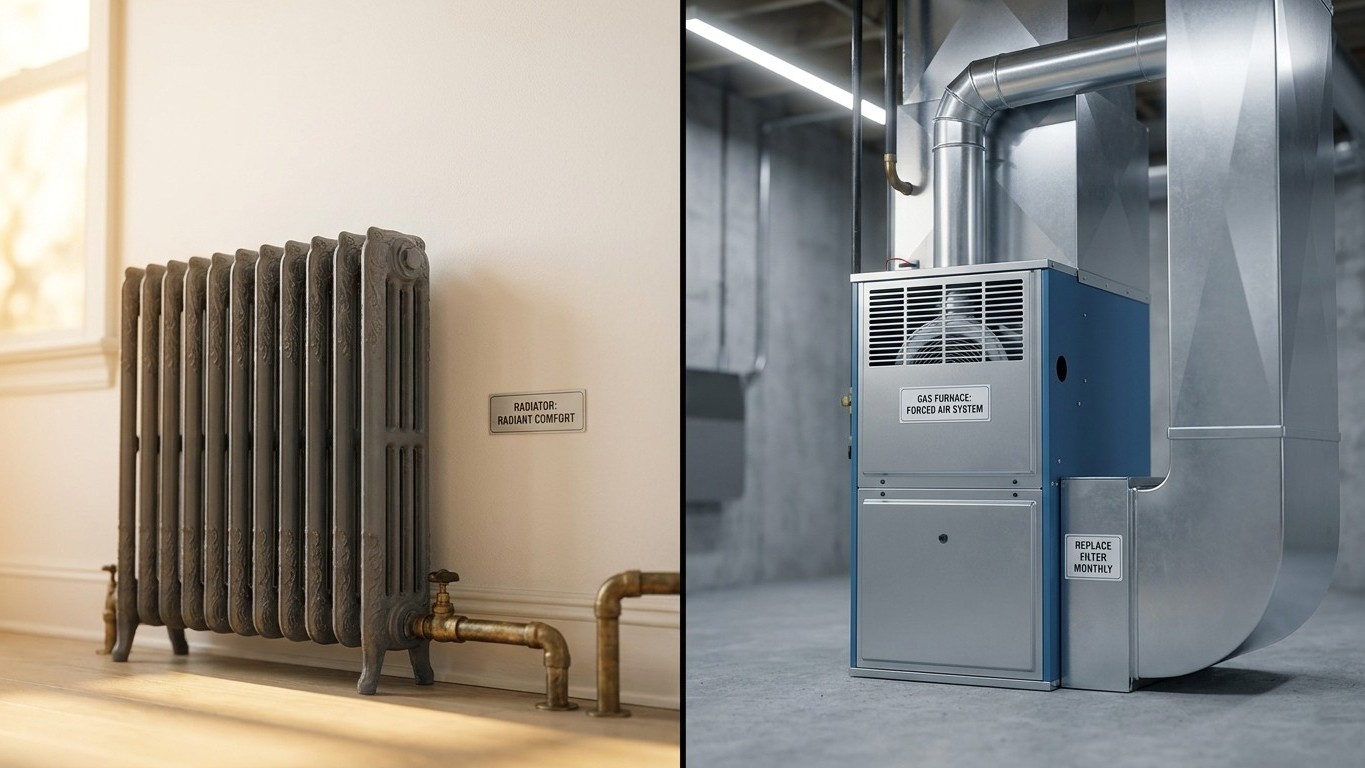

The short answer: a boiler heats water and sends it through pipes to radiators or baseboard units, while a furnace heats air and pushes it through ducts with a blower. That single mechanical difference decides how a home feels, how it sounds, what it costs to modify, and whether the same system can also cool the house in summer.
Water or air, and everything follows

Once you know which medium a system moves, you can predict almost everything else about it. A boiler warms water in a sealed loop, then circulates that hot water (or the steam it produces) through pipes to radiators, baseboard convectors, or a network of tubing under the floor. A furnace burns fuel or uses electric resistance to heat air directly, then a blower fan forces that air through a duct system and out through vents in each room. No shared parts, no shared installation path, no shared repair playbook.
That distinction cascades into every practical category a homeowner actually cares about: how even the heat feels, whether dust and allergens get stirred up, how loud the system runs, what it would cost to retrofit into a house built for the other type, and whether the same equipment can double as an air conditioner in July. Here’s how the two stack up side by side.
| Dimension | Boiler (hydronic) | Furnace (forced air) |
|---|---|---|
| Heat distribution | Water or steam through pipes to radiators/baseboard/radiant floor | Heated air through ducts and vents |
| Comfort profile | Steady, radiant, fewer temperature swings | Faster warm-up, but heat cycles on and off more noticeably |
| Dust and allergens | No air movement, so nothing gets stirred up | Blower circulates dust, pet dander, and whatever is in the ducts |
| Noise | Quiet operation, occasional pipe ticking or knocking | Blower fan and air rushing through vents are audible |
| Retrofit into the other type | Expensive: no ductwork exists to reuse | Expensive: no piping or radiators exist to reuse |
| Cooling capability | Cannot cool; a separate system is needed | Same ducts can carry air conditioning |
Efficiency is measured differently depending on the appliance, but for boilers the number to know is AFUE, the ratio of a boiler’s annual heat output to the total annual fossil fuel energy it consumes. An AFUE of 90% means 90% of the fuel’s energy becomes heat inside the home, while the remaining 10% escapes up the flue and elsewhere. Furnaces use the same AFUE scale, so the metric itself doesn’t tell you which appliance type to choose, only how well a specific unit converts fuel into usable heat.
What each feels like
Homeowners who’ve lived with both tend to describe hydronic heat the same way: even, quiet, and free of drafts. Because water carries far more heat per volume than air, radiators and baseboard units can maintain a steady room temperature without the on-off blast that forced air produces. There’s no fan noise, no whoosh of air from a vent, and no dust getting kicked into circulation every time the system cycles. For anyone with allergies or asthma, that absence of moving air can matter more than any efficiency rating on a label.
Forced air trades that steadiness for speed and versatility. A furnace can raise a cold room’s temperature faster than a radiator can, simply because moving heated air is quicker than heating an entire loop of water and letting it radiate outward. The same duct network that delivers heat in winter can carry cooled air in summer, and it can run through a filter that catches dust, pollen, and other particles before they reach the living space. That combination of speed, cooling, and filtration is why forced-air systems remain the default choice in most new construction across the country.
Matching the system to the household
Neither approach is objectively better, and the right fit depends on what a household actually wants from its heating system. A home in an older neighborhood with cast-iron radiators already in place, and no interest in central air conditioning, has little reason to disrupt that setup. A family that wants central air, wants a single system for both seasons, or has a house with existing ductwork will usually find forced air the more practical and less expensive path. The choice, in most cases, was already made decades ago by whoever built the house and installed the first distribution system.
Changing from one to the other
The honest answer to “should I switch” is: rarely, and the reason has nothing to do with the boiler or furnace itself. The appliance is the cheap half of the system. The expensive half is the distribution network, the pipes and radiators on one side, the ductwork and vents on the other, and that’s the part you can’t simply swap out during a routine replacement.
A house plumbed for hydronic heat has no ducts hidden in its walls or floors. Converting to forced air means cutting into finished walls and ceilings, running duct trunks through spaces that were never designed for them, and often sacrificing closet space or ceiling height to fit everything in. A house built around ductwork has the opposite problem: adding radiators or baseboard units means running new supply and return piping throughout the structure, plus installing a boiler and expansion tank where none existed. Either direction means paying for a full distribution retrofit on top of the new heat source itself, which is why most homeowners replace like with like when their existing system reaches the end of its service life.
The exception that changes this calculation is a whole-house renovation, where walls and floors are already open and the marginal cost of adding ductwork or piping drops considerably. Short of that, it’s worth reading how furnace systems are sized and installed before assuming a switch makes sense, and worth comparing both against a heat pump, which distributes conditioned air like a furnace but runs on electricity and can heat and cool with the same equipment. For many households replacing an aging boiler, that three-way comparison, not a straight boiler-versus-furnace swap, turns out to be the more useful question.
Whichever system stays in the house, routine care matters more than the debate over which type is better. The U.S. Fire Administration advises homeowners to “maintain heating equipment and chimneys by having them cleaned and inspected each year by a professional,” a recommendation that applies equally to a fuel-burning boiler and a fuel-burning furnace.
Common questions
Can a boiler provide air conditioning like a furnace can?
No. A boiler only moves and heats water; it has no mechanism for cooling or dehumidifying air, and no duct network to distribute cooled air even if it did. Homes with hydronic heat that want central cooling need a separate ducted system installed alongside the boiler.
Is a boiler or a furnace more efficient?
Efficiency depends on the specific unit’s AFUE rating, not the appliance category. The U.S. Department of Energy’s Federal Energy Management Program, writing guidance for federal purchasers, notes that an ENERGY STAR-qualified residential gas boiler meets 0.90 AFUE, and its worked example compares models rated at 0.84, 0.90, and 0.97 AFUE. That guidance is built around federal procurement decisions, not a household weighing a replacement, so its cost thresholds shouldn’t be read as advice for a homeowner’s budget.
Do boilers need carbon monoxide alarms the same way furnaces do?
Yes, for any fuel-burning boiler. Carbon monoxide is colorless and odorless, and a fuel-burning boiler produces it the same way a fuel-burning furnace does, so a working CO alarm is necessary. An electric boiler, which burns no fuel, doesn’t produce carbon monoxide and isn’t subject to that same concern.
Why does hydronic heat feel more even than forced air?
Water carries far more heat per unit of volume than air does, so a radiator or baseboard unit can release heat steadily over a longer stretch of time rather than in the short bursts typical of a furnace’s on-off cycle. That’s the physical reason hydronic systems are described as producing fewer noticeable temperature swings, independent of how efficient the boiler itself is rated.