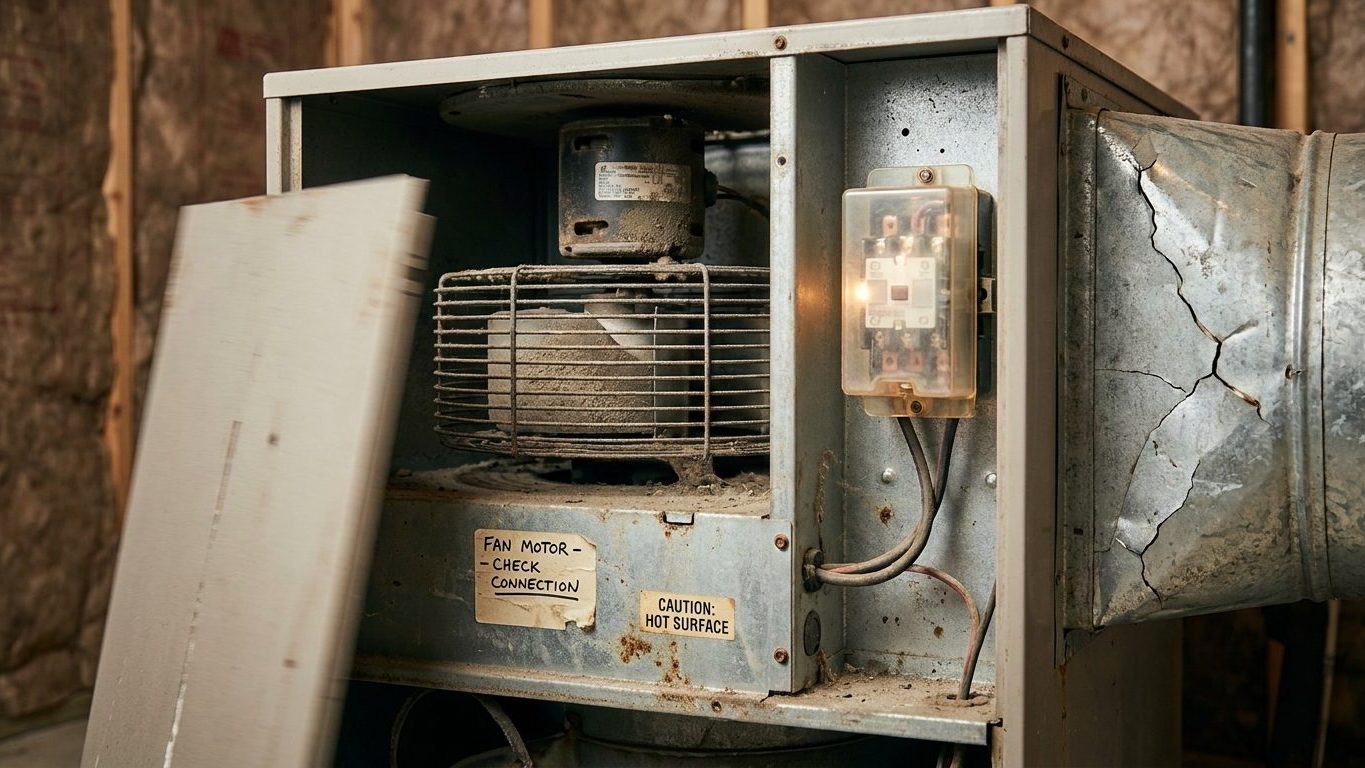

Rattles, hums, and bangs coming from a central air system are not random noise. Each one points to a specific failure mode: rattles mean something loose is vibrating, hums point to an electrical component or a worn motor bearing, and bangs almost always trace back to ductwork flexing or a rough start. None of them fix themselves, and waiting rarely makes the repair cheaper.
Rattles, Hums and Bangs
Each noise traces back to a different physical process, and knowing which is which can save a service call aimed at the wrong problem. A rattle is almost always a loose object striking something else at high frequency: a panel screw that backed out, a piece of insulation flapping in the airstream, or a fan blade clipping a bent shroud. A hum is electrical or mechanical resonance, a contactor buzzing as it tries to close, a capacitor humming under load, or a motor bearing losing lubrication and grinding at a steady pitch. A bang is different from both. It’s usually a sudden release of built-up tension, either in sheet-metal ductwork that expands and contracts as air temperature changes, or in a gas furnace burner firing a beat late and igniting a small pocket of accumulated gas all at once.
Duct noise deserves its own explanation, because it’s the one homeowners misread most often. Metal ducts are rigid but not perfectly stiff, and every time hot or cold air pushes through them the metal flexes by a fraction of an inch. Where a section is well-fastened, that flex stays silent. Where a screw is missing, a strap has slipped, or two sections were friction-fit instead of sealed, the metal snaps back into place with an audible bang, or a panel rattles against its frame with every cycle. That loose or poorly sealed joint isn’t just a noise problem. It’s frequently the same physical gap where conditioned air escapes. According to ENERGY STAR, “In a typical house, however, about 20 to 30 percent of the air that moves through the duct system is lost due to leaks, holes, and poorly connected ducts.” This is why a room that never quite warms up or cools down isn’t always a sign of a broken furnace or failing compressor. The conditioned air can be leaking out of the very duct joint that’s making the noise, before it ever reaches the vent.
Hums are the noise most likely to point at a part that’s actually failing rather than just loose. A steady, unchanging hum from The Outdoor Unit while the compressor refuses to start is a classic sign of electrical strain on a component asked to do a job it can no longer complete.
How to tell, in your own house
The order of these checks matters as much as the checks themselves. Start with what costs nothing and stop only when you’ve reached the point where the tools required carry real risk.
- Listen and locate. Walk the house while the system runs and note where the sound is loudest: the indoor air handler, the outdoor condenser, or ductwork running through the attic, basement, or crawlspace. This single step narrows the problem to one of three areas before you touch anything.
- Check visible panels and screws. Both the indoor cabinet and the outdoor unit have access panels held by screws that loosen from vibration over time. If a screw is missing or backed out, hand-tighten it. This is the single most common source of a rattle and takes minutes.
- Clear the outdoor unit. Leaves, twigs, and loose debris caught in the fan guard or against the coil can tick, rattle, or hum as the fan spins. Turn off power at the disconnect before reaching in, clear what you can see, and don’t force anything that’s wedged against a blade.
- Inspect accessible ductwork. In an unfinished basement, attic, or crawlspace, look for sections where the metal touches a joist or stud directly, where tape or mastic has peeled back, or where a connection looks loose. A strip of foam pipe insulation between duct and framing, or re-taping a visibly separated seam, is within reach for most homeowners.
- Note when the sound happens. A bang at startup points toward ignition; a bang at shutoff points toward ductwork cooling and contracting. Write down the timing before calling anyone, because it’s the first question a technician will ask.
Homeowner work ends at the panel screw and the visible duct joint. Opening the furnace’s electrical cabinet, testing a capacitor, or touching a contactor is off-limits without training, because line voltage reaches the blower motor and contactor even when the thermostat is off, and a capacitor holds a charge that needs to be discharged safely before it’s handled. Refrigerant lines are sealed and pressurized, and federal rules require EPA certification to open one. Past the fifth step above, the next call is to a licensed technician.
What it costs you to ignore it
A rattle left alone doesn’t stay a rattle. Continued vibration works screws looser, lets panels shift further out of alignment, and eventually lets a fan blade contact something it shouldn’t, bending the blade or wearing a bearing that was otherwise fine. A hum left alone means an electrical component is straining every time it’s asked to work, and components under repeated strain fail completely rather than gradually, often taking a compressor with them if the compressor keeps attempting to start against a capacitor that can no longer support it. Compressor replacement is the most expensive repair a central air system faces, and it’s frequently preceded by weeks of a hum nobody addressed.
Ductwork is the quieter cost. A joint that bangs or rattles is often a joint that’s also leaking, and that leak doesn’t heal itself. It widens with every heating and cooling cycle as the metal keeps flexing at the same weak point. The result is a system that runs longer to reach the temperature on the thermostat, because part of what it produces never arrives where it’s supposed to. Rooms stay uneven, humidity control suffers during cooling season, and the equipment logs more running hours than the house actually needs, hours that show up as wear on a blower motor and a compressor that would otherwise have lasted longer.