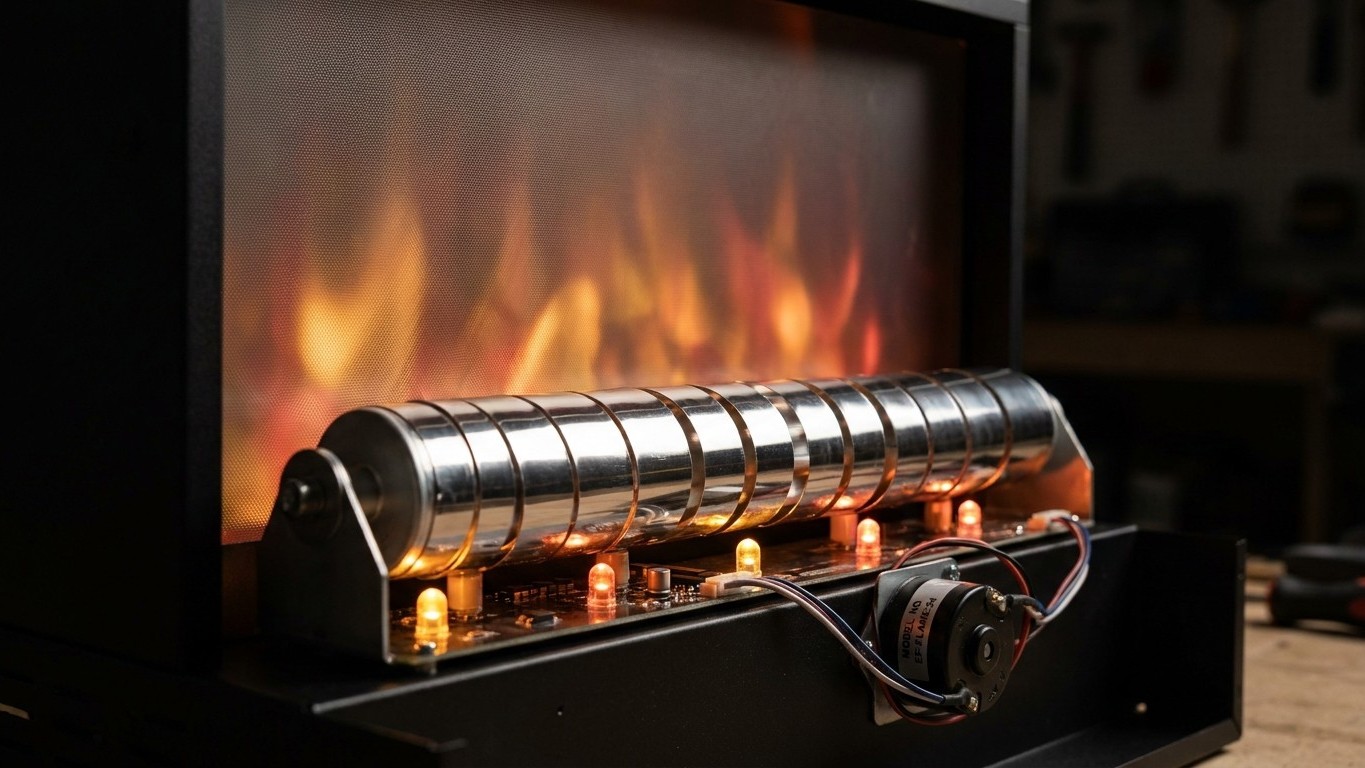

The flickering flame in an electric fireplace is light, not fire. LEDs shine onto a rotating or vibrating reflector, and that motion gets projected onto a screen, glass panel, or the unit’s back wall to fake the flicker of real combustion. Newer models use ultrasonic mist lit from underneath for a plume that actually has depth. None of it produces heat. The warmth, when the unit has any, comes from a separate heating element entirely.
LEDs, a mirror and a turning rod

Once you know the effect is built from light and motion rather than combustion, the Differences between a convincing flame and a cheap-looking one start to make sense. Most units rely on a small motor turning a rod fitted with reflective strips or gauze. LEDs behind or below that rod cast light onto the moving surface, and the reflection gets bounced up onto a diffusing screen. The flicker you see is really shadow and highlight chasing each other across that screen, timed to look random the way an actual fire does.
Why some effects convince and others don’t
Three variables separate a flame that fools you at a glance from one that reads as an obvious gadget the moment you walk in. Depth matters most: cheaper units project onto a flat panel, so the flame sits in one plane and looks papery from an angle. Better ones layer multiple LED strips or use a curved reflector to create foreground and background movement, which is closer to how a real fire stacks logs and gaps.
Motion speed is the second tell. Real flame moves unevenly, fast licks mixed with slow drifting embers. Units with a single fixed rotation speed tend to repeat the same pattern every few seconds, and once your eye catches the loop, the illusion is gone. Color temperature is the third factor. Warm amber and orange LEDs read as fire; anything shifting too far toward yellow-white looks more like a nightlight than a hearth.
Water-vapor units solve the depth problem differently. An ultrasonic transducer turns water into a fine mist, which rises through a chamber and gets lit from below by colored LEDs. Because the mist genuinely occupies three-dimensional space, the plume has real volume and drifts unevenly on its own, without needing a mechanical trick to fake randomness. The tradeoff is a water reservoir to refill and a chamber that needs occasional cleaning, something a purely LED-and-mirror unit never asks of you.
| Effect type | How it works | Realism | Upkeep |
|---|---|---|---|
| Rotating reflector | LEDs bounced off a spinning rod onto a screen | Flat, can loop visibly | None, sealed unit |
| Multi-layer LED panel | Several strips at different depths and angles | Better depth, less repetition | None |
| Water vapor | Ultrasonic mist lit from below | Real three-dimensional plume | Refill water, clean chamber |
Running the picture without the heat
Here’s the fact that changes how most people actually use these appliances: the flame effect and the heater inside are two separate circuits, and the flame draws next to nothing. A plug-in electric fireplace on a standard 120-volt circuit is built at or below about 1,500 watts, roughly 5,000 Btu per hour, when the heater is running. That’s the whole unit, heating one room, not a house. But the LED and motor assembly that makes the flame move pulls power closer to what a few light bulbs use, nowhere near that 1,500-watt ceiling.
What that means for an evening on the couch
Because the visible flame is basically a lighting fixture, it’s entirely normal to leave it running for ambiance on a mild evening without the heater ever switching on. Most units let you select “flame only” mode specifically for this. You get the glow in the room without the fan noise, without the warm air, and without the added draw the heating element would otherwise put on the circuit. For a deeper breakdown of what that split between flame-only and full-heat mode does to your bill over a season, the running cost page in this guide walks through the math using your own rate.
Since the exact price per kilowatt-hour varies by state, utility, and even time of day, check the rate printed on your own electric bill rather than relying on a national average. That number, multiplied against the wattage on the unit’s spec plate, gives a far more accurate picture than any generalized estimate could.
Worth stating plainly, since it’s easy to lose track of amid the flame talk: an electric fireplace burns nothing. There’s no flue, no carbon monoxide to vent, no combustion air being pulled from the room, and no water vapor released as a byproduct of burning fuel. That’s the real advantage over a gas or wood-burning unit, not the look of the flame but the complete absence of anything to vent or exhaust.
The heat itself, when it’s on, comes from a resistive element and a fan pushing air across it, the same basic mechanism as a portable space heater. The flame you’re watching has nothing to do with that warmth. It’s worth keeping that distinction in mind, because it changes how you should place the unit and what you keep near it.
What to look at in a showroom
Showroom lighting is designed to make every flame effect look good, which is exactly why it’s a poor place to judge one. Retail floors are often dim on purpose, and a flame that looks rich and layered under those conditions can look thin and obviously synthetic once it’s sitting in a living room with lamps on and daylight coming through a window. Ask the salesperson to turn on the room’s overhead lights before you evaluate the display, or better yet, view it near a window if there’s natural light available.
Sit down before you decide
Standing and looking straight at a fireplace from a few feet away flatters almost every design, because that’s the angle the reflectors and LED layers are built for. Most of these units end up watched from a couch or chair, at a lower angle and often from an offset position rather than dead center. Sit in a chair near the display if one’s available, or crouch to approximate seated eye level, and watch the flame from that angle for a full minute rather than a glance. Flat, single-plane effects tend to lose their depth first when viewed from the side or from below, while multi-layer units and water-vapor plumes hold up better.
Brightness control matters more than most buyers expect going in. A flame effect that’s brilliant and eye-catching under showroom lighting can be overwhelming in a dim room at night, especially in a bedroom or a smaller living room where the unit sits close to seating. Check whether the display brightness and even the flame color can be adjusted independently of the heater setting, since the two are usually controlled separately. A unit locked to one brightness level offers a lot less flexibility over years of use than one with a simple dimmer or a range of preset intensities.
Finally, treat the fireplace like the heat-producing appliance it is regardless of how decorative the flame looks. The U.S. Fire Administration advises to “Keep anything that can burn at least 3 feet from all heat sources including fireplaces, wood stoves, radiators, space heaters or candles,” and that guidance applies just as much to an electric unit’s heater as it does to a wood stove. The agency also recommends to “Turn space heaters off when leaving the room or going to bed,” a habit worth carrying over even though the flame itself poses no fire risk on its own.
Common questions
Does the flame effect get hot to the touch?
No. The glass or screen showing the flame is lit by LEDs and carries no heat itself. Any warmth felt near the unit comes from the separate heating element and fan, not from the visual display.
Can I run the flame without the heater on?
Yes, most units include a flame-only setting that keeps the LED display running while the heating element and fan stay off, which is why the flame alone draws so little power compared to the roughly 1,500-watt ceiling of the full unit.
Do water-vapor fireplaces need special maintenance?
They need periodic refilling of the water reservoir and occasional cleaning of the misting chamber, upkeep that LED-and-reflector models don’t require since there’s no water involved.
Is a more expensive flame effect always more realistic?
Not automatically. Price often reflects screen size, cabinet materials, or heater output more than flame quality. Judge realism by sitting at a normal viewing angle in a lit room and watching for flat, repeating motion, regardless of what the price tag suggests.