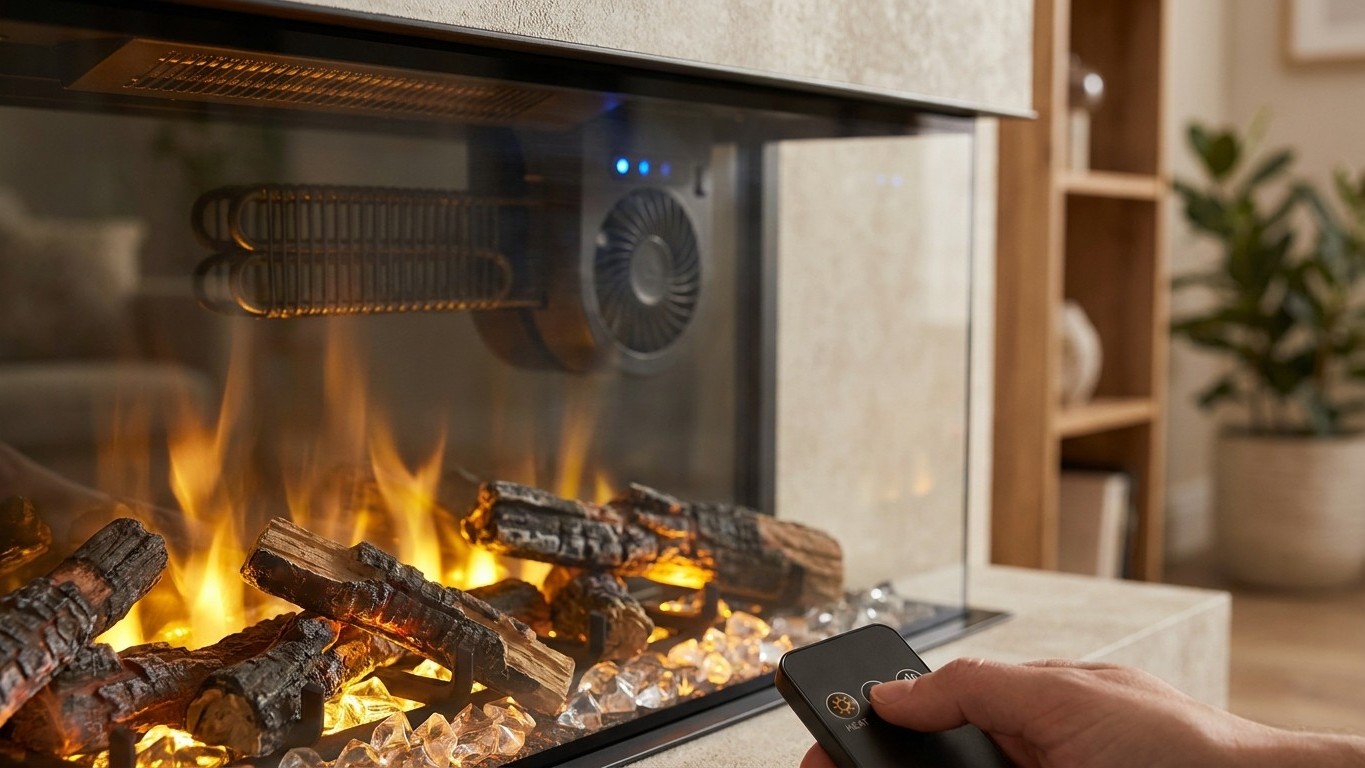

Flames dancing but no warmth coming out usually means the appliance is doing exactly what it was built to do. Electric fireplaces run the light show and the heat on separate systems, so a flame effect with cold air is often just a setting, not a failure. The next most common cause is a thermostat or safety cutout that has already done its job. After that, it’s the wall circuit, not the fireplace, that’s the problem.
The flame and the heater are separate

Inside almost every plug-in electric fireplace there are two circuits that don’t talk to each other. One runs a strip of LEDs and a small motor that spins a reflector or drum, throwing moving light through a screen of gauze, glass, or acrylic crystals. That’s the entire flame effect. It’s light, not heat, and it draws almost nothing from the wall. The other circuit runs a resistive heating element, similar to the coil in a toaster, paired with a fan that pushes air across it and out into the room. That part behaves exactly like a portable space heater bolted inside a mantel.
Because these two systems are wired independently, you can turn one off without touching the other. Most units default to “flame only” during warmer months, which is convenient in July but confusing in October when someone forgets the heater was switched off.
Where the second control hides
The heat setting is rarely obvious. It’s often tucked into one of these spots:
- A button on the handset marked with a sun icon, a fan icon, or “high/low/off”
- A rocker switch behind the lower trim panel or louvered vent, separate from the main power switch
- A dial inside the media console cutout, if the fireplace insert was installed into existing cabinetry
If the remote has weak batteries or a lost signal, the heater command may simply never reach the unit while the flame, controlled by a separate low-power circuit, keeps running fine.
An electric fireplace burns nothing. There’s no flue, no carbon monoxide to worry about, no combustion air requirement, and no water vapor released into the room. That’s the honest advantage over a gas insert, and it’s also why the flame can run independently of the heat with zero venting concerns. It’s just a light box and a fan heater sharing one cabinet. Before assuming something is broken, press the heat button twice, check that the unit wasn’t left in flame-only mode after cleaning or during a warm stretch, and confirm the remote’s batteries are fresh.
The thermostat has already stopped it
Many electric fireplaces include a built-in thermostat, either a simple dial or a digital display with a target temperature. Once the room sensor reads that the set point has been reached, the heating element cycles off while the flame effect keeps running, because again, they’re on separate circuits. This is normal behavior, not a malfunction, and it works the same way a central thermostat cycles a furnace on and off through the day.
A room that’s already warm from sunlight, a nearby space heater, or just a warm afternoon can trigger the same result. The fireplace’s thermostat sees a temperature above its target and simply doesn’t call for heat, even though the flames suggest the unit is fully “on.”
The overheat cutout
Separate from the thermostat is a safety device called an overheat cutout, or high-limit switch. It trips when the intake or outlet vents are blocked and internal temperatures climb past a safe threshold. The most common cause isn’t a wiring fault at all: it’s furniture or a rug placed too close to the appliance, restricting airflow. A media console shelf sitting right above the vent, or a thick rug pushed up against the front grille, is often enough to trip the cutout on its own.
The U.S. Fire Administration puts it plainly: “Keep anything that can burn at least 3 feet from all heat sources including fireplaces, wood stoves, radiators, space heaters or candles.” That clearance isn’t just about fire risk. It’s also what keeps the intake and exhaust paths clear enough for the unit to run without shutting itself down.
If the cutout has tripped, unplug the unit, clear anything blocking the front and rear vents, and let it sit for a few minutes before plugging it back in. If the heater still won’t fire up after clearing the obstruction, the switch itself may have failed and the unit likely needs service rather than a DIY fix.
When it is the circuit, not the appliance
A plug-in electric fireplace on a standard 120-volt circuit is built at or below about 1,500 watts, roughly 5,000 Btu per hour. That’s enough for one room, not a house, and it’s a meaningful draw for a single outlet.
Why extension cords don’t work
Run that fireplace alongside a hair dryer, a window air conditioner, a microwave, or a space heater already on the same circuit, and a breaker trip becomes likely. When that happens, the entire circuit loses power, including the low-draw flame effect, which is a different situation from the thermostat cutting only the heater. If the flames also go dark, the problem almost certainly lives in the breaker panel, not inside the fireplace. Check whether other devices on that circuit were running at the same time, and try the unit alone on a different outlet before assuming the appliance itself is faulty.
An extension cord complicates this further. Standard household extension cords aren’t rated to carry a continuous 1,500-watt load reliably, and the voltage drop across a long or thin cord can cause the heater to shut down, run at reduced output, or trip its own internal safeguard even while the outlet itself is fine. For more on why this matters and which setups actually hold up, see our guide on electric fireplace extension cord safety.
The U.S. Fire Administration also advises: “Turn space heaters off when leaving the room or going to bed.” An electric fireplace’s heating element is functionally a space heater, and that habit matters just as much here, both for safety and for reducing the odds of tripping a circuit overnight. One more thing worth checking before calling for repair: an outlet protected by a GFCI, common in kitchens, bathrooms, and some living rooms, can trip on its own and cut power to the fireplace with no visible sign at the breaker panel itself.
Common questions
Why does my electric fireplace have flames but blow cold air?
The flame effect and the heating element run on separate circuits. Cold air with active flames almost always means the heat setting is off, not that the appliance is broken.
Can I run an electric fireplace on an extension cord?
It’s not recommended for continuous use. A 1,500-watt draw needs a cord rated for that load, and most household extension cords aren’t built for it, which can cause voltage drop or overheating.
Why did my electric fireplace suddenly stop heating on its own?
This is often the overheat cutout responding to blocked vents, or the built-in thermostat reaching its set temperature. Both are normal safety behaviors, not failures.
Does an electric fireplace need a chimney or vent?
No. It burns nothing, so there’s no flue, no carbon monoxide, and no combustion air requirement, unlike a gas or wood-burning fireplace.