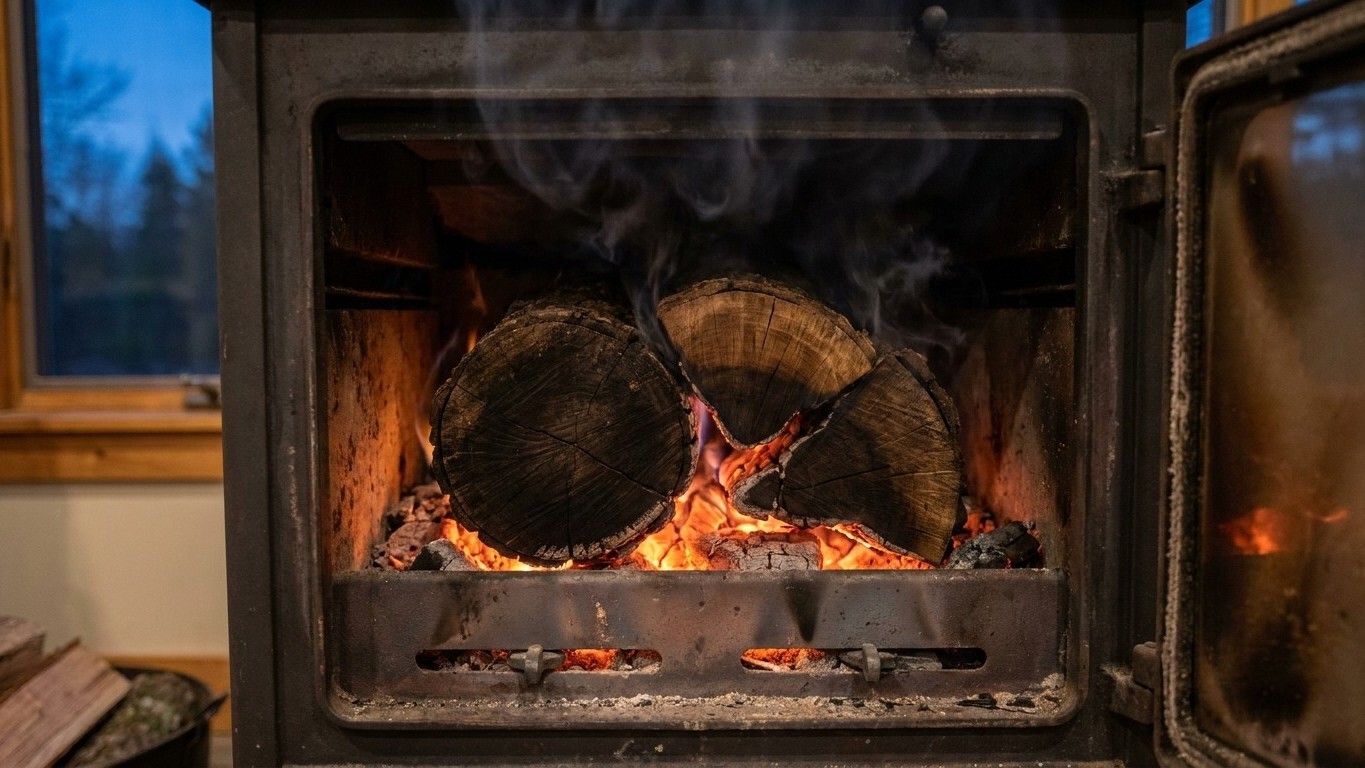

A fire that lasts through the night comes down to two things: how much dense wood is in the firebox and how little air reaches it. There’s no trick, no special log, no magic damper setting that stretches a burn past what mass and airflow allow. Most stoves won’t hold a fire for twelve hours, and any advice claiming otherwise is usually selling a product, not explaining physics.
Making a Fire Last Through the Night

Extension services and state forestry agencies that publish wood-burning guidance generally agree on the same principle: burn duration is a function of fuel mass and oxygen supply, not of technique or gadgetry. A firebox packed with large, dense rounds and starved of air will smolder for hours longer than the same firebox loaded with split, seasoned pieces and left wide open. That’s the entire mechanism. Everything else, the way you load it, the timing, the coal management, exists to support that one relationship.
Large unsplit or half-split rounds of a dense hardwood species burn slowest. The reason is straightforward: a round log has less exposed surface area relative to its volume than the same piece split into quarters. Less surface area means less wood is in direct contact with flame and oxygen at any given moment, so the fire eats through it more gradually. Split wood catches faster and burns hotter, which is exactly what you want for a quick evening fire, but it’s the wrong choice if the goal is a bed of coals still glowing at 5 a.m.
Why density matters more than species reputation
People often ask which species “burns longest,” as if there’s a single answer. Density is the real variable. A dense hardwood round holds more fuel mass per cubic foot than a lighter species of the same size, so it simply has more material to consume before it’s spent. State agriculture and forestry extension programs that publish firewood comparison charts consistently rank species by pounds per cord for exactly this reason: mass predicts burn time far better than folklore does.
Airflow is the other half of the equation, and it’s the part people misuse most. Closing the air supply down slows combustion, which extends the burn, but there’s a real cost to doing that too aggressively. A house that holds its heat, through insulation, sealed windows, and a tight envelope, needs the fire to work less hard in the first place. That’s a separate problem from stove technique, but it changes how much damping you actually need to get through the night.
How to do it
Start the process a few hours before bed, not right at bedtime. Build the fire up to a strong, hot burn first. A hot fire produces the deep coal bed that everything later depends on. Skipping this step and loading big wood onto a weak fire just smothers it.
Once you’ve got a solid bed of glowing coals, rake them forward toward the air intake or glass, rather than leaving them spread thin across the firebox floor. This concentrates the heat where the new wood will sit and gives the incoming logs direct contact with the hottest part of the fire.
Load your largest, densest, least-split pieces against that raked coal bed. Position them so they’re touching the coals directly, not perched above them. The goal is contact, because that’s what gets the new wood igniting from underneath rather than waiting on flame from above.
Leave the air control open for several minutes after loading. This is the step people rush, and it’s the one that causes the most trouble later. The new wood needs to actually catch, meaning visible flame across a good portion of its surface, before you touch the damper. Watch for it rather than guessing on a timer.
Once the wood has caught, close the air down gradually, in stages, not in one motion. Bring it most of the way down and check back in ten minutes. If the fire is still active and the flue draft sounds steady, close it the rest of the way to your normal overnight setting.
What to check before you walk away
Before leaving the fire for the night, confirm a few things:
- The new wood is visibly burning, not just sitting on hot coals
- The air control is at its lowest useful setting, not fully shut if your stove allows a small minimum airflow
- There’s enough coal and wood mass in the box to outlast the hours until you’ll check it again
- Nothing combustible is near the stove’s radiant heat zone
This whole sequence, hot fire first, raked coals, dense wood loaded in contact, air open until it catches, then closed in stages, is really just a reliable order of operations for applying the mass-and-air principle. None of it substitutes for having genuinely dense, well-seasoned wood on hand. A firebox full of punky or half-seasoned rounds will smolder and die regardless of how carefully you load it.
What goes wrong
The most common failure is closing the air down too soon, before the new wood has actually caught. The fire looks fine when you shut the damper, then twenty minutes later it’s producing thick, gray smoke instead of flame, and by morning you’ve got a firebox of half-burned wood sitting on dead coals. If this happens, don’t just crack the air back open and walk away. Open the damper fully, and if there’s enough coal left, rake it forward again and give the load direct air until flame reestablishes. If the coal bed is gone, you’re starting over with kindling.
The second failure is more serious, and it’s the one that gets ignored because the fire technically “worked.” Damping a fire down hard enough to stretch the burn is exactly the condition that produces creosote buildup inside the flue. A smoldering, oxygen-starved fire burns cooler and less completely, and the unburned compounds in that smoke condense on the way up a cooler chimney. That’s the deposit that accumulates over a season of nightly damped-down burns. Chimney safety resources published by fire-safety and extension organizations are consistent on this point: the same technique that gets you through the night is the technique that requires more frequent flue inspection and cleaning, not less.
The trade-off nobody advertises
There’s a real tension between a fire that lasts twelve hours and a fire that burns clean. The longer and lower a burn, the more incomplete combustion you’re generating, and the more residue ends up coating the flue. Homeowners who run their stove hard damped-down every single night through a whole heating season should be scheduling chimney inspection more often than the once-a-year minimum, not less.
A third common problem is simply expecting too much. A fire that’s stone dead by 3 a.m. after being loaded at 10 p.m. isn’t necessarily a failure of technique. It may just mean the firebox is undersized for a true overnight burn, or the wood wasn’t dense or dry enough to begin with. In that case, the fix isn’t a different loading method, it’s reassessing what’s realistic for that particular stove and wood supply, and possibly accepting that a morning reload with kindling on live coals is simply part of the routine rather than a sign something went wrong.