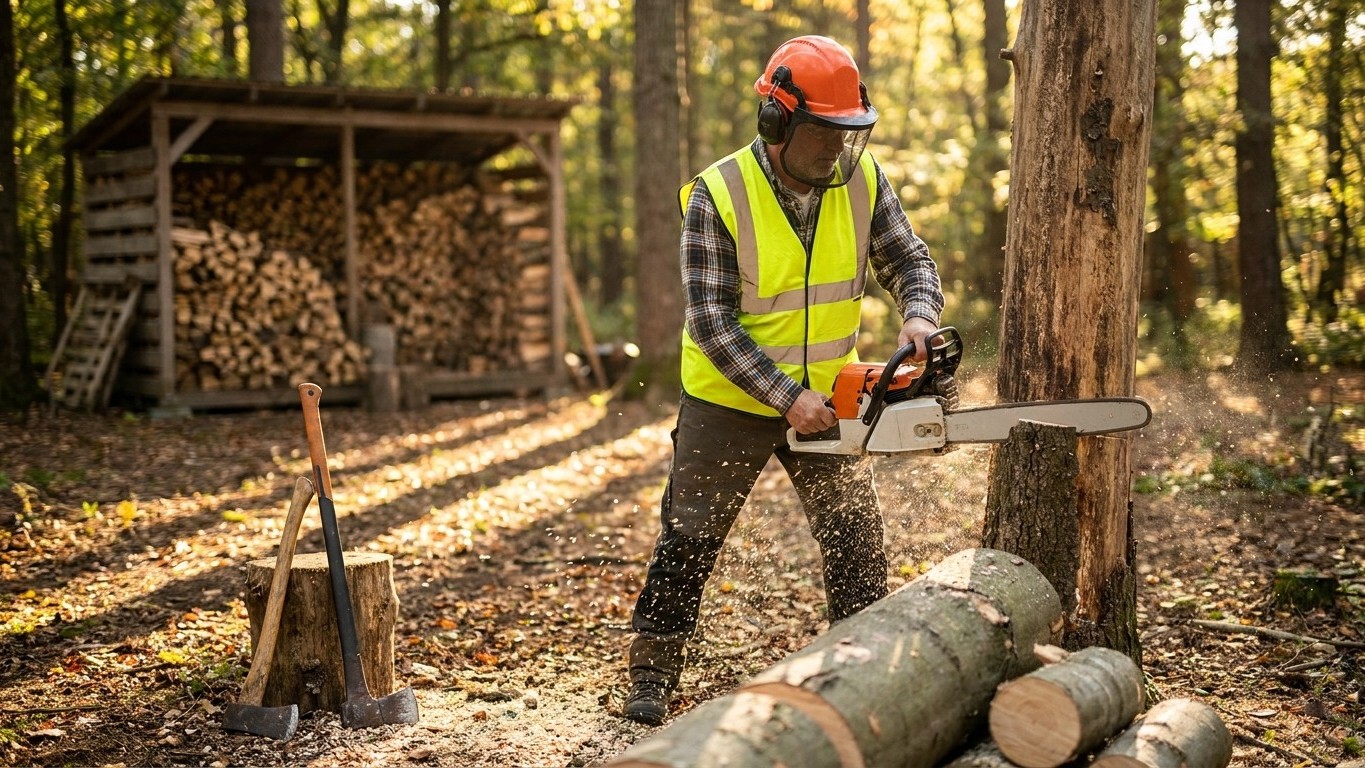

Yes, cutting your own firewood is entirely doable for a landowner with the right permit, the right saw, and the patience to learn the technique before the tree comes down. It is also unforgiving of shortcuts. The wood itself is the easy part. What separates a full woodshed from a trip to the emergency room is almost always preparation, not luck.
Cutting firewood

Firewood cutting is legal on land you own outright, and on many state and national forests through a personal-use permit, usually issued by a ranger district office or a state forestry agency for a set volume of cords per household per year. The paperwork is not a formality. It typically marks which units are open to cutting, what species you may take, and how close to a road you can work. Skip it and you are trespassing, even on public land you have every right to visit.
Live wood vs. standing dead
Standing dead wood is often the driest fuel you will ever burn, sometimes drier than anything stacked and covered for a season, because it has been losing moisture in place for months or years before you ever touch it. It is also frequently the most dangerous tree on the property to fell. A living tree bends and telegraphs its intentions as the saw works through it. A dead one doesn’t. Bark can be loose and shed in sheets the moment the saw vibration hits it. Limbs already weakened by rot can drop without warning, a hazard experienced cutters call a widowmaker for good reason. The wood at the base may look solid and be hollow six inches in. None of that shows up until the cut is already underway.
That unpredictability is the real danger in felling, more than the saw itself. A chainsaw does exactly what you tell it to do. A tree does what its own weight, lean, wind exposure, and internal decay tell it to do, and those factors don’t always agree with your reading of the situation. Extension forestry programs, including guidance published by Penn State Extension and the University of Minnesota Extension, walk through hinge wood, notch angles, and escape routes for exactly this reason: the plan has to account for what the tree might do, not just what you want it to do.
This is also where the line gets drawn between a weekend project and a job for a licensed tree service. A tree with a heavy lean in an unwanted direction, one that’s already hung up in a neighboring tree’s canopy, or one within falling distance of a power line, a fence, or a structure is not a DIY cut. That combination of factors is exactly what turns routine work into the kind of accident that shows up in extension safety bulletins every year. If any of those conditions apply, the responsible move is to call a professional, not to push ahead because the truck is already loaded and the saw is already gassed up.
How to do it
Assuming you’ve got a legal tree to take, on your own land or under a valid permit, and it’s a straightforward standing tree with no lean toward people or property, here’s the order of operations for a weekend cut.
Before you start the saw
- Confirm the permit and the boundary. Know exactly which trees are yours or covered by your permit before you walk in with a saw.
- Walk the fall zone. Look up for hung dead limbs, check the lean, and pick two escape routes at 45-degree angles away from the expected fall line.
- Gear up completely. Chaps, hearing protection, eye protection, and a helmet with a face screen are the minimum standard, and all four together cost far less than a single trip to urgent care.
- Sharpen the chain. A chain that needs forcing through the wood is a chain that’s already blunt. Sharp steel pulls itself into the cut with light pressure; a dull chain makes you push, and pushing is how saws kick back or skate off the bark.
- Bring a second person. Never cut alone. Someone needs to know where you are and be close enough to help or call for help if something goes wrong.
Felling and bucking
Cut your notch on the side facing the direction you want the tree to fall, then make the back cut slightly above the notch’s base, leaving a hinge of uncut wood to guide the fall. Step back along your escape route the moment the tree starts to go, don’t watch it fall from directly behind the stump.
Once it’s down, buck the trunk into rounds sized for your stove or fireplace, working from the base toward the crown. Keep every cut below shoulder height. Cutting overhead puts the bar in an unstable position and puts your arms and face directly in the path of any kickback. From there, split while the wood is still fresh (it splits easier than fully seasoned rounds) and stack it off the ground where air can move through the pile.
What goes wrong
The most common failure isn’t the dramatic one. It’s the saw binding halfway through a cut because the log’s own weight has pinched the bar. When that happens, stop the saw, don’t fight it. Use a wedge or a second cut from the opposite side to relieve the pressure before trying to free the bar. Yanking on a pinched saw is how chains break and bars bend.
Kickback is the failure that sends people to the hospital, and it’s almost always tied back to that same blunt-chain problem. A dull chain forces you to lean into the cut, and the moment the tip of the bar contacts wood or bark at the wrong angle, the saw can snap back toward your face and shoulder faster than you can react. The fix isn’t a technique, it’s maintenance: keep the chain sharp, keep your body positioned to the side of the saw rather than directly behind it, and never let the nose of the bar touch anything unintentionally.
A hung-up tree, one that’s fallen but caught in the branches of a neighboring tree instead of hitting the ground, is the single most dangerous situation an amateur cutter can walk into. It looks stable. It is not. The safe response, once it’s already happened, is to back away, mark the area so no one else wanders under it, and bring in a professional with the right rigging to bring it down safely. Cutting the base to try to drop it, or cutting the tree that’s holding it, is how a tree that already fell once falls a second time, unpredictably, on someone standing underneath.
Fatigue causes its own share of trouble late in a cutting day, when reflexes slow down and shortcuts start looking reasonable. If you’re working with a partner and either of you gets tired, that’s the signal to stop for the day rather than push through one more tree. And if an injury does happen, the reason to never cut alone becomes obvious fast: a chainsaw cut isn’t the kind of wound that waits for you to walk out alone. Having someone within earshot, with a phone and a plan for the nearest road access, is the difference a lot of safety guidance from state forestry programs keeps coming back to, because it’s the one precaution that covers every other mistake on this list.