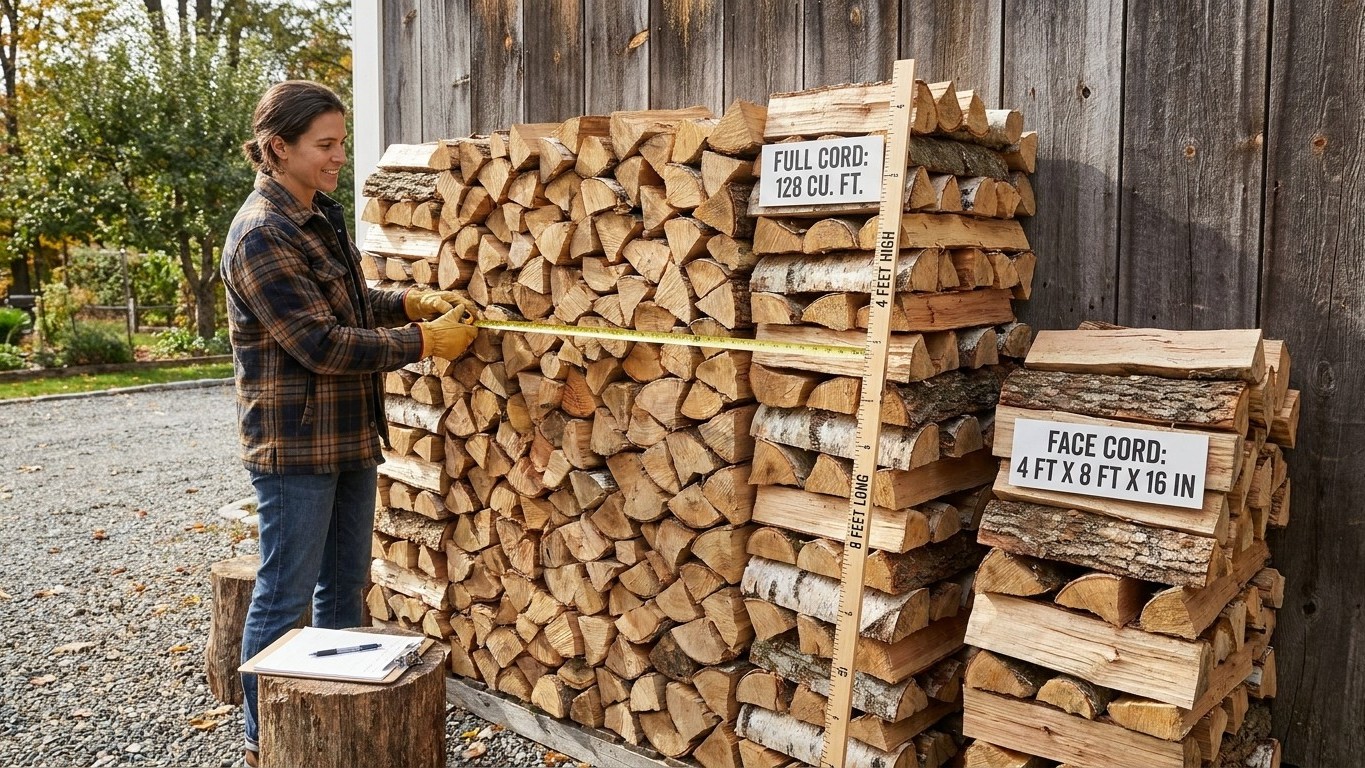

The single best defense against a firewood scam is knowing the legal definition of a cord (128 cubic feet, stacked tight, typically 4 feet high by 4 feet deep by 8 feet long) and insisting the seller meet it, on paper, before money changes hands. Everything else, moisture content, species, delivery timing, matters too, but a short-loaded cord is the most common way buyers lose money on firewood, and it’s also the easiest problem to catch if you know what to measure.
Know What a Cord Actually Is Before You Call Anyone

A full cord is 128 cubic feet of stacked wood. That’s it. No wiggle room, no regional dialect where a “cord” secretly means three-quarters of that. The confusion comes from terms sellers invent to sound legitimate while quietly shrinking the load: “face cord,” “rick,” “truckload,” “rack,” or “pile.” None of these are legal units of measure. A face cord usually means a stack 4 feet high by 8 feet long but only as deep as the logs are long, often 16 inches, which works out to roughly a third of a true cord. There’s nothing wrong with buying a face cord if the price reflects that, but plenty of sellers advertise “cord” and deliver a face cord’s worth of wood while charging full-cord prices.
The National Institute of Standards and Technology publishes the official weights-and-measures guidance that states use to regulate firewood sales, including the requirement that wood be sold by the cord or fraction of a cord and that sellers state the quantity in those terms at the time of sale. You can review the relevant provisions in NIST Handbook 130, which most state weights and measures offices adopt directly. If a seller can’t tell you how many cubic feet you’re getting, or gets cagey when you ask, that’s your first warning sign.
How Short-Loading Actually Happens
Short-loading isn’t usually a dramatic heist. It’s a truck bed that looks full because the wood is stacked loosely, with air gaps between crooked splits, instead of tightly racked. A pickup truck bed loaded loosely might look like it holds a cord but actually contains closer to half a cord once you stack it properly. Sellers count on buyers not restacking the load to check.
Three things make short-loading easy to pull off:
- Delivery happens at dusk or in a hurry, so the buyer doesn’t watch the wood come off the truck
- The wood is dumped in a loose pile rather than stacked, making volume nearly impossible to eyeball
- The seller uses vague language like “a good load” or “a truckload” instead of a cubic-foot figure
The fix is simple even if it’s a little tedious: stack the wood yourself, or watch it get stacked, in a rectangular shape you can measure with a tape measure. Multiply height by width by length in feet. If you paid for a full cord and the math comes out to 90 cubic feet instead of 128, you were short-loaded by nearly 30 percent, and you have grounds to ask for a refund or additional wood.
Wet Wood Sold as “Seasoned”
This is the second most common way buyers get burned, sometimes literally, since unseasoned wood smokes heavily and can contribute to dangerous creosote buildup in a chimney. “Seasoned” isn’t a regulated term the way “cord” is, so a seller can slap the word on wood that was split three weeks ago and call it good. Properly seasoned firewood needs roughly six months to a year of drying time, depending on species and how it was stored, before its moisture content drops to the 20 percent range that burns cleanly and efficiently.
A $15 to $25 moisture meter, the pin type sold at most hardware stores, takes the guesswork out of this. Split a piece of wood in half (moisture readings from the exterior surface are unreliable because the outside dries faster than the core) and press the pins into the freshly exposed face. A reading above 20 percent means the wood isn’t ready to burn well, no matter what the invoice says. Readings between 15 and 20 percent are the sweet spot for most hardwood species. If a seller resists letting you test a sample, or claims their wood “doesn’t need testing,” treat that as a signal to keep shopping.
Visual and physical clues help too, though they’re less reliable than a meter. Seasoned wood tends to be lighter than it looks, has cracks radiating from the center of the cut ends, and makes a sharp, hollow knock when two pieces are struck together rather than a dull thud. Wet wood feels noticeably heavier for its size and often shows dark, damp coloring at the cut ends.
Species Substitution and Mixed Loads
Not every scam is about quantity or dryness. Some sellers advertise premium hardwood, oak, hickory, sugar maple, species that burn hot and long, then deliver a load mixed heavily with softwoods like pine or fast-growing species like poplar and willow. Softwoods aren’t useless (they’re fine for kindling or shoulder-season fires) but they burn faster and produce less heat per piece, so a load that’s 40 percent pine when you paid for oak is effectively a shortage dressed up as a full delivery.
Learning to identify a handful of common species by bark and grain pattern pays off fast. Oak bark is deeply furrowed and dark gray; the split wood has a tight, straight grain. Hickory has a similar furrowed bark but a slightly lighter, more orange-tinted wood underneath. Pine is easy to spot from the sap: it’s often sticky or has visible resin pockets, and the wood smells distinctly like turpentine when freshly split. If you’re not confident identifying species on sight, ask the seller to name what’s in the load and hold them to it. A reputable dealer will tell you upfront if a load is mixed and typically charges less for it.
What to Ask and Get in Writing Before Delivery
A phone call or text exchange before the truck shows up prevents most disputes. Confirm the exact quantity in cubic feet or fraction of a cord, the species (single species or mixed, and which ones), whether the wood is seasoned or green, and the total price including delivery and stacking fees if those apply. Ask for this in a text message, email, or written receipt rather than a verbal promise. Many states require sellers to provide a receipt or delivery ticket showing the quantity sold in cord terms, the seller’s name and address, and the date of delivery, precisely because verbal agreements are so easy to dispute later.
Keep that receipt until you’ve measured the delivered wood. If the stacked measurement comes up short, the paper trail is what lets you file a complaint with your state’s weights and measures division, the same office that calibrates gas pumps and grocery scales. Most states take firewood complaints seriously because short-weighting and short-volume sales fall under general consumer protection statutes, not some firewood-specific loophole.
Timing Your Purchase Matters
Buying in late summer or early fall, before the seasonal rush, tends to get better prices and better wood, since sellers haven’t yet drawn down their driest, best-seasoned stock to meet peak winter demand. Waiting until the first cold snap in November or December often means paying premium prices for wood that was cut and split just weeks earlier, because dealers are scrambling to keep up with orders and don’t have properly dried inventory left. If you have the storage space, buying a year ahead and letting the wood season on your own property under a simple cover gives you the most control over quality and the least exposure to being cheated on dryness claims.
Red Flags Worth Walking Away From
A few patterns show up again and again in firewood complaints. Cash-only sellers with no fixed address or business name are harder to track down if something goes wrong. Sellers who refuse to state quantity in cord or fractional-cord terms, sticking instead to “truckload” or “pile,” are often hedging so they can’t be held to a measurable standard. Anyone who insists on dumping the wood in an out-of-the-way spot rather than letting you watch or help stack it is making it harder for you to verify what you received. None of these guarantee a scam, but stacked together they’re a strong signal to find a different supplier, ideally one with reviews, a local reputation, or a referral from a neighbor who’s bought from them before.
One more practical detail: firewood transport across state lines, and sometimes even within a state, is often restricted because of invasive pests like the emerald ash borer, which spreads through moved firewood. Buying from a local supplier isn’t just about avoiding a scam. It also keeps you on the right side of quarantine rules that many states and the USDA enforce specifically to slow the spread of tree-killing insects.