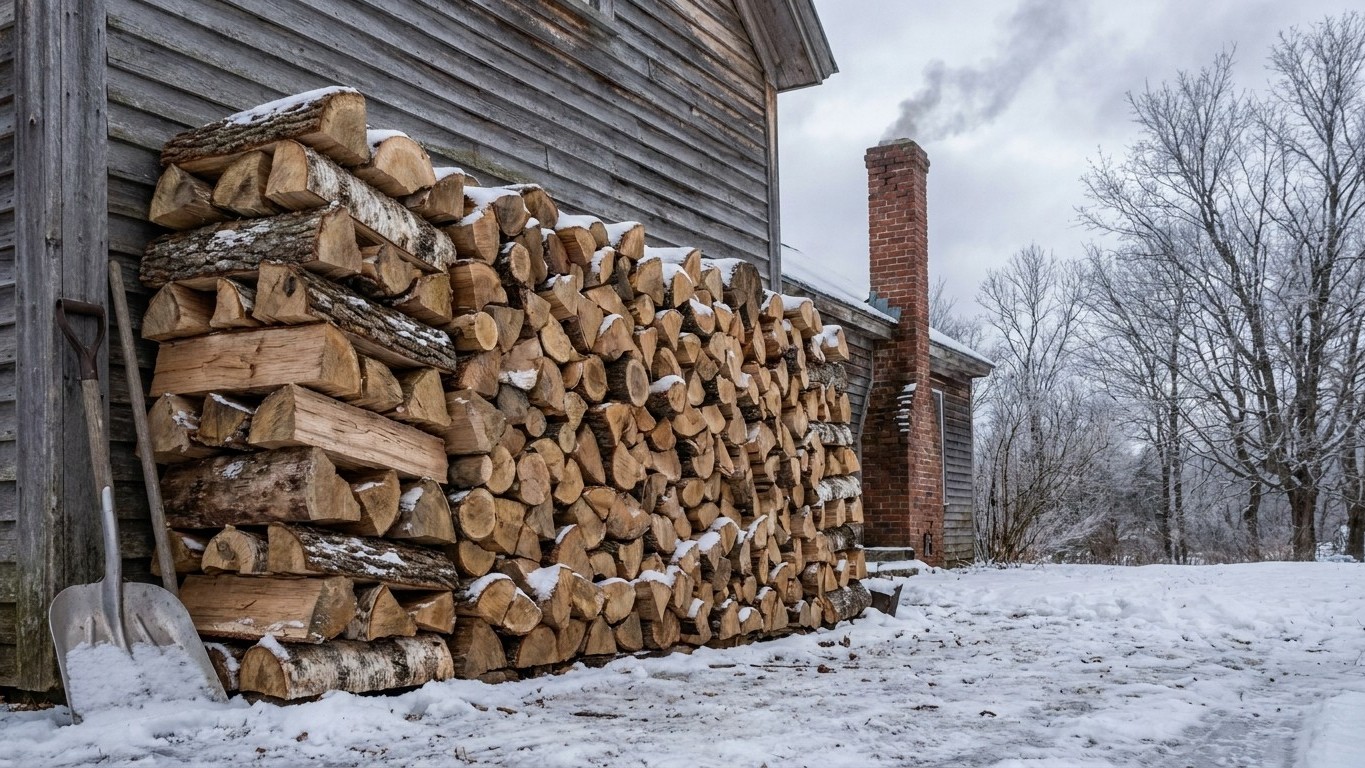

There’s no single number that answers how much firewood a winter takes, and any article that hands you one is guessing. The real answer depends on your coldest nights, how tight your house is, and whether wood carries the whole heat load or just takes the edge off. The only trustworthy figure is the one you measure yourself, starting this season.
How Much Firewood a Winter Takes

Ask five neighbors how many cords they burn and you’ll get five different answers, and none of them will tell you much about your own house. State extension services and forestry agencies that publish heating-with-wood guides are consistent on this point: firewood consumption swings by climate zone, insulation quality, and stove or furnace efficiency, and two houses on the same street can differ by a factor of three. A drafty farmhouse with single-pane windows and a wood stove as the sole heat source can chew through triple the wood of a well-sealed, well-insulated home the same size, even if both sit in the same county and face the same winter.
What extension publications generally do offer is a mechanism, not a magic number: they walk homeowners through counting heating degree days for their region, comparing that to the BTU output of their appliance, and factoring in how much of the house’s heat load wood is actually expected to carry. That’s useful as a framework, but it still lands on an estimate, not a guarantee. The honest way to get a real figure is to burn through one full winter, track what you use, and treat that as your personal baseline going forward.
Why the range is so wide
Three variables do almost all the work. First, climate severity: a winter with three weeks below zero burns differently than one that mostly hovers in the 30s, even in the same town, because cold snaps drive consumption far harder than average temperature does. Second, the house itself: attic insulation, air sealing around windows and doors, and even how many exterior walls a room has all change how fast heat leaks back out. Third, the role wood plays: a house using wood as a backup for occasional cold nights burns a fraction of what a house heating entirely with wood needs.
The cord is the one unit worth reasoning in, because it’s a physical measurement, not a marketing term: 128 cubic feet of stacked wood, typically racked as a stack 4 feet high, 4 feet wide, and 8 feet long. Everything else, face cords, ricks, truckloads, is a regional stand-in for that measurement and varies by how tightly the wood is stacked and how it’s split. When you’re comparing what you burned last year to what you’re buying this year, convert to full cords first, or you’re comparing two different things.
How to do it
Building a real number for your own house takes one full season and some basic tracking. Here’s the order that actually works.
- Mark your starting stack this weekend. Measure the woodpile you’re heating with right now in cubic feet, height times width times length, and convert to cords by dividing by 128. Write the number down somewhere you won’t lose it.
- Note what role wood plays in your heating. Decide honestly whether it’s your only heat source, your primary source with a backup furnace, or just supplemental heat for the coldest nights and the living room. This changes everything that follows.
- Track refills through the season. Every time you restack or bring in a new load, log the date and the cord measurement. A phone note or a piece of paper taped near the wood rack works fine.
- Log the cold snaps. Note the weeks that ran unusually cold versus the weeks that were mild. This tells you later whether a big jump in wood use came from weather or from a leaky damper.
- Measure what’s left at the end of winter. When you stop burning regularly in spring, measure the remaining stack the same way you measured the start.
- Do the subtraction. Starting stack, plus everything added, minus what’s left, equals your real seasonal usage in cords. That’s your baseline, specific to your house, your climate, and your habits.
- Buy or cut for next winter now, not later. Wood cut or bought this fall is usually not seasoned enough to burn well this winter. Order or split a year ahead so it has a full season to dry before it goes in the stove.
Using the baseline
Once you have one season’s real number, adjust it for known changes rather than starting from scratch. If you added attic insulation or sealed drafty windows, expect usage to drop the following year. If you switch from supplemental burning to heating the whole house with wood, expect it to climb sharply. The baseline isn’t a fixed number for life, it’s a starting point you correct year over year.
What goes wrong
-
I ran out of wood in February
This is almost always a planning problem, not a burning problem: the stack was sized off a guess, or off someone else’s usage, instead of a measured baseline. If it’s already happened, the immediate fix is buying seasoned wood locally rather than green wood, even at a higher price, because unseasoned wood this late in the season won’t dry in time to burn well. Longer term, use this season’s shortfall as data: measure how many weeks the stack lasted and how many weeks of cold remained, and size next year’s supply against that gap plus a buffer.
-
I bought wood this fall and it won’t burn right
Wood cut or bought within the same year is usually still too wet to burn efficiently, no matter what the seller called it. Green or under-seasoned wood hisses, smokes heavily, and throws far less heat than dry wood of the same species. If you’re stuck with it now, burn it mixed with your driest, oldest splits to keep the fire hot enough to combust the moisture, and expect lower heat output and more chimney deposits until it’s used up. The fix going forward is timing: buy or cut a full year ahead so the wood has a complete season, spring through fall, to dry before it’s needed.
-
My usage this year is way higher than last year and nothing obvious changed
Before assuming the house got leakier, check the two variables that swing usage the most: how cold the season actually ran compared to last year, and whether wood took on more of the heating load, say a furnace that struggled or got used less. A colder winter or a shift toward wood as primary heat can easily explain a big jump without any change to the house itself. If neither explains it, the next place to look is the stack measurement itself, since a face cord or rick counted as a full cord by mistake will throw off the comparison every time.
-
I don’t know how much wood is actually in my stack
This usually means the pile was estimated by eye rather than measured. Fix it directly: measure height, width, and length in feet, multiply the three together, and divide by 128 to get cords. Loosely thrown stacks measure larger than tightly racked ones for the same amount of actual wood, so restack it square against a wall or between stakes before measuring if the pile looks uneven. Once it’s measured properly, that number becomes the one you track all season, not a guess corrected later.