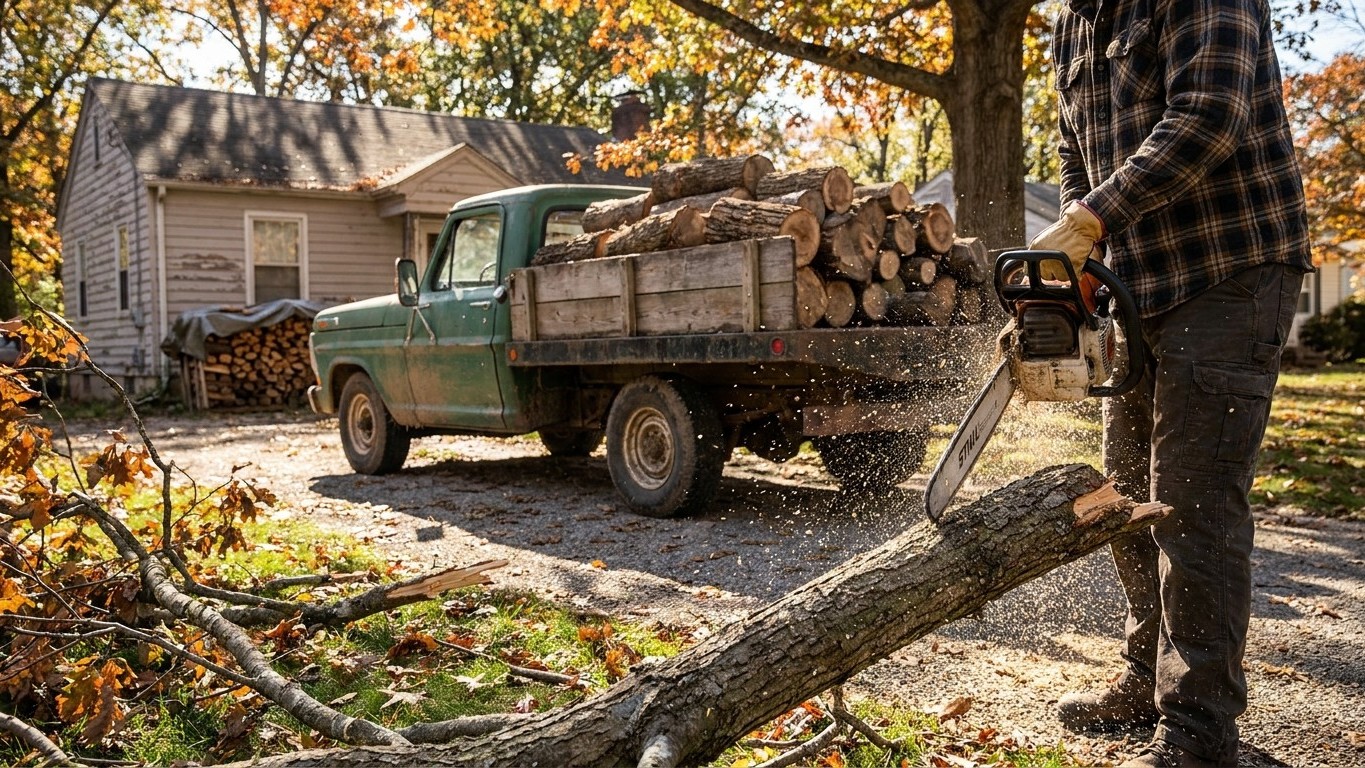

Free firewood is out there, and it costs nothing but time, a truck, and a saw. Storm damage, tree removal services, and utility line clearing are the three sources that consistently produce wood for the taking. Public forests add a fourth option through personal-use cutting permits. The catch: nearly all of it arrives green, so plan on a full year of drying before it’s ready for the stove.
Finding Firewood Without Buying It

The fastest route to a free wood supply runs through storm damage. After a windstorm, ice event, or hurricane remnant moves through a region, municipalities and utility crews clear downed trees off roads and rights-of-way, and a lot of that wood ends up in a pile with nobody’s name on it. That doesn’t mean it’s free for the taking, though. A downed tree belongs to someone, even when it’s sitting on the roadside. Always ask, whether that means knocking on the nearest door, calling the county public works line, or checking with the crew on scene before you load a single round into your truck.
Tree services are the second reliable channel. Arborists and tree removal companies cut wood every day and often pay to haul it to a landfill or a wood-recycling yard. Many are happy to drop logs at a homeowner’s property instead, since it saves them a dump fee and saves you a purchase. A short conversation with a local company, asking to be added as a drop-off option, can produce a standing arrangement that pays off for years.
Utility line clearing is the third no-cost source. Power companies trim and remove trees along transmission corridors on a rotating schedule, and the cut material sometimes sits at the edge of the right-of-way waiting for pickup. Calling ahead and asking about scheduled clearing work in your area, and whether residents can claim the wood, is worth the ten minutes it takes.
Beyond these three, many public forests sell personal-use cutting permits for a modest fee, with rules on species, size, and season that vary by forest and change from year to year. Rather than guessing at those conditions, go straight to the agency that manages the land. Land-grant university extension services and state forestry agencies are the standard sources for current permit rules, safe cutting practices, and wood-drying guidance, and they publish this information specifically for homeowners doing exactly this kind of legwork.
One physical fact applies no matter which source produces the wood: do not take standing dead trees near a road, a trail, or a building. They fall unpredictably, and a permit or a friendly tree service doesn’t change the physics.
How to do it
- Call your county emergency management office or public works department this week and ask what happens to downed trees after storms, and whether residents can claim cleared wood.
- Contact two or three local tree service companies or arborists and ask to be added as a drop-off location for logs they’d otherwise pay to dump.
- Check your electric utility’s website or call customer service to find out if line-clearing work is scheduled in your area, and whether cut material is available for pickup.
- Search for your state’s public forest, state park, or state land agency page and locate the personal-use firewood permit information, including current species, size, and season restrictions.
- Apply for the permit through that agency, and read the map or unit description carefully before you go, since permitted cutting areas are usually specific and limited.
- Walk the permitted area first and identify standing dead trees that are clearly away from roads, trails, and structures before you fire up a saw.
- Cut and buck the wood into stove-length rounds on site, then haul it home the same day or within whatever window the permit specifies.
- Split and stack the wood off the ground immediately, in a spot with airflow, and mark the date so you know when the year-long drying clock started.
What goes wrong
I cut or hauled wood that turned out to belong to someone else
This is the most common misstep, especially with roadside storm debris that looks abandoned but isn’t. If it’s already happened, the right move is to contact the property owner or the local authority directly, explain the situation, and offer to return or pay for the wood. Most disputes resolve quickly once the owner sees it was a genuine mix-up rather than deliberate theft, but ignoring it or hoping nobody notices tends to make things worse.
The free wood I collected won’t burn well
Free wood is almost always green wood, and green wood smokes, hisses, and struggles to hold a flame. If you’re already stuck with a load of it, split it into smaller pieces to speed evaporation, stack it somewhere with full sun and wind exposure, and give it the better part of a year before burning. In the meantime, burn only wood you already know is seasoned, and treat the green load as next winter’s supply, not this winter’s.
I got flagged for cutting the wrong species, size, or season under my permit
Permit rules differ from forest to forest and change over time, so a rule that applied last season may not apply now. If you’ve already cut something outside the permit’s terms, stop cutting immediately and contact the managing agency’s office directly rather than waiting to be contacted. Explaining the mistake up front, and asking how to correct it, is treated very differently than being caught mid-violation.
A standing dead tree I cut fell somewhere I didn’t expect
Standing dead trees near roads, trails, or buildings are unpredictable by nature, which is exactly why they’re off-limits regardless of permit status. If a tree has already come down in an unsafe direction, clear the area, check for anyone nearby, and report the hazard to the landowner or managing agency so it can be assessed before anyone else approaches it. Going forward, choose only standing dead trees with a clear, open fall zone in every direction.