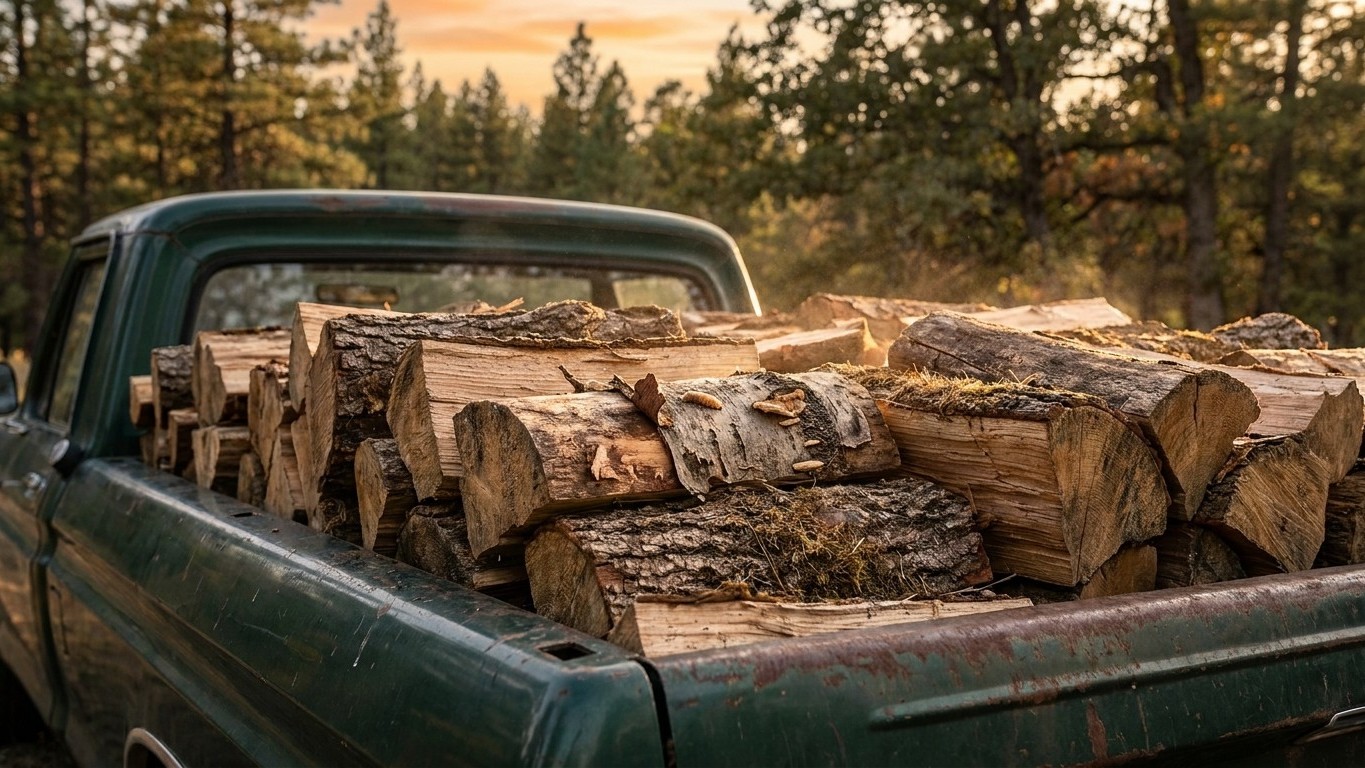

Moving firewood spreads tree-killing insects and fungi that can’t travel far on their own, but hitch a ride easily in a car trunk or truck bed. A single load can carry the emerald ash borer, the Asian longhorned beetle, or oak wilt spores across a hundred miles in an afternoon, arriving in a forest that has no natural defense against them. That’s the entire reason the rule exists, and it’s why campgrounds keep asking where your wood came from.
Why You Should Not Move Firewood

A log sitting in your garage looks harmless. Under the bark, it can hold beetle larvae, fungal spores, or eggs that won’t hatch or spread on their own for months. Left in a forest, these pests move a few miles a year at most, limited by how far an insect can fly or a spore can drift on wind. Put that same log in a car and drive it to a state park three counties over, and you’ve just handed the pest a shortcut it could never have found by itself.
This is exactly how the emerald ash borer became one of the most destructive forest pests in North American history, and how the Asian longhorned beetle and oak wilt fungus have jumped into new regions far from their original range. None of these organisms are strong travelers. All of them are excellent hitchhikers. The national Don’t Move Firewood campaign, backed by the USDA Forest Service and The Nature Conservancy, was built specifically around this gap between how far a pest can travel naturally and how far a human will drive with a bundle of logs in the back seat.
Campgrounds are ground zero
The classic scenario plays out at campgrounds every summer: a family loads up firewood from the pile behind their house, drives two or three hours to a state park, and burns what they can. Whatever’s left over sometimes gets left at the site, sometimes gets hauled to the next campground the following month. Multiply that by thousands of camping trips each season, and you get a distribution network for tree pests that no forest could build on its own.
State forestry and agriculture departments respond by restricting or banning the transport of untreated firewood across county or state lines. But the rules vary widely from one place to the next, and they change as new pests are detected. A restriction that applies in one county may not exist thirty miles away, and a state that had no rule last year may have added one this year in response to a new infestation. Rather than rely on a rule quoted secondhand, check with your own state’s forestry or agriculture department before you load the truck. That’s the only way to know what actually applies to your trip.
How to do it
Handling firewood responsibly doesn’t take special equipment or expertise. It takes a change in habit, and every step below is something you can put into practice on your very next trip.
- Check the rules for where you’re headed before you leave. Visit your state’s forestry or agriculture department website, or call the campground directly, to find out whether there’s a restriction on bringing in outside firewood.
- Skip packing wood from home. If you’re driving to a campground, state park, or cabin, plan on not bringing any firewood with you at all. Treat it the same way you’d treat a cooler of live bait you’re not allowed to release.
- Buy it where you’ll burn it. Purchase firewood from a vendor at or near your destination, ideally within the same county. This is the simplest way to guarantee you’re not moving anything across a pest boundary.
- Ask for certified heat-treated wood if you must transport any. Heat treatment kills insects and fungal spores inside the wood, and certified bundles are usually labeled as such at retail locations. This is the only wood that’s generally considered safe to carry any real distance.
- Burn everything you buy. Plan your purchase for the length of your stay so you use it all rather than ending the trip with a stack of unburned logs to deal with.
- Leave any leftovers behind. If wood remains at the end of your visit, leave it at the campground, offer it to the camp host, or give it to another camper staying longer. Don’t put it back in the vehicle.
What goes wrong
Even with good intentions, plans change and mistakes happen. Here’s what to do when you find yourself in one of these situations.
I already brought firewood from home and it’s sitting in my trunk
Don’t drive it back home, and don’t move it to a different site or campground. Burn it entirely during this stay if local rules allow burning it at all, or ask the campground host or ranger for guidance on how to dispose of it on-site. The goal is to make sure that wood never leaves this location in either direction.
I found bugs, tunnels, or fungal streaks in wood I bought locally
Stop burning that batch and set it aside from other wood piles. Contact your state’s forestry or agriculture department to report what you found; many maintain hotlines or online reporting tools specifically for suspected pest sightings. Even wood purchased nearby can occasionally carry an infestation if it came from an already-affected area.
The campground won’t let me bring in the wood I already purchased
This usually means the wood doesn’t meet the local certification or heat-treatment requirement, or it wasn’t sourced close enough to the site. Ask the office if they sell or can direct you to compliant wood on-site. It’s inconvenient, but it’s far better than being turned away or fined at the gate.
I have wood left over and I’m packing up to head home
Resist the urge to save it “for next time.” Offer it to neighboring campers, give it to the camp host, or leave it in a designated wood drop area if the campground has one. Taking it home defeats the entire purpose of buying local in the first place, since it turns your vehicle into the same kind of pest transport it was meant to avoid.