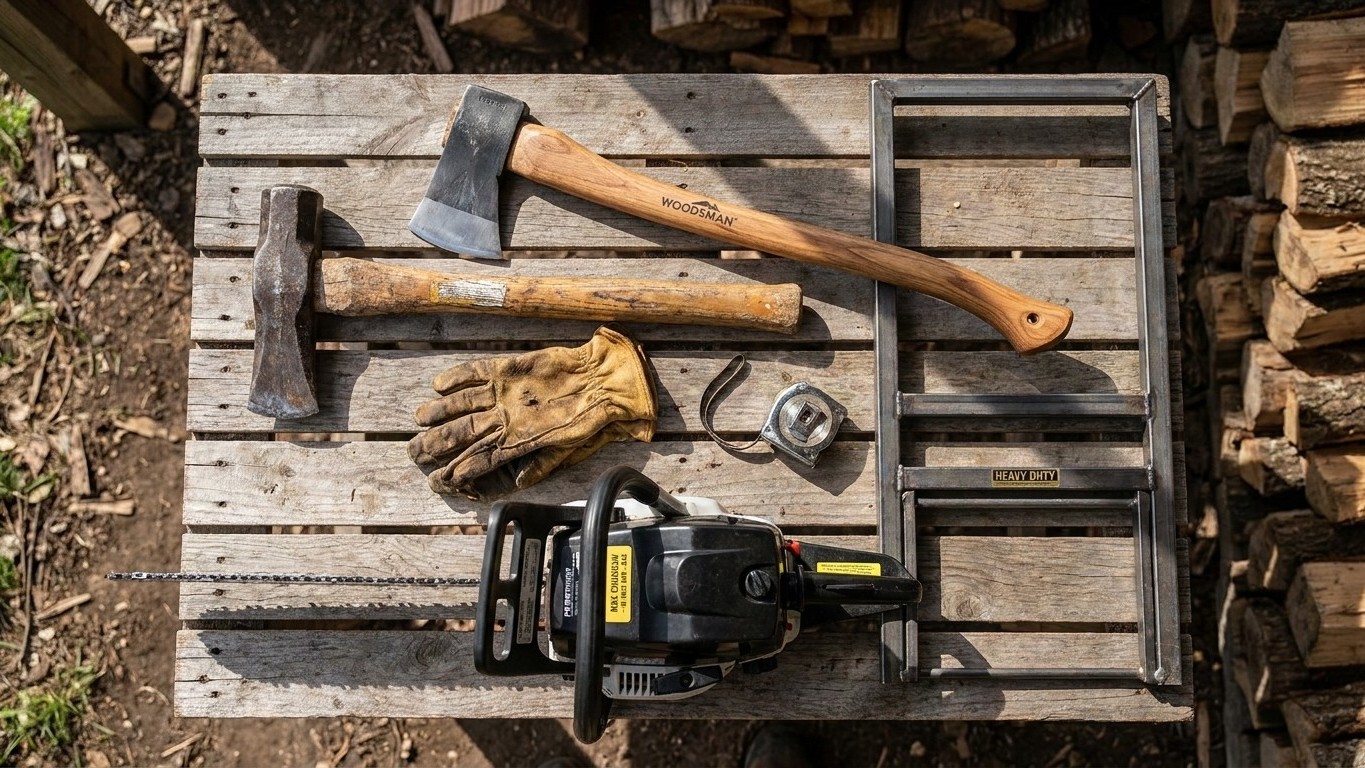

A firewood season lives or dies on five tools, and none of them is the splitter you’re probably picturing first. What keeps a woodpile dry, a chain cutting instead of grinding, and a knotty round splitting instead of bouncing back at your shins is a short list of gear that costs less than one cord of seasoned oak. Here’s what actually earns its keep.
The Tools a Firewood Season Actually Needs

The single tool that matters most isn’t a chainsaw, a splitter, or even a good axe. It’s whatever keeps the wood off the ground. Firewood stacked directly on dirt or grass wicks moisture up from below faster than rain falls on it from above, and that moisture is exactly what stalls the seasoning process and invites rot and insects into rounds that would otherwise burn clean. A stack of pallets, a few pressure-treated 2x4s, or a purpose-built rack does the job. Nothing fancy required, just air between the wood and the ground.
Past that, the cutting and splitting tools split into two jobs that get confused constantly. A splitting axe and a splitting maul are not the same tool, even though they look similar leaning against a shed wall. The axe cuts, using a thinner, sharper edge designed to bite into fiber and sever it. The maul wedges, using a heavier head and a blunter profile designed to force wood apart along the grain rather than slice through it. Grab a felling axe, the kind meant for cutting down a tree, and try to split rounds with it, and you’ve made the classic wrong-tool mistake. A felling axe is ground for a cutting bite, and on a round of firewood it tends to glance off at an angle instead of driving straight down, which is how ankles and shins get hurt.
When Wood Fights Back
Some rounds won’t split no matter how good your swing is. Knotty, twisted, or crotch-heavy wood locks up under an axe or maul because the grain runs in more than one direction at once. This is where wedges and a sledge do what no axe will ever manage. Driving a steel or plastic wedge into a starter crack and following it with sledge blows lets you open resistant rounds in stages, redirecting force exactly where the wood is weakest instead of relying on one clean overhead swing.
Chainsaw maintenance belongs on this list too, and it’s the piece people skip most. A chain that needs forcing through a cut is a blunt chain, and a blunt chain is the dangerous one. Dull teeth make the saw wander, kick, and require more downward pressure than a sharp chain would ever need, which is a recipe for the saw jumping when it finally does bite. A flat file, a filing guide, and five minutes per tank of fuel keep a chain cutting instead of fighting you.
Then there’s protection, which several state forestry extension programs list as the cheapest part of the entire operation relative to what it prevents. Chainsaw chaps, eye protection, ear protection, and a solid pair of gloves cost a fraction of what a single emergency room visit runs, and they’re the difference between a scare and a real injury when a chain grabs or a round splits unpredictably.
How to do it
- Build or set up an off-ground stacking surface first. Lay pallets, rails, or a rack before you cut a single round, so freshly split wood never touches soil even for a day.
- Sort your rounds by grain before you split. Set aside anything with visible knots or crotch wood so you’re not surprised mid-swing by a round that resists a normal split.
- File the chain before the first cutting session of the day. A few strokes with a guided flat file restores a clean bite and takes less time than fighting a dull chain through one stubborn log.
- Put on chaps, eye protection, ear protection, and gloves before starting the saw. Do this every session, not just the first one, since habits fade fast once nothing bad has happened yet.
- Cut rounds to a consistent length. Uniform pieces stack tighter, season more evenly, and are easier to judge for splitting difficulty at a glance.
- Split the straight-grained rounds first with the axe. Save the maul and wedges for anything with knots or twisted grain, so you’re not switching tools mid-pile out of frustration.
- Start a stubborn round with a wedge, not repeated maul swings. Drive the wedge into a crack, then follow with the sledge in controlled strikes rather than trying to force the maul through resistant grain.
- Stack split wood on the off-ground surface immediately. Don’t let split rounds sit on the ground overnight even temporarily; moisture starts working on exposed wood fast.
- Leave gaps in the stack for airflow. Loose, criss-crossed stacking beats a tight, neat pile every time when it comes to actual drying speed.
- Re-check the chain’s sharpness at the end of the session. A chain that started sharp can dull fast in dirty or knotty wood, and starting the next session already blunt compounds the problem.
What goes wrong
-
The axe keeps glancing off the round instead of biting in
This is almost always the wrong-tool problem: a felling axe, ground thin for cutting, doing a splitting maul’s job. Stop using it on rounds immediately. Switch to an actual splitting maul, and if the round still resists after a couple of solid swings, move straight to a wedge and sledge rather than repeating the same glancing swing and hoping for a different result.
-
The chainsaw needs real muscle to get through a cut
A saw that requires pushing or leaning into the cut has a blunt chain, full stop. Stop cutting. Continuing to force a dull chain is how kickback happens, since the saw compensates for lost sharpness by grabbing unevenly. File the chain with a guided flat file before making another cut, even if it means stopping mid-session.
-
The wood pile is moldy or soft after just one season
This points straight back to ground contact. If the bottom rows of a stack feel spongy or show white or gray mold, the wood was sitting on dirt, grass, or a tarp laid flat on the ground with no airflow underneath. Pull the affected rounds, let them dry separately in full sun and wind, and rebuild the stack on pallets or rails going forward. The rest of the pile, if it was elevated, should be fine.
-
A knotty round split, but shot a chunk sideways
Twisted or crotch grain doesn’t fail predictably, and a maul or axe swing on that kind of wood can send a piece flying at an angle instead of straight down. This is exactly why eye protection and standing clear of the swing radius matter even on rounds that look manageable. Going forward, identify knotty rounds before swinging and start them with a wedge and sledge, which controls the split direction far better than a single overhead blow.