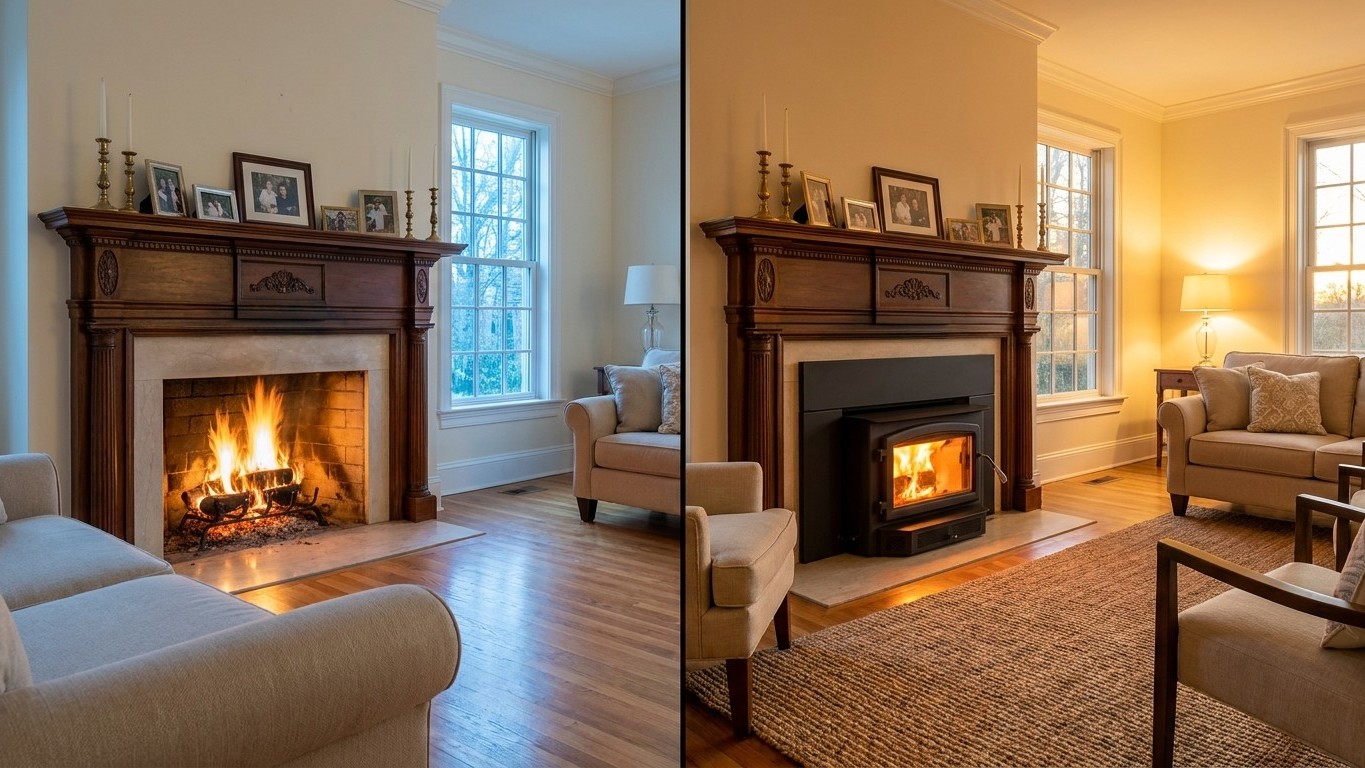

An open fireplace burns beautifully but heats poorly, while an insert or a wood stove turns the same firebox into a real heat source. The choice comes down to what you actually want from that wall: a glowing focal point for the living room, or a unit that can carry part of the winter heating load. Both are legitimate, they just solve different problems.
Open Fireplace, Insert or Stove

Here’s the physical reality most homeowners never get told at the hardware store: an open fireplace can pull more warm air out of a house than it puts in. The fire needs a constant supply of air to keep burning, and it draws that air straight out of the room and up the chimney. Every cubic foot of heated air that leaves through the flue gets replaced by cold air seeping in around windows, doors, and outlets elsewhere in the house. On a windy night, a roaring open fire can leave the rest of the home colder than if no fire were burning at all.
An insert or a closed stove changes that ratio completely. Because the firebox is sealed behind glass and the air supply is controlled through a damper or vent, the unit isn’t constantly siphoning room air to feed an open flame. The same cord of wood that barely takes the chill off in an open hearth can heat a room, sometimes a good part of a house, once it’s burning inside a closed system. State forestry and agricultural extension programs that study residential wood heating consistently point to this as the single biggest efficiency gap in home heating setups: it’s not the wood that changes, it’s the appliance around it.
Glass doors and a controllable air intake are what actually convert a fire into a heat source rather than a decoration. The doors stop the open pull of room air into the flue, and the air control lets you meter exactly how much oxygen reaches the coals, which is what determines how long and how evenly the wood burns. Without those two features, you’re essentially burning wood to look at it.
None of this makes an open fireplace a bad choice. It’s an atmosphere appliance, and there’s nothing wrong with wanting that. A crackling open fire on a holiday evening, with the option to fully open the flue and watch actual flames, is worth something that a sealed stove with a small glass window can’t replicate. The mistake is expecting an open fireplace to do a stove’s job, or installing an insert and being disappointed that it doesn’t look like a campfire anymore. Deciding which one you want starts with deciding which job you’re hiring it for.
How to do it
- Watch how your current fireplace behaves during one real fire. Note whether the room actually gets warmer, or whether people drift toward it for the glow while the rest of the house stays cold. That single observation tells you more than any spec sheet about whether you have an ambiance fireplace or something worth upgrading.
- Measure the firebox opening. Width, height, and depth, taken with a tape measure this weekend, determine which insert or stove sizes will even physically fit. Bring these three numbers with you to any conversation about upgrading.
- Check for an existing damper and test it. Open and close it fully with the fire out and cold, feeling for how tightly it seals. A loose or rusted damper is often the real reason a fireplace loses heat, independent of whether it’s ever converted to an insert.
- Schedule a chimney inspection before any conversion decision. An insert or stove insert liner has different clearance and venting requirements than an open masonry flue, and a certified sweep can tell you in one visit whether your existing chimney can support the change.
- Decide between glass doors alone and a full insert. Glass doors are the cheaper, smaller step: they stop the worst of the room-air pull without changing the whole appliance. A full insert or stove is the bigger step that actually changes the heat output.
- Run the next fire with the air control mostly closed and the doors shut. If you already have doors or an insert installed, this weekend is the time to practice metering the burn instead of leaving it wide open out of habit. Watch how much longer the same amount of wood lasts.
What goes wrong
-
The room next to the fireplace is colder than before
This is the classic sign of an open fireplace pulling more air out than it delivers. If you’ve already lit fires all winter and noticed this pattern, the fix isn’t more wood, it’s less draw: install glass doors, or close the damper down to the narrowest opening that still lets smoke draw properly. If the cold persists even with doors installed, have the damper checked for a poor seal, since a leaking damper keeps pulling house air up the flue even when no fire is lit.
-
Smoke rolls into the room when the door is open
This usually means the chimney isn’t drawing well, often from a cold flue, a partial blockage, or negative pressure in the house from an exhaust fan running elsewhere. If it’s already happening, crack a nearby window to break the pressure imbalance and hold a lit match or lighter near the damper to check for upward draw before adding more wood. If the problem repeats every time, get the flue inspected rather than assuming it will clear itself.
-
The insert glass blackens or hazes over within a few fires
Dark, sooty glass almost always means the fire is being run too cool or too damped-down, which happens when the air control is closed too far too soon. Once it’s happened, run a hotter, brighter fire with the air control opened wider for twenty to thirty minutes; that hotter burn will clean much of the glass on its own. Wipe it down when fully cool afterward, and adjust the air control less aggressively on future fires.
-
Cold drafts return once the fire dies down
An open flue left even partially cracked overnight keeps pulling warm house air out long after the fire is out. If you’re feeling this draft now, close the damper completely once the coals are fully cold and gray, not just dim. Make it a standing habit to fully seal the damper after every fire, since a fireplace not in use should behave like a closed door, not an open window.