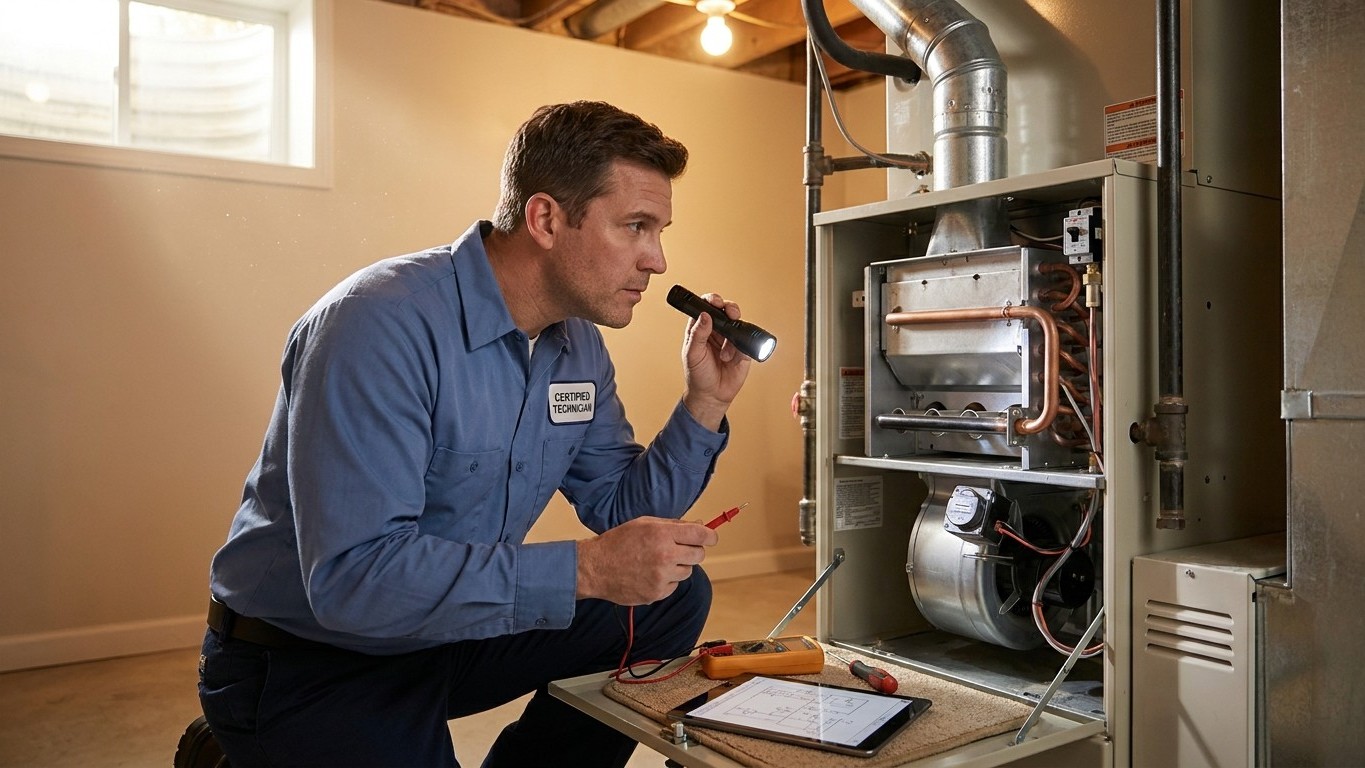

A yearly furnace service is two things bundled into one visit: a safety inspection of the parts that could produce carbon monoxide, and a mechanical check of the parts that keep the system running efficiently through the season. It covers the heat exchanger, the burners and ignition, the venting, the blower, the filter, and the safety controls, done once before cold weather sets in on any fuel-burning furnace. What that actually means in the field, and what falls to the homeowner in between visits, is where most people lose the thread.
Why yearly, and who says so
Two federal agencies have put this recommendation in writing, and they agree on the timing but not on the exact wording, which is worth reading closely rather than paraphrasing away. The U.S. Consumer Product Safety Commission states it broadly: “CPSC urges consumers to schedule a yearly professional inspection of all fuel-burning home heating systems, including furnaces, boilers, fireplaces, wood stoves, water heaters, chimneys, flues and vents.” That list matters because a homeowner who has had the furnace looked at has usually not had the water heater, the chimney, or the flue looked at in the same visit, and CPSC is naming all of them as part of the same yearly habit.
The U.S. Environmental Protection Agency frames the same idea around a calendar deadline instead of a checklist. In guidance dated October 1997 (EPA 402-K-97-002), the agency states: “EPA does, however, recommend that if you have a fuel burning furnace, stove, or fireplace, they be inspected for proper functioning and serviced before each heating season to protect against carbon monoxide poisoning.” Put the two together and the picture is complete: CPSC tells you what equipment belongs on the list, EPA tells you when on the calendar that list needs to get done. Neither is a suggestion to inspect once and forget it. Both point to a repeating, seasonal task tied directly to carbon monoxide risk, not to comfort or efficiency.
Notice the word doing the work in both quotes: fuel-burning. CPSC’s inspection list and EPA’s carbon monoxide warning apply to furnaces that burn natural gas, propane, or oil, along with the other combustion appliances named alongside them. An electric furnace or a heat pump does not burn fuel and does not produce carbon monoxide, so this particular safety case does not reach it the same way. That doesn’t mean an electric system needs no attention at all, but the annual inspection built around CO risk is specific to combustion equipment, and it’s worth being clear about which category a given system falls into before assuming the same urgency applies.
What is on the list
This is the part most people are actually paying for without knowing it, since “furnace tune-up” on an invoice doesn’t say much on its own. A proper visit works through a specific set of components, checking each for a specific kind of failure, rather than just running the system and listening for strange noises. Here’s what that generally looks like, described in terms of what each check is looking for rather than specific readings or thresholds, since those vary by equipment and are set by the manufacturer, not by a general standard.
| Component | What the check is looking for |
|---|---|
| Heat exchanger | Cracks, corrosion, or separation that could let combustion byproducts mix into the air the blower distributes through the house |
| Burners and flame | Even, stable combustion rather than flame that’s uneven, lifting, or discolored, which can point to a fuel or air mixture problem |
| Ignition system | Reliable start-up of the burners on each call for heat, whether the system uses a pilot, hot surface igniter, or intermittent spark |
| Flue and vent | A clear path for combustion gases to leave the house, free of blockage, disconnection, or damage along the run |
| Blower and motor | Smooth operation, proper mounting, and a motor that isn’t laboring, since a struggling blower affects airflow through the whole system |
| Filter | Condition and fit, since a clogged or misaligned filter restricts airflow to the rest of the equipment |
| Safety controls and limits | Correct response of the switches that shut the system down if it overheats or if airflow is interrupted |
| Condensate path (high-efficiency units) | Free drainage with no blockage or leaking, since condensing furnaces produce water that has to go somewhere |
Some of these checks are visual, some involve testing that a control responds the way it’s supposed to, and none of them should be reduced to “we cleaned it” on the paperwork. The list is also a reminder of scope: a technician who only glances at the burners and swaps the filter has not done what CPSC and EPA are describing when they say “inspected” and “serviced.”
What you do the rest of the year
The annual visit is one appointment. The months in between are on the homeowner, and the good news is that the highest-value task on that list is also the simplest one.
- Handle the filter on a monthly schedule, not a seasonal one. ENERGY STAR’s guidance is direct: “Inspect, clean, or change air filters once a month in your central air conditioner, furnace, and/or heat pump.” That’s once a month, across all three types of equipment, not once at the start of the season and once at the end. The reason it matters this much comes down to airflow: as ENERGY STAR puts it, “Airflow problems can reduce your system’s efficiency by up to 15 percent.” A dirty filter is one of the most common causes of exactly that kind of airflow restriction, and it’s the one a homeowner can fix without a tool.
- Keep the area around the unit clear. Boxes, laundry, and stored items pushed up against a furnace cabinet restrict the air it needs to breathe and can turn into a fire hazard depending on what’s stored there.
- Keep supply and return grilles unblocked. Furniture pushed over a floor register or a return grille closed off in an unused room changes the airflow balance the system was designed around, in the same direction as a dirty filter.
- Check outside vent terminations after storms. Wind-blown debris, nesting material, or snow can block a vent or intake pipe where it exits the house, and that’s worth a quick visual check after any serious weather, not just once a year.
None of this replaces the professional inspection. It’s the maintenance that keeps the system running the way it was left after that inspection, instead of drifting back toward the airflow and efficiency problems ENERGY STAR describes.
Getting a service that is worth the money
Not every visit billed as a furnace tune-up does the same amount of work, and the difference usually shows up in what you can ask for before and after the appointment rather than in the price.
- Ask what’s on their checklist before booking. A company that can describe its process in specific terms, heat exchanger, burners, ignition, venting, blower, controls, is telling you something different than one that just says “we’ll take a look.”
- Ask whether the heat exchanger inspection is included. Given what CPSC and EPA are both warning about, this is the single component worth confirming by name rather than assuming.
- Ask for what was found in writing. A written report, even a short one, is what separates a service from a visit. “We cleaned it” is not a report. A record of what was checked, what condition it was in, and what was done about it is something you can compare year to year and hand to the next technician who works on the system.
- Ask what they recommend and why. If something needs attention, the reasoning behind that recommendation should be explainable in plain terms tied to what was actually found during the inspection, not a general statement about the age of the equipment.
A furnace that’s been serviced this way has a paper trail. That trail is worth more than it looks like at the time, particularly if something does go wrong down the line and the question becomes what was inspected, and when.
Common questions
Does an electric furnace need the same annual inspection?
The CPSC and EPA guidance above is written around fuel-burning equipment because the concern is carbon monoxide, which an electric furnace does not produce. That doesn’t mean an electric system needs zero attention, but the specific annual safety inspection built around combustion risk doesn’t apply to it in the same way.
What if the furnace smells like gas?
Leave the house. That’s the only step that belongs in this discussion, and it’s not a diagnostic step, it’s a safety step. Do not attempt to locate the source or troubleshoot the system yourself.
Can I skip the professional inspection if I’m diligent with the filter?
No. Filter changes address airflow and efficiency, which matters, but they don’t check the heat exchanger for cracks, test the safety controls, or verify the venting is clear, all of which require the kind of inspection CPSC and EPA are describing.
What does it mean if the furnace shows an error code?
Error and fault codes differ by manufacturer, so there’s no universal list to check a code against. The correct step is to read the panel or manual for that specific unit rather than guess based on codes from a different system.