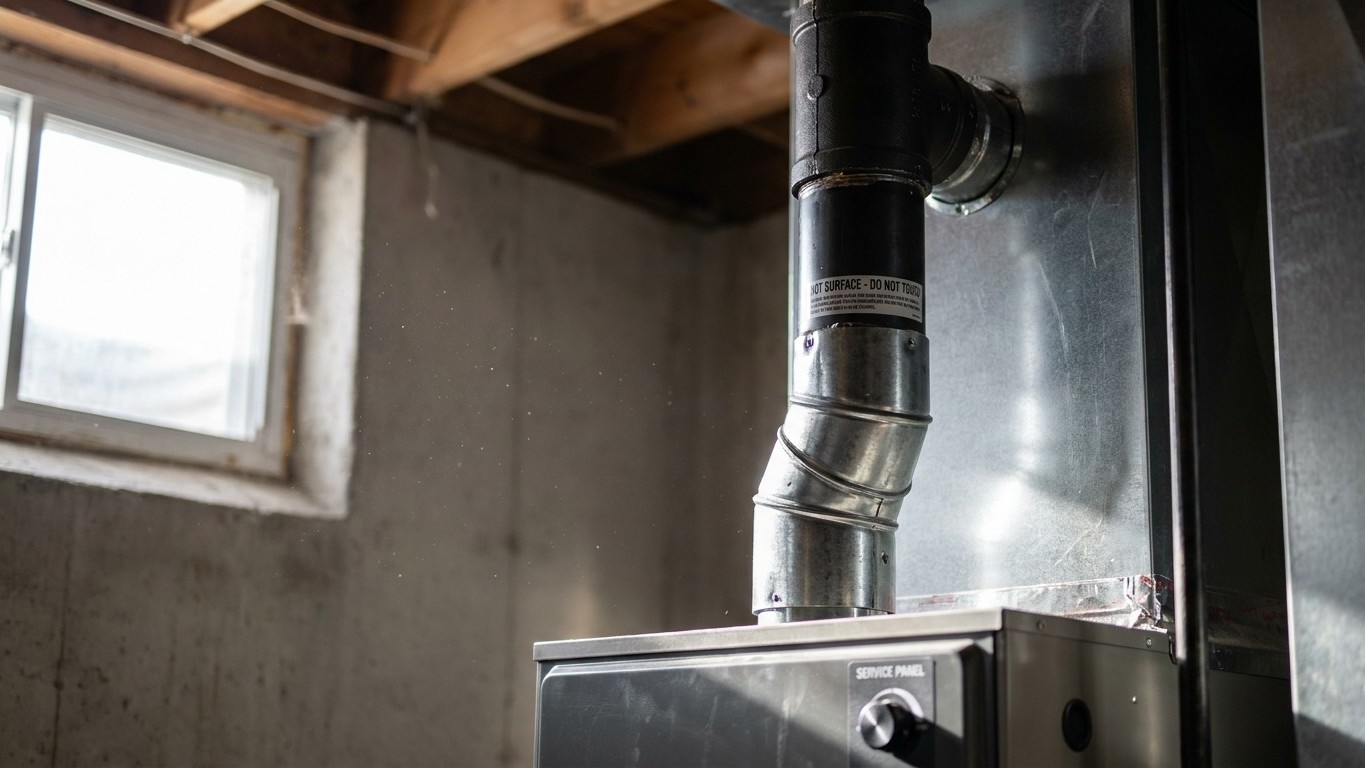

A blocked furnace vent stops combustion exhaust from leaving the house, which forces carbon monoxide and other byproducts back into living space instead of outside. It can happen from a snow drift against a wall vent, a nest built in a chimney over the summer, or a flue pipe that’s rusted through and separated at a joint. None of it is visible from inside the house until something goes wrong, which is exactly why it’s worth understanding what’s actually happening in that pipe before winter starts asking questions.
Where the exhaust goes

A fuel-burning furnace makes exhaust the same way a car engine does, and that exhaust has exactly one way out of the house: the flue or vent. That’s the entire premise of this page. Not “usually” the only way out, not “mostly” clear of your living space. It has to run continuously, every time the burner fires, for as long as the system operates. If that path narrows, kinks, or closes off even partway, the exhaust doesn’t just disappear. It backs up somewhere, and somewhere is inside your house.
Most homes have one of two setups, and telling them apart takes about ten seconds. Older furnaces and higher-output systems typically vent through a metal flue pipe that runs up and connects into a masonry or metal chimney, the same chimney a water heater might also share. You’ll see it as a round or oval metal duct disappearing into a wall or ceiling near the top of the furnace, usually painted black or left as bare galvanized metal.
High-efficiency furnaces work differently. Because they extract more heat from the combustion gases, what’s left over is cool enough to vent through plastic pipe (usually white or gray PVC) instead of metal. That pipe runs horizontally through an exterior wall rather than up a chimney, and it terminates outside the house at roughly waist height or lower, often paired with a second intake pipe right next to it. If you can walk outside and point to a capped plastic pipe sticking a few inches out of the siding, that’s a sidewall termination. If instead your furnace disappears into a masonry or metal stack heading toward the roof, that’s the chimney arrangement.
Knowing which one you have matters because they fail in different ways and in different places, which is the whole subject of the next section.
What blocks it
Vent blockages aren’t random. They tend to cluster around a handful of predictable causes, each with its own season and its own warning signs.
| Cause | When it happens | How to check |
|---|---|---|
| Snow and ice drift against sidewall termination | During and after heavy snowfall or wind-driven drifting | Walk outside and look at the pipe opening after every significant snow event |
| Bird or wasp nest in chimney or vent hood | Builds up over spring and summer when the flue sits unused | Visual check of the chimney cap or vent hood before the heating season starts |
| Leaves and debris | Fall, especially near trees, or after storms | Look at the base of the termination and the surrounding ground for buildup |
| Disconnected or corroded flue section | Any time, more common in older systems with age-related rust | Look for gaps, rust holes, or sections that have pulled apart at the seams |
| Deteriorated chimney liner | Develops gradually over years, worse in unlined or older masonry chimneys | Usually requires a professional inspection to assess properly |
The snow one deserves the most attention, and not just because it’s the easiest for a homeowner to actually see. It’s seasonal in the most inconvenient way possible: it happens exactly when the furnace is running the hardest and the exhaust volume is highest. A sidewall vent that’s low to the ground is an easy target for a plow pile, a drift building against the foundation, or ice accumulating from a dripping gutter above it. Unlike a nest or a corroded joint, this is a problem that can appear and disappear within days, and it’s genuinely a homeowner’s job to walk outside and look after a storm rather than wait for a technician’s annual visit to catch it.
The other four causes tend to build slowly. Nests take a whole unused season to form. Corrosion takes years. A liner doesn’t deteriorate overnight. That’s part of why they get missed: nothing about them changes fast enough to catch a homeowner’s attention the way a fresh snowdrift does.
Checking it, and the CO connection
There’s a real limit to what a homeowner should do here, and it’s worth being direct about where that limit sits. None of the following involves climbing on a roof, dismantling flue sections, or reaching into a chimney. It’s all visual, from the ground or from inside the house.
- After every heavy snowfall, walk outside and look at the vent termination. If it’s a sidewall pipe, confirm you can see straight through the opening.
- Clear a path around the termination if snow has drifted against it, without prying at the pipe itself or forcing ice off with a tool that could crack it.
- Indoors, look at the flue joints near the top of the furnace for soot staining, which can indicate exhaust is escaping the pipe instead of venting outside.
- Check that flue sections are still fitted together snugly and haven’t separated or shifted, especially if the furnace has been bumped or serviced recently.
That’s the full list. Anything past that (a suspected liner problem, a nest lodged out of sight, a chimney that needs to be scoped) is a job for a professional, not a ladder and a flashlight.
The reason any of this matters beyond drafty air or a smelly basement comes down to carbon monoxide. According to the U.S. Consumer Product Safety Commission, “Each year, more than 200 people die from unintentional non-fire related carbon monoxide poisoning associated with consumer products. Heating equipment and portable generators are among the top contributors to CO deaths.” That figure covers consumer products broadly, not furnaces alone, and it groups heating equipment together with portable generators rather than isolating either one. A blocked vent is the mechanism that turns an ordinary furnace into a contributor to that count: it’s what stops the exhaust from leaving and pushes it back into the house instead.
This is why CO alarms exist as a backstop, not a formality. The CPSC recommends: “Install battery-operated CO alarms or CO alarms with battery backup on every level of the home and outside sleeping areas. Interconnected CO alarms are best; when one sounds, they all sound.” And if one ever does sound, the agency’s guidance is specific and sequential: “Know the symptoms of carbon monoxide poisoning: headache, dizziness, weakness, nausea, vomiting, sleepiness, and confusion. If you suspect CO poisoning, get outside to fresh air immediately, and then call 911.”
The inspection that covers this
Everything above is a homeowner-level watch list, useful for catching the obvious and the seasonal. What it isn’t is a substitute for a professional looking at the whole system, because the parts you can’t see from the ground (a liner, an internal flue connection, the draft the system actually produces under load) are exactly the parts that cause the quiet, slow-building failures.
The CPSC’s broader recommendation covers more ground than most homeowners assume: “CPSC urges consumers to schedule a yearly professional inspection of all fuel-burning home heating systems, including furnaces, boilers, fireplaces, wood stoves, water heaters, chimneys, flues and vents.” That list is the point. A homeowner who’s had the furnace itself serviced has often not had the chimney, the flue, or even the water heater’s vent looked at separately, and all of those can share the same chimney or the same failure modes described above.
The EPA adds a timing note to the same idea. In its October 1997 guidance (EPA 402-K-97-002), the agency states: “EPA does, however, recommend that if you have a fuel burning furnace, stove, or fireplace, they be inspected for proper functioning and serviced before each heating season to protect against carbon monoxide poisoning.” Read together, the CPSC sets the frequency at yearly and widens the scope to the whole heating system, while the EPA anchors the timing to before each heating season starts, not sometime during it.
Both of these apply specifically to fuel-burning equipment. Neither reaches an electric furnace or a heat pump, since those systems don’t produce combustion exhaust and have no flue to block in the first place. For a walk-through of what a professional inspection actually covers each year, see the annual furnace service guide on this site.
Common questions
How do I know if my furnace vent is blocked?
Watch for soot staining around flue joints indoors, a furnace that shuts off unexpectedly or short-cycles, or a visible obstruction (snow, a nest, debris) at the outside termination. A CO alarm sounding is also a direct signal, and the response to that is to get outside immediately and call 911, not to investigate the vent first.
Can a blocked furnace vent cause carbon monoxide poisoning?
Yes. When the exhaust path is blocked, combustion byproducts including carbon monoxide can’t leave the house through the flue and can end up in living space instead. This is exactly why CO alarms are recommended on every level of the home and outside sleeping areas.
Yes. When the exhaust path is blocked, combustion byproducts including carbon monoxide can’t leave the house through the flue and can end up in living space instead. This is exactly why CO alarms are recommended on every level of the home and outside sleeping areas.
Does snow really block a furnace vent that often?
It’s one of the more common seasonal causes, particularly for high-efficiency furnaces that vent through a low sidewall pipe rather than up a chimney. Drifting snow, plowed piles, and ice buildup can all obstruct that opening, and it’s worth a quick visual check after any heavy snowfall.
Does this apply to an electric furnace?
No. Electric furnaces and heat pumps don’t burn fuel, so they produce no combustion exhaust and have no flue or vent to block. The CPSC and EPA guidance quoted here applies specifically to fuel-burning furnaces, boilers, stoves, and fireplaces.