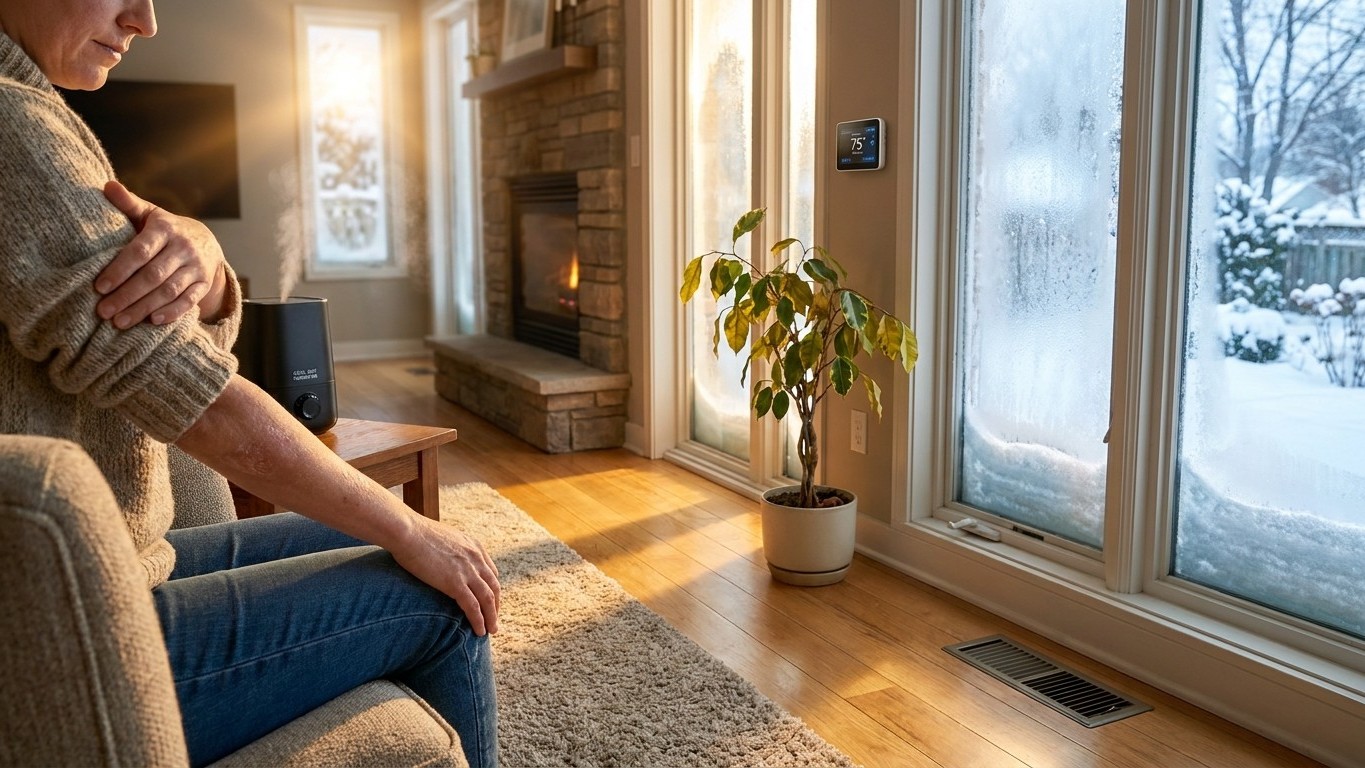

A house feels dry in winter because heating cold outdoor air lowers its relative humidity, not because a furnace strips moisture out of it. The water vapor already in that air stays the same amount; warm air just has room to hold far more, so the same moisture reads as thinner, drier air. The furnace’s real role is upstream: it heats whatever air gets into the house, including the dry outside air sneaking in through gaps.
The furnace is not removing moisture

Here’s the belief worth correcting first: a furnace does not dry the air it heats. It has no mechanism for pulling water vapor out of a room the way an air conditioner or a dehumidifier does. What it does is raise the temperature of the air passing through it. That single act changes how the air feels, and that’s where the confusion starts.
Warm air can hold significantly more water vapor than cold air before it reaches saturation. So if a cubic foot of air holds a fixed amount of moisture and you heat that air up, its relative humidity, the percentage of the maximum it could hold, drops. Nothing left the air. Its capacity just grew faster than its moisture content did. That’s why a house can feel bone dry in January even though the furnace ran fine and never touched the humidity directly.
The actual source of the dryness sits outside the house. Cold winter air, especially in northern climates, carries very little water vapor in absolute terms. Cold air simply can’t hold much. So every cubic foot of that frigid outdoor air that finds its way into the living space, through a gap around a door, a crack in the foundation sill, a poorly sealed attic hatch, arrives already dry, and then gets heated by the furnace to room temperature. Heating it doesn’t add moisture back. It just makes the dryness more noticeable, because now that thin, dry air is circulating through every room at a comfortable temperature.
This is why the problem is better understood as an air leakage symptom than a heating equipment problem. A tightly sealed house loses much less of its indoor moisture to the outdoors and pulls in much less of that dry replacement air. A leaky one is constantly trading its own humid indoor air for dry outdoor air, and the furnace just keeps heating the exchange rate. Homeowners who chase the dryness by adjusting the furnace itself are usually solving the wrong end of the problem. The house’s ventilation rate and where its envelope is losing air matter more than anything happening inside the furnace cabinet.
What makes it worse
Several ordinary conditions compound this effect, some of them working against you in ways that aren’t obvious from inside the house.
| Condition | Why it worsens dryness |
|---|---|
| A leaky building envelope | Every gap around windows, doors, sill plates, and penetrations lets warm, moist indoor air escape and pulls dry outdoor air in to replace it, a constant swap that keeps resetting indoor humidity lower. |
| A furnace or water heater drawing combustion air from inside the living space | Fuel-burning equipment that pulls its combustion air from indoors rather than from outside consumes indoor air continuously while it runs, and that consumed air gets replaced by infiltration, adding another steady channel of dry outdoor air into the house. This is the least understood contributor on this list, and it applies specifically to fuel-burning furnaces and water heaters, not electric ones. |
| Exhaust fans running longer than needed | Bathroom and kitchen fans are built to remove moisture and odors, and they do that job by exhausting indoor air outdoors, which has to be replaced by air pulled in from outside. Left running well past a shower or a pot of boiling water, they just keep depleting indoor humidity along with whatever they were meant to clear. |
| A fireplace with an open damper | An open flue is effectively a large, unsealed hole to the outdoors. Even with no fire burning, it drafts warm indoor air up and out, drawing in cold dry air somewhere else in the house to replace it. |
| Keeping the house warmer than it needs to be | Because relative humidity falls as temperature rises for a fixed amount of moisture, a house held several degrees warmer than necessary will always read drier than the same house at a lower setting, with the same air and the same moisture in it. |
None of these factors are exotic. Most houses have several of them running at once without anyone noticing, and each one adds to the same basic mechanism: indoor moisture leaving, dry outdoor air replacing it, and the furnace faithfully heating whatever mix results.
The order of fixes
The sequence below matters more than any single step in it. Doing them out of order means fighting a problem that keeps regenerating itself.
- Seal the air leaks first. Every other fix downstream of this one is fighting an uphill battle if the house is still trading its air with the outdoors through gaps and cracks. Air sealing around window and door frames, sill plates, attic hatches, and duct penetrations reduces how much dry outdoor air gets pulled in to begin with.
- Reconsider how warm the house is kept. Since relative humidity drops as temperature rises for the same amount of moisture, a house held a few degrees cooler will read less dry with no other changes at all. This costs nothing and it’s worth testing before adding equipment.
- Only then, add moisture deliberately if the house is still dry. A Humidifier, whether portable or tied into the furnace, adds water vapor to the air. But it’s genuinely a last step, not a first one.
Adding moisture to a leaky house is a losing race, and it’s worth understanding why. A humidifier can only add water vapor as fast as its reservoir or its water line delivers it. A leaky envelope removes moisture continuously, all day, as warm humid air escapes and dry air replaces it. Run a humidifier in a house that’s still hemorrhaging air through unsealed gaps, and it ends up working harder, using more water, and still falling behind, because the leak rate outpaces the humidifier’s output. Seal the envelope first and the same humidifier, or often no humidifier at all, does the job with far less effort. Readers working on this step by step will find more detail in this site’s guides on air sealing and Insulation, both of which address the leaks that drive this problem before any humidity equipment gets involved.
The humidifier on the furnace
For houses that are still dry after the envelope work and after backing off the thermostat, a whole-house humidifier mounted on the ductwork is the equipment most furnace systems can accept. It’s a simple device: mounted near the furnace, tied into the duct that carries warm air through the house, and connected to a small water supply line. Air passing over its wetted pad or through its water panel picks up moisture as it moves through the ducts, so the humidified air gets distributed the same way heated air does, room by room, through the existing system.
The key thing to understand is that it only runs when the furnace runs. It’s not a standalone appliance humidifying the air on its own schedule. It rides on the furnace’s blower, so its output is tied directly to how much the heating system is cycling that week.
That water panel or pad is a different part from the furnace’s air filter, and it’s the one people forget entirely. The air filter still needs its own regular attention: the U.S. Department of Energy’s ENERGY STAR program advises to “Inspect, clean, or change air filters once a month in your central air conditioner, furnace, and/or heat pump,” and notes that “Airflow problems can reduce your system’s efficiency by up to 15 percent.” The humidifier’s pad is separate hardware, sitting inside the humidifier housing rather than in the main filter slot, and it scales up with mineral deposits from the water running over it all winter. It needs to be inspected and typically replaced each season, along with checking the small drain that clears excess water and making sure the unit’s water supply is shut off at the end of the heating season so it isn’t sitting wet and unused for months.
The real risk with any humidifier, portable or furnace-mounted, is overdoing it. Adding more moisture than the house and its windows can handle shows up as condensation, not as a comfortable reading on a gauge. Watch for water beading or fogging on the inside of cold window glass, dampness or discoloration developing around window frames, or a musty smell building in closets and along exterior walls. Any of those signs mean there’s more moisture in the air than the coldest surfaces in the house can tolerate without condensing it back out, and that moisture finding its way into wall cavities is a bigger problem than dry air ever was. Dial back the humidifier’s output and give the house a few days to respond before deciding whether it needs further adjustment.
Common questions
Does a new furnace fix a dry house?
Not by itself. A furnace, new or old, heats air; it doesn’t add or remove moisture. A house stays dry in winter because of how much dry outdoor air is getting in and how warm the indoor air is kept, both separate from the furnace’s age or efficiency.
Is dry winter air actually caused by the cold outside, not the heating system?
Yes. Cold outdoor air holds very little moisture in absolute terms. Once it leaks into the house and gets heated, its relative humidity drops further, since warmer air can hold more moisture than the same air held when it was cold. The furnace heats that dry air; it doesn’t create the dryness.
Should I run a fireplace to help with dry air?
No. An open damper, whether or not a fire is burning, drafts warm indoor air up and out of the house, pulling in cold, dry replacement air elsewhere. It works against indoor humidity rather than helping it, on top of being a fuel-burning appliance that needs its own annual inspection and a working carbon monoxide alarm nearby.
Can sealing air leaks alone solve the dryness without a humidifier?
Often, yes, at least partially. Reducing how much dry outdoor air gets pulled in and how much indoor moisture escapes addresses the root cause directly. Many houses find the remaining dryness manageable after air sealing and after checking that the house isn’t being kept warmer than necessary; others still choose to add a humidifier afterward, and it performs far better once the leaks are no longer working against it.