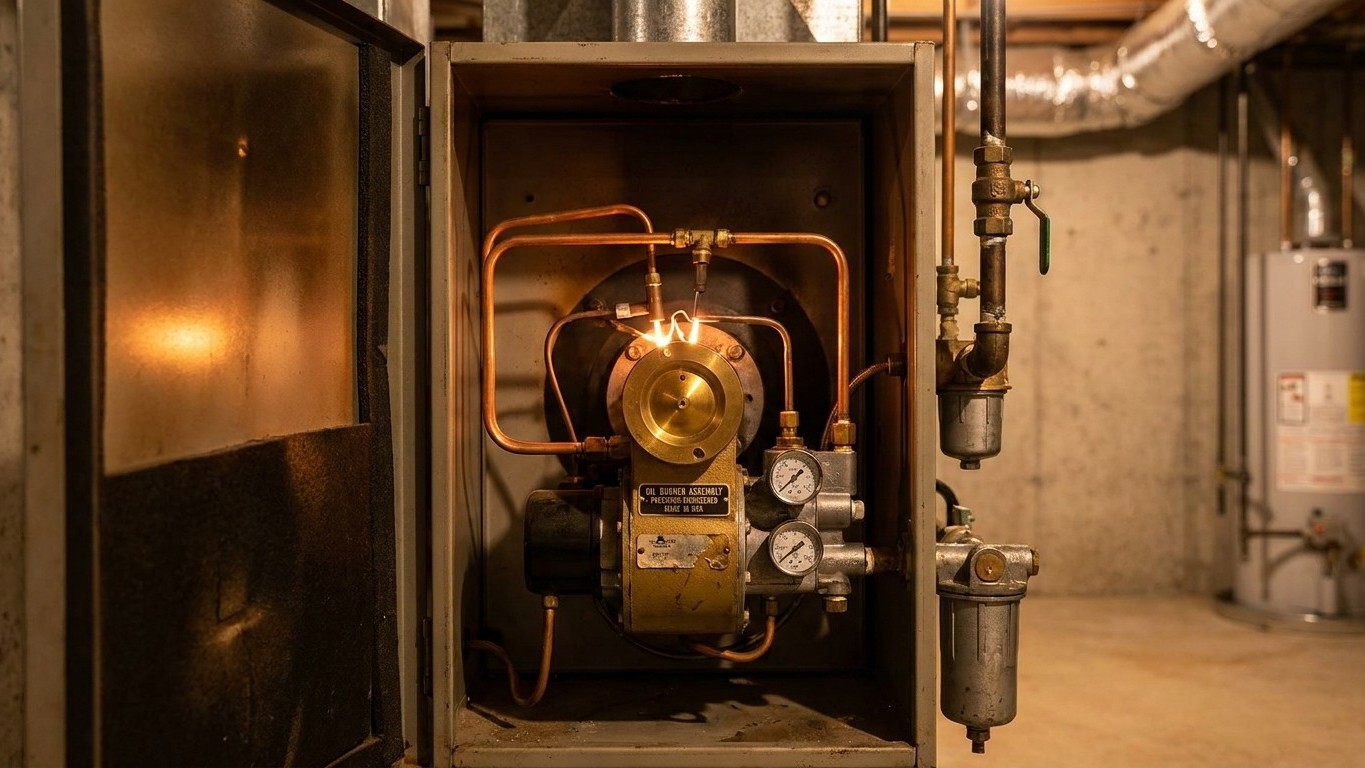

An oil furnace burns a liquid fuel that has to be turned into a fine mist before it will ignite, and that single fact changes almost everything about how the system is serviced. It needs a pump, a nozzle, and an electrode where a gas furnace just needs a valve and a pilot or igniter. It needs a filter for the fuel itself, on top of the air filter. And it needs an owner who checks a tank gauge the way a gas customer never has to.
Not a marginal system

Oil heat is often treated as a footnote in national heating conversations, but the equipment-and-fuel data tell a different story depending on where you live. In Maine, fuel oil or kerosene is the main heating fuel in 49% of homes, according to the U.S. Energy Information Administration’s Residential Energy Consumption Survey (RECS 2020). Propane covers another 16% of Maine homes. On the equipment side, 46% of Maine households heat with a furnace and 31% with a steam or hot-water boiler.
Those two facts, equipment and fuel, come from separate columns of the same survey, and mixing them up is a common mistake. A furnace is a type of equipment; it can burn gas, oil, or propane, or run on electricity. A boiler is a different type of equipment and can also burn any of those fuels. Knowing that 46% of Maine homes have a furnace tells you nothing about what that furnace burns. Knowing that 49% burn fuel oil or kerosene tells you nothing about whether the equipment is a furnace, a boiler, or something else. Both numbers matter, but they answer different questions.
Compare that to Maryland, where 64% of homes run a furnace, 49% use natural gas, and 41% use electricity, or to Washington, where 47% run a furnace, 55% use electricity, and 37% use natural gas. Oil barely registers in either state’s fuel column. That regional split explains why oil furnace maintenance gets so little attention nationally: it is a dominant system in parts of the Northeast and a minor one almost everywhere else. Where RECS shows “not reported” or an estimate suppressed for a fuel or equipment type in a given state, that means the sample was too small or the estimate too unreliable to publish, not that zero homes use it.
This page exists because an oil furnace does not fail the way a gas furnace fails, and it does not get maintained the way a gas furnace gets maintained. The fuel arrives by truck and sits in a tank the homeowner owns and monitors. The combustion process involves moving mechanical parts that wear, clog, and need periodic replacement. And the symptoms of a problem, soot, smell, a rumble at startup, are specific enough to this fuel that a homeowner used to gas heat would not recognize them.
What the machine does that a gas furnace does not
Natural gas and propane are already gases at the burner, so they mix with combustion air and ignite with comparatively little mechanical help. Fuel oil is a liquid at room temperature, and a liquid will not burn efficiently on its own. It has to be broken into a fine spray, atomized, and shot into the combustion chamber under pressure, then lit by a high-voltage spark from an electrode. That whole assembly, a pump that pressurizes the oil, a nozzle that atomizes it, and electrodes that ignite it, is the part of an oil furnace that a gas system simply does not have, and it is the part that a technician is servicing at every visit.
None of the settings for that assembly, pressure, spray angle, nozzle size, belong on a general guide. They are specific to the make and model of the appliance, printed on its rating plate or in its manual, and set by a technician with test equipment. What every owner can understand, though, is what each part does and what it looks like when that part is neglected.
| Part | What it does | What neglecting it looks like |
|---|---|---|
| Nozzle | Atomizes the oil into a fine spray as it enters the combustion chamber | Uneven flame, soot, a furnace that struggles to reach temperature |
| Oil filter | Catches sediment and water from the tank before the oil reaches the pump | Reduced fuel flow, pump strain, intermittent shutdowns |
| Electrodes | Provide the spark that ignites the atomized oil | Delayed ignition, a bang or thump at startup, failure to light |
| Combustion chamber | Contains and directs the flame for complete, even burning | Cracking, deteriorating refractory material, uneven combustion |
| Flue | Carries combustion byproducts safely out of the home | Blockage, backdraft, and buildup of soot inside the vent |
A technician cleans or replaces most of these parts at every service visit, because oil combustion leaves residue that gas combustion does not. That residue is exactly why an oil furnace tends to need more frequent hands-on attention than a gas one, even when both are running well.
Soot, smell, and what they mean
Oil heat gives off warning signs that gas heat rarely does, and learning to read them is part of owning the system. A smell of oil inside the house, as opposed to outside near the fill pipe, usually points to a leak somewhere in the supply line or at a fitting, not to normal operation. Soot around the furnace cabinet or drifting out of supply registers means unburned particles are escaping the combustion chamber and flue path. A rumble or thump at startup often signals a delay between when oil sprays into the chamber and when it actually ignites. A visible puff of smoke when the burner fires is the same problem in a more obvious form.
None of these are cosmetic. Soot in particular means the combustion is not clean, and incomplete combustion is exactly the condition that produces carbon monoxide. The U.S. Consumer Product Safety Commission puts the stakes in plain terms: “Each year, more than 200 people die from unintentional non-fire related carbon monoxide poisoning associated with consumer products. Heating equipment and portable generators are among the top contributors to CO deaths.” That figure covers consumer products broadly, not furnaces specifically, but heating equipment is named as one of the leading contributors, and an oil furnace producing soot is a heating appliance not burning cleanly.
The CPSC’s guidance on detection is just as direct: “Install battery-operated CO alarms or CO alarms with battery backup on every level of the home and outside sleeping areas. Interconnected CO alarms are best; when one sounds, they all sound.” A CO alarm is not the same device as a propane leak detector, and one should not stand in for the other in a home that uses both a fuel oil furnace and propane appliances.
The practical rule is simple: a furnace that is producing soot, an oil smell, an unusual rumble, or visible smoke at startup gets shut off and looked at by a technician. It does not get run through the weekend on the theory that it will sort itself out. Waiting out a soot problem is waiting out a combustion problem, and combustion problems are the ones tied to carbon monoxide.
The tank, and the yearly visit
An oil furnace comes with a piece of equipment a gas furnace owner never deals with directly: the fuel tank. Most tanks have a gauge that shows the fuel level, and it is worth a glance periodically rather than only when the burner fails to fire. Tanks also accumulate water at the bottom over time from condensation inside the tank, and that water can be drawn into the fuel line if it is not managed. The fuel filter, separate from the furnace’s air filter, catches sediment and some of that water before it reaches the pump.
Running the tank completely empty is not a simple inconvenience solved by a refill. Once air enters the fuel line, the system typically will not restart on its own, because the pump needs a solid column of oil, not air, to build the pressure that feeds the nozzle. A technician usually has to bleed the air out of the line before the furnace will run again, which turns a scheduling problem into a service call.
The service visit itself is not optional, according to both federal safety and environmental agencies. The CPSC states: “CPSC urges consumers to schedule a yearly professional inspection of all fuel-burning home heating systems, including furnaces, boilers, fireplaces, wood stoves, water heaters, chimneys, flues and vents.” The U.S. Environmental Protection Agency, in guidance dated October 1997 (EPA 402-K-97-002), adds: “EPA does, however, recommend that if you have a fuel burning furnace, stove, or fireplace, they be inspected for proper functioning and serviced before each heating season to protect against carbon monoxide poisoning.” Both statements apply to fuel-burning equipment specifically; they do not reach an all-electric furnace or a heat pump.
Between those professional visits, an owner’s checks are limited but meaningful:
- Check the tank gauge periodically, not only when the burner stops working.
- Watch for water at the bottom of the tank if the system has a way to check for it, and mention it to the technician at the annual visit.
- Replace or clean the air filter on the schedule recommended for the furnace, keeping in mind that this is a different filter from the oil filter and the two get confused often.
- Note any oil smell, soot, rumble, or smoke and report it rather than waiting for the next scheduled service.
- Keep the area around the tank and the furnace clear so a technician can inspect both without obstruction.
None of this replaces the yearly professional inspection both agencies call for. It just means the months between visits do not pass without anyone noticing a problem that could otherwise wait until the furnace fails to start on the coldest morning of the year.
Common questions
Does every home with a furnace burn oil?
No. Furnace refers to the equipment, not the fuel. RECS 2020 data shows a furnace can burn natural gas, propane, or fuel oil, or run on electricity. In Maryland, for example, 64% of homes have a furnace and 49% use natural gas, meaning many of those furnaces run on gas, not oil.
Is a puff of smoke at startup always serious?
It should always be treated as a signal worth investigating rather than ignored. A puff at ignition points to unburned fuel, the same underlying issue as soot, and both are tied to incomplete combustion. The furnace should be shut off and inspected rather than run again until a technician has looked at it.
Can I set the pump pressure or nozzle size myself?
No. Those figures are specific to the make and model of the furnace, printed on its rating plate or listed in its manual, and set with test equipment a technician carries. An incorrect setting can damage the appliance or create an unsafe combustion condition, so this is not a homeowner adjustment.
Does a CO alarm also detect a propane leak?
No. A carbon monoxide alarm and a propane or gas leak detector are different devices built to sense different things. A home with both an oil furnace and propane appliances needs both types of detection, not one standing in for the other.