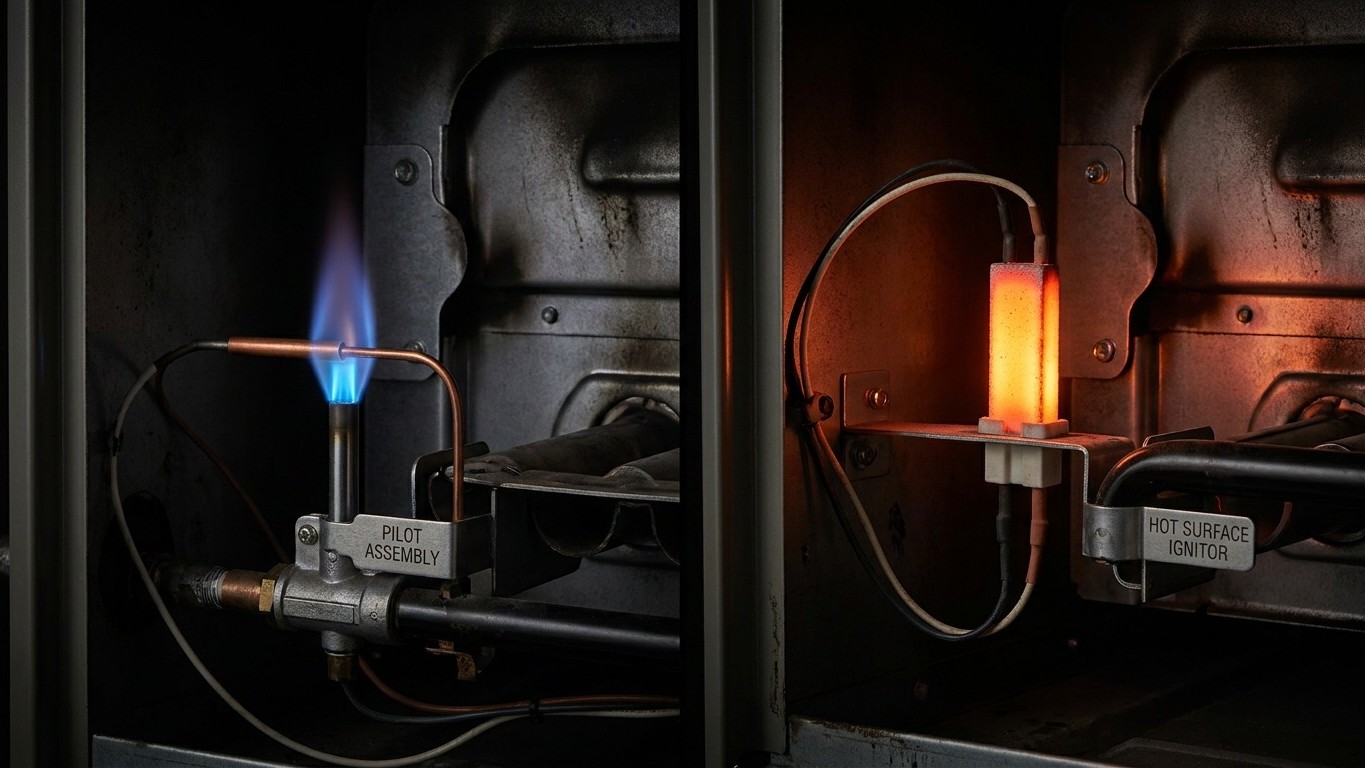

A pilot light is a small flame that burns continuously, waiting to light the burners. A hot-surface ignitor is an electric element that only heats up when the thermostat calls for heat, then glows hot enough to ignite the gas. If your furnace has neither warmth nor flame between heating cycles, you likely have the newer ignitor system.
Pilot Light and Hot-Surface Ignitor
The difference isn’t cosmetic. A standing pilot light burns gas around the clock, even in July, because the system relies on a thermocouple, a small metal rod sitting in that flame, to prove the flame exists before it lets the main gas valve open. Cut the flame, cool the thermocouple, and the valve locks shut as a safety measure. That constant low burn is simple and reliable, but it wastes fuel every hour it’s not needed.
A hot-surface ignitor skips the standing flame entirely. When the thermostat calls for heat, a control board sends power to a silicon-based element that glows orange within seconds, hot enough to ignite the gas as it’s released. A flame sensor then confirms ignition happened, usually within a few seconds, or the board shuts the gas valve again and tries once more before locking out. No flame burns between cycles, so no fuel is lost sitting idle.
That distinction tracks almost exactly with furnace age and efficiency. Standing pilots were standard on furnaces built before the early 1990s, back when AFUE ratings in the 60s and low 70s were normal. As manufacturers pushed toward higher efficiency standards, eliminating the standing pilot became one of the easiest wins available, since a furnace that isn’t burning gas 24/7 for no reason automatically wastes less. U.S. ENERGY STAR criteria for oil furnaces now call for a “Rating of 87% AFUE or greater,” and for gas and oil furnaces alike, “Less than or equal to 2.0% air leakage” out of the cabinet. An 87% AFUE furnace turns 87 cents of every fuel dollar into heat that reaches your rooms over a season. Hot-surface ignition, by removing the constant pilot draw, is one of the mechanical changes that helped get furnaces into that range.
The two systems also fail differently, which matters more than which one is “better.” A pilot light that keeps blowing out usually points to a draft, a dirty orifice, or a weakening thermocouple. A hot-surface ignitor doesn’t blow out, it degrades, the silicon element grows a hairline crack after years of heating and cooling cycles until one day it doesn’t get hot enough to light the gas at all.
How to tell, in your own house
You don’t need tools for most of this. The order below matters: each step costs a little more effort than the last, but a homeowner who does only the first three has still covered what actually determines whether a professional is needed.
- Look through the furnace’s viewing window. Most furnace cabinets have a small glass port near the burner compartment. A standing pilot shows a small, steady blue flame burning right now, even if the furnace isn’t running. If you see nothing until the furnace kicks on, and then a longer flame appears across the burners, you have hot-surface ignition.
- Listen through a full heating cycle. Turn the thermostat down a few degrees, wait a couple minutes, then raise it back up. A pilot system usually lights the burners almost instantly with a soft whoosh. A hot-surface system has a short delay, a faint hum or click as the ignitor warms, then a gentler “whump” as the burners catch, typically well under a minute later.
- Check the data plate on the furnace. Open the front panel (no tools needed on most models, it usually unclips or lifts off) and look for the manufacture date sticker. Anything installed before the early 1990s was very likely built with a standing pilot. Furnaces from the 2000s onward are almost always hot-surface.
- Check the flame color, not just its presence. A healthy flame, pilot or main burner, burns steady blue with maybe a small yellow tip. Yellow, orange, or flickering flame across most of its length suggests a combustion problem worth a technician’s attention, separate from the ignition system itself.
Here’s where homeowner work ends: don’t remove the burner compartment cover to relight a pilot yourself if it keeps going out repeatedly, don’t touch a hot-surface ignitor element with bare fingers (skin oil creates a hot spot that cracks the silicon on the next cycle), and don’t test or rewire anything connected to the gas valve or control board. Repeated ignition failure, gas odor, or a flame that won’t stay blue calls for a licensed HVAC technician, not a second attempt at the same fix.
What it costs you to ignore it
A pilot light that’s gone out means no heat, full stop, until something relights it, either you or a technician. That’s the obvious cost. The quieter one is what happens before it goes out completely: a pilot flame partially starved of air burns dirty yellow instead of clean blue, which means incomplete combustion, and incomplete combustion means some of the fuel you’re paying for is leaving as soot and unburned gas instead of heat. That’s a separate issue from furnace cabinet sealing, which is what the 2.0% air leakage standard actually measures; a furnace can meet that spec and still burn dirty at the pilot or burner level.
With a hot-surface ignitor, the failure pattern is different but no less costly to ignore. A cracking element doesn’t always fail outright the first time. It often limps along, lighting the burners on some cycles and failing on others, which means the control board repeatedly tries, fails, locks out, and resets. Each failed attempt still cycles gas into the burner chamber briefly before the safety system catches it. Left unaddressed, that pattern accelerates: the crack widens with every heat cycle until the ignitor stops working at all, usually on the coldest night of the stretch, because that’s when the furnace runs the most and the weak point gets exercised hardest.
Either way, the house cools while the system is down, and repeated short-cycling from failed ignition attempts puts more wear on the gas valve and control board than a furnace that lights cleanly every time. None of that shows up as a single dramatic bill. It shows up as a furnace that needs more service calls over its life than one where the ignition system was checked and corrected the first time the flame color or the cycle timing looked off.