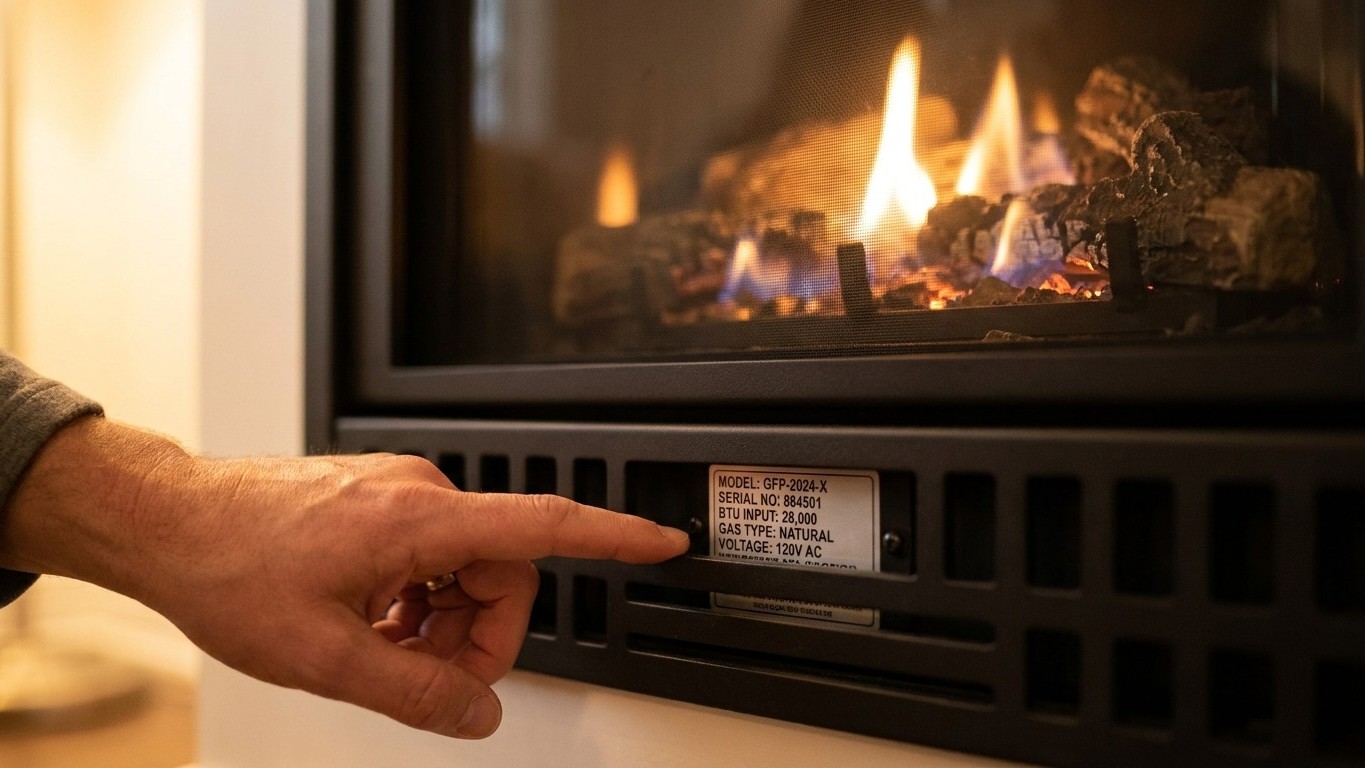

There’s no single dollar figure for what a Gas Fireplace costs to run, because the answer depends on three numbers that are different in every home: the appliance’s input rating in Btu per hour, the energy content of the fuel, and the price you’re actually paying for that fuel this month. Multiply the first two, divide by the third, and you get a cost that’s specific to your unit and your utility account, not a number borrowed from somewhere else. The label behind the lower louvre is where that math starts.
The calculation, and the number you need

Every gas fireplace has an input rating stamped on a metal plate, usually behind the lower louvre or on the burner assembly itself. It’s expressed in Btu per hour, and it tells you how much energy the unit consumes when the main burner is firing at full output. Some inserts modulate, meaning they can run at a lower rate than the full nameplate number, so if your unit has a variable-flame control, the actual draw at a low setting will be less than the maximum figure printed on the plate.
From there, the fuel matters. Natural gas is billed by the therm, propane by the gallon, and each has its own fixed energy content that your utility company or propane supplier can tell you directly, or that appears on your billing statement. Divide the appliance’s hourly Btu draw by that energy content, and you get how much fuel the unit burns in an hour. Multiply that by your current price per therm or per gallon, and you have a real, current, local cost per hour of operation.
Why nobody can hand you a flat number
Natural gas and propane prices swing by state, by season, and sometimes month to month depending on supply. A rate that’s accurate in one part of the country in January can be off by a wide margin somewhere else in July, or even in the same house a few months later. That’s why the honest answer to “what does it cost” is a method, not a memorized figure. Pull your last gas bill, find the price per therm (or call your propane company for the current delivered price per gallon), and run the appliance’s own Btu rating against it. That fifteen-minute exercise gives you a number nobody else’s article, including this one, can responsibly hand you.
One more variable worth tracking: how many hours a day the main burner actually fires versus how many hours the fireplace is simply glowing on a low setting. Two households with identical fireplaces can post very different totals depending on how the thermostat or remote is used, which is really a separate question from the appliance’s rated draw.
The pilot burns all year if you let it
The main burner isn’t the only thing consuming gas. A standing pilot light, the small flame that keeps the appliance ready to ignite instantly, runs continuously once it’s lit, including in July when nobody’s asked the fireplace for heat in months. That’s a cost most households never add up, because it doesn’t show up as a separate line item, it just sits inside the total gas bill every single month of the year, heating season or not.
The pilot’s own draw is modest next to the main burner’s, but modest multiplied by every hour in a year behaves differently than a burner that only fires during the coldest months. A furnace or fireplace burner that runs seasonally gets a break for half the year. A standing pilot doesn’t, unless someone physically shuts it off. Whether that trade-off is worth it, given how much some units cost to relight or the inconvenience of doing so, is exactly the seasonal decision covered on our pilot light page, including when it makes sense to leave it lit through the shoulder seasons and when it doesn’t.
Where the pilot question overlaps with safety
Many fireplaces built around a standing pilot are vent-free units, meaning they have no outside vent for their combustion products and depend entirely on ordinary room ventilation to clear them. According to the U.S. Consumer Product Safety Commission, currently manufactured unvented gas-fired room heaters include an oxygen depletion sensor under the industry’s voluntary standard, a device meant to shut off the gas before carbon monoxide can reach a life-threatening level in the room. The CPSC also notes that inadequate airflow or a maladjusted burner in an unvented appliance can still let dangerous levels build up, which is why a working carbon monoxide alarm matters in any room where one of these runs for long stretches. Carbon monoxide has no color and no smell, so an alarm is the only way a household actually detects it.
The U.S. Fire Administration puts it plainly: “Maintain heating equipment and chimneys by having them cleaned and inspected each year by a professional.” A unit that runs on a standing pilot twelve months a year is a unit that’s actually operating far more hours annually than most people assume, which makes that yearly inspection worth more than a formality.
Cheaper than the furnace, sometimes
The comparison people actually care about isn’t the fireplace against nothing, it’s the fireplace against the furnace. Heating a single room where a family spends most evenings, while turning the central thermostat down a few degrees for the rest of the house, can genuinely cost less than keeping the whole system running at a higher setpoint around the clock. That’s the entire logic behind zone heating: pay to warm the space you’re occupying, let the furnace do less work everywhere else.
It only works that way if the central thermostat actually comes down. A household that runs the fireplace in the evenings but leaves the furnace exactly where it was isn’t replacing any furnace cost, it’s simply adding a second heating bill on top of the first one. The savings only materialize when the fireplace is substituting for furnace output, not supplementing it. A standing pilot burning through months when the fireplace isn’t even being used as a zone heater erodes whatever savings the strategy produced during the cold months, which is part of why the pilot decision and the zone-heating decision aren’t really separate questions.
When zone heating adds up and when it doesn’t
A few patterns show up consistently in how this plays out:
- One or two rooms occupied most evenings, rest of the house genuinely turned down: often a net savings.
- Whole family gathered in one room but central heat left untouched: a straight addition to the bill, no offset.
- Large, open floor plan where the fireplace can’t realistically heat the occupied area on its own: furnace still doing most of the work, fireplace mostly ambiance.
- Older or drafty room with poor insulation: the fireplace runs longer to hold a comfortable temperature, narrowing or erasing the savings.
The details of matching a fireplace to a specific room, and deciding which rooms in a house are actually good zone-heating candidates, are covered on our zone heating page. Whatever the setup, the U.S. Fire Administration’s baseline rule still applies to anyone sitting close to a running unit for hours at a time: “Keep anything that can burn at least 3 feet from all heat sources including fireplaces, wood stoves, radiators, space heaters or candles.” And if at any point a room smells like gas, that outranks every calculation on this page: leave the house and call your gas company or fire department from outside, not from the room in question.
Common questions
Does a bigger fireplace always cost more to run?
Not automatically. A larger unit with a higher Btu rating will cost more per hour at full output, but if it heats the room faster and gets turned down or shut off sooner, the total energy used over an evening can end up similar to a smaller unit running longer. The rating on the label only tells you the maximum draw, not how many hours it actually fires.
Is propane always more expensive to run than natural gas?
It depends entirely on local pricing and delivery arrangements, which vary by state and by supplier. There’s no fixed rule that one fuel always costs less than the other; the only reliable way to know is comparing your own natural gas rate or propane delivery price against the appliance’s Btu draw.
Should I turn off the pilot light every summer to save money?
That’s a real trade-off worth weighing, since a pilot that runs continuously does add to the bill even when the fireplace sees no use for months at a stretch. The relighting process, the risk of a draft blowing it out unnoticed, and how the specific unit’s ignition system works all factor into that decision, which is covered in more detail on the pilot light page.
Do vent-free fireplaces cost less to run than vented ones?
Vent-free units release all their combustion byproducts, including water vapor, directly into the room instead of losing heat up a flue, which can make them more efficient at warming the space they’re in. That efficiency comes with the ventilation and carbon monoxide considerations noted above, so the choice isn’t only about running cost.