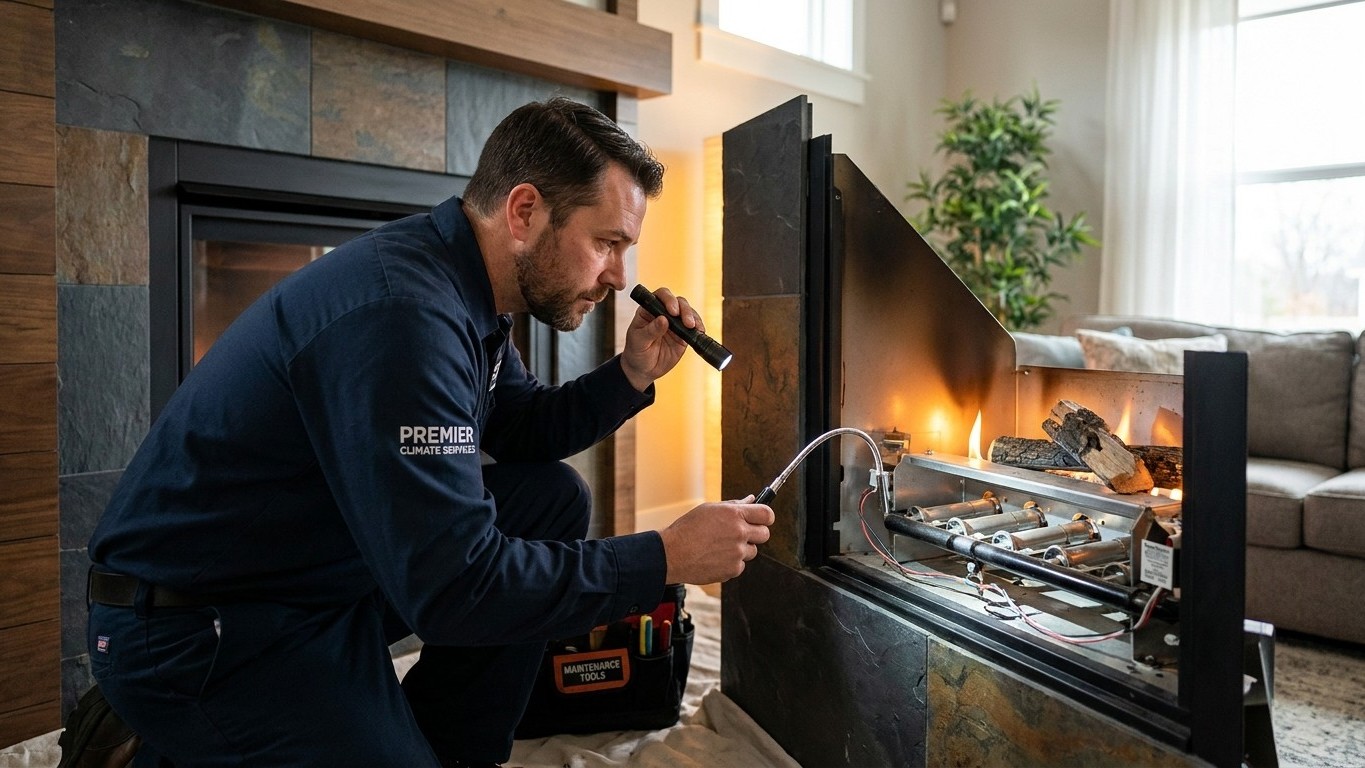

Once a year, a gas fireplace needs a professional inspection covering the burner, the venting, the sensors, and the seals, along with light homeowner upkeep in between. The two categories of appliance matter here: a vented fireplace sends combustion byproducts outdoors through a flue or direct-vent terminal, while a vent-free unit releases them, along with water vapor, straight into the room. That single distinction shapes almost every maintenance decision that follows.
| Feature | Vented fireplace | Vent-free (unvented) fireplace |
|---|---|---|
| Combustion byproducts | Exhausted outdoors through flue or direct-vent terminal | Released into the room |
| Depends on | Vent draft and terminal clearance | Room ventilation and an oxygen depletion sensor (ODS) |
| Main risk if neglected | Blocked or corroded vent path | Inadequate airflow plus a maladjusted burner |
A clean-burning appliance still needs looking at

Gas gets a reputation as the tidy fuel. No ash, no creosote, no soot streaking up the chimney the way a wood fire leaves behind. That reputation leads a lot of owners to assume the appliance can just run, year after year, with nothing more than a flip of the switch. It’s a fair assumption on the surface, and it’s wrong in practice.
A gas burner is a precisely calibrated device. Over months of cycling on and off, the orifice can accumulate lint and dust, the flame pattern can drift, and the mixture of air and gas that was set correctly at installation can shift out of adjustment. None of that produces smoke you’d notice from across the room. It shows up instead as a flame that burns yellow instead of blue, or one that flickers unevenly along the log set.
The oxygen depletion sensor built into vent-free units is a case in point. Under the industry’s voluntary standard, currently manufactured unvented gas-fired room heaters are required to carry an ODS that shuts off the gas supply before carbon monoxide can reach a life-threatening level, according to the U.S. Consumer Product Safety Commission. That’s a voluntary standard, not a federal mandate. The CPSC actually revoked its own mandatory rule on this back in 1984, by which point 95 to 100 percent of manufacturers were already building the sensor in anyway. The nuance matters: the safeguard exists today because the industry adopted it, not because a law requires it, and a sensor that’s corroded or coated in dust can fail quietly.
The CPSC has also been specific about how unvented appliances get into trouble in the first place. These heaters have no outside vent carrying combustion products away, so they depend entirely on ordinary room ventilation. Inadequate airflow combined with a maladjusted burner, layered on top of the normal drop in room oxygen as fuel burns, is one of the named routes to fatal carbon monoxide accumulation. That’s not a hypothetical about some other appliance. It’s the mechanism a badly tuned burner in your own living room can set in motion.
None of this shows up as visible dirt. A gasket can dry out and lose its seal, a vent terminal outside can get packed with debris, and a sensor can degrade, all while the fireplace still lights on command and looks perfectly normal from the couch. That’s exactly why “clean burning” and “no maintenance needed” aren’t the same claim.
What the owner can do
Most of what a homeowner can safely handle is light and mechanical, not technical. It doesn’t replace a professional visit, but it keeps the appliance in reasonable shape between them and gives you an early read on whether something’s changed.
- Keep the louvers and the glass clear. Dust and pet hair build up on the front louvers and can settle on the glass panel. A soft brush or vacuum attachment, used on a cold appliance with the gas off, is usually enough.
- Vacuum the firebox only when it’s cold and the gas is off. Dust inside the firebox can drift onto the burner over time. Never vacuum around a lit pilot or a warm appliance.
- Check the vent terminal outside. Walk around the exterior wall or roof penetration each fall and clear away snow, fallen leaves, or anything resembling a bird’s or wasp’s nest. A blocked terminal changes how the whole vented system draws.
- Look at the flame every autumn before the heating season starts. A healthy flame on most gas fireplaces burns mostly blue with soft yellow tips near the logs. Note what’s normal for your unit so you can spot a change later.
That last point deserves its own emphasis. If the flame has changed color, turned mostly yellow, started producing visible soot on the glass, or looks like it’s lifting off the burner or burning unevenly, that’s information to report to a qualified technician, not a problem to fix yourself. Adjusting a burner without the right equipment can make the air-to-gas ratio worse instead of better, and a burner that’s been nudged out of calibration is precisely the kind of condition the CPSC points to when it discusses how unvented appliances can let carbon monoxide build to dangerous levels. Owners can clean and observe. Owners shouldn’t tune.
The same goes for anything involving the gas valve, the pilot assembly, or the sensor housing. These parts look simple from the outside, a few screws and a small metal tube, but they’re calibrated to tolerances that aren’t visible to the eye. Touching them without training risks turning a fireplace that was working fine into one that isn’t, and you may not find out until the flame or the sensor tells you the hard way.
Why the logs go exactly where they go
Here’s a detail that catches a lot of people off guard. Those ceramic logs sitting in the firebox aren’t decorative props you can rearrange for a better-looking fire. They’re part of the certified appliance, tested and listed as a set, and their exact position, how far apart they sit, how they overlap, where the embers pile up beneath them, was specified by the manufacturer when the unit was certified.
Move a log an inch to the left, and you can change where the flame travels across it. Flame that hits ceramic in a spot it wasn’t designed to touch burns differently there. It can produce visible soot on the glass and, on a vented appliance, alter how combustion gases move through the flue. It sounds like a small thing, an inch of ceramic log, but it’s one of the more common reasons a fireplace that used to burn clean starts leaving black marks on the inside of the glass a season or two after someone cleaned it and put things back “close enough.”
The embers underneath matter just as much as the logs on top. Loose ember material, sometimes glowing granules or a bed of vermiculite, is arranged to sit at a specific depth and in a specific pattern relative to the burner ports. Vacuuming that bed out completely, or piling it up unevenly, changes how the flame draws air at the base.
The fix is almost embarrassingly simple: take a photo of the log and ember arrangement before you clean anything inside the firebox. Snap it straight on, and another from an angle if the depth matters. When you’re done vacuuming dust and debris, use the photo to put every log back exactly where it came from. It takes thirty seconds and it’s the cheapest insurance available against turning a clean fireplace into a sooty one.
If a log has cracked, chipped, or crumbled, that’s not something to patch with a spare piece from a hardware store. Replacement log sets are appliance-specific, and a mismatched piece can sit at the wrong height or block a burner port. That’s a job for whoever handles the annual inspection, since they’ll have access to a set that matches your model.
What the visit covers
An annual professional visit is where the parts an owner shouldn’t touch actually get addressed. A technician checks the burner and pilot assembly, confirming the flame pattern and adjusting the air-to-gas mixture if it’s drifted. They test the sensors, including the oxygen depletion sensor on vent-free units, to confirm it’s still shutting the gas off the way the voluntary industry standard requires.
The venting gets its own scrutiny on any vented unit, from the flue path itself out to the exterior terminal, checking for corrosion, blockage, or anything that’s shifted since the last inspection. Gaskets and glass panels get inspected for wear, since a dried-out seal changes how the firebox draws air even when nothing looks visibly wrong. The gas connection itself, the shutoff valve and the line running to the appliance, gets checked for leaks and secure fittings.
None of this replaces the one piece of equipment every household with a gas fireplace needs regardless of how well the appliance is maintained: a working carbon monoxide alarm. Carbon monoxide is colorless and odorless, so an alarm is the only detection method a household actually has against it. For the specifics on alarm placement and what the readings mean, see our dedicated guide on carbon monoxide safety for gas fireplaces.
Common questions
Can I skip the annual service if the fireplace seems to be working fine?
A fireplace can look and sound normal while a sensor has degraded or a burner has drifted out of adjustment, none of which is visible from across the room. The inspection exists precisely to catch what a working flame doesn’t reveal on its own.
Is a vent-free fireplace more work to maintain than a vented one?
They require different attention rather than more of it. Vent-free units depend on room ventilation and an oxygen depletion sensor, so that sensor and the surrounding airflow need checking. Vented units depend on a clear flue and terminal, so that path is the priority there instead.
What does a change in flame color actually mean?
A shift from mostly blue to mostly yellow, or a flame that starts flickering unevenly, points to a burner that’s out of adjustment or airflow that’s changed. Report it to a technician rather than adjusting the burner yourself.
Do I need to clean the ceramic logs myself?
Light dusting is fine, but photograph the arrangement first. The logs and embers are positioned to a specific layout set by the manufacturer, and moving them can send flame where it wasn’t designed to burn.